



Which Is Better, a Rule Based or an AI Chatbot?
A rule based chatbot follows scripts, while an AI chatbot understands open questions. Here is how they compare and how to choose between the two.

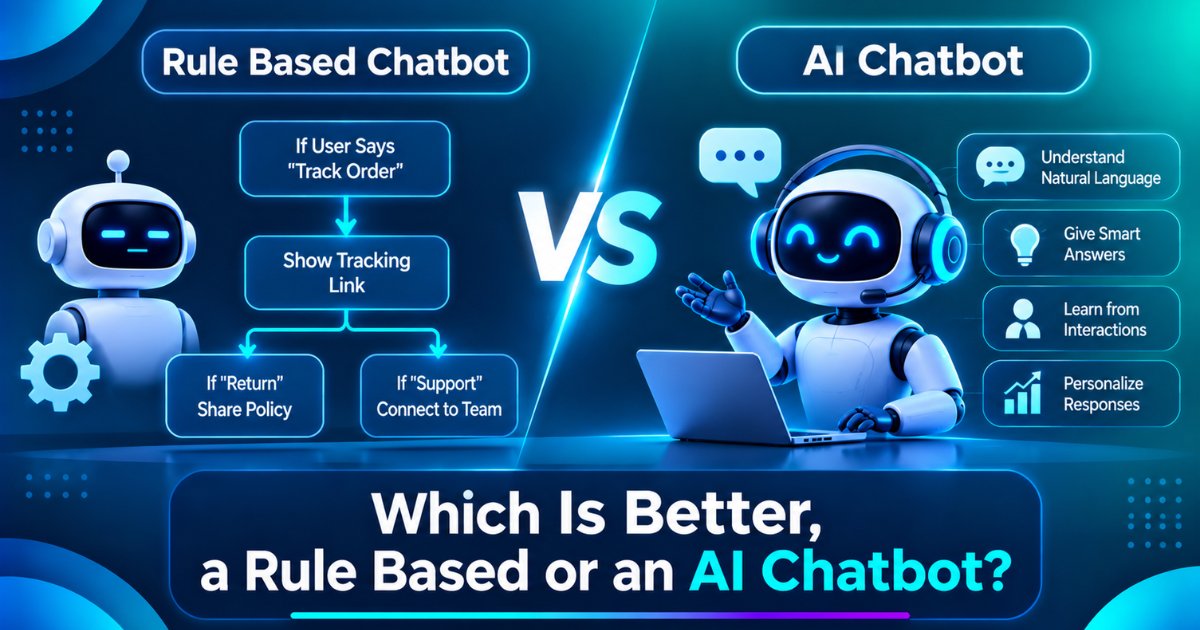
What is the difference between a rule based chatbot and an AI chatbot?
A rule based chatbot matches what the customer types or clicks against a list of rules you wrote, and it replies with a prepared answer. An AI chatbot reads the customer's words with a language model, works out what they mean and writes a reply, usually from your own content.
The difference is who does the thinking. In a rule based bot, a person decides every question and answer in advance. In an AI bot, the model interprets the question, and your job is to control what it may say. That is why rule based bots are predictable and narrow, and AI bots are flexible and need testing. The rule-based vs AI chatbots choice is therefore less about which is smarter and more about which kind of risk you can accept: a bot that fails to understand, or a bot that understands and sometimes answers wrongly.
Rule based vs AI chatbots, how do they compare?
Area | Rule based chatbot | AI chatbot |
|---|---|---|
How it works | Keywords, menus and decision trees | A language model reads and replies, often from your documents |
Handles new wording | No, unless you add a rule | Usually yes |
Same answer every time | Yes | No, wording can vary |
Risk of wrong or invented answers | Low, because answers are prewritten | Present, and needs controls |
Setup | Design flows and write every answer | Prepare content, write instructions, build a test set |
Upkeep | Add and edit rules as questions change | Update content, re-test after changes |
Cost to run | Low | Higher, because model usage is charged per use |
Best for | Fixed FAQs, menus, simple lead capture, regulated wording | Open questions about changing content |
What is a rule based chatbot?
A rule based chatbot is a bot that works from rules you define. The simplest kind shows buttons such as “Track my order” or “Talk to sales” and follows a fixed path after each click. A slightly more advanced kind matches keywords in typed text. Rule-based bots are also called scripted chatbots or decision tree bots, and the term describes the same idea: every possible path was written by a person.
When people compare rule-based bots with AI, they usually mean this scripted design. It has real strengths. Answers are exact, so you can approve the wording of a refund policy once and know it will never change. It is cheap to run, easy to audit and quick to launch for a small set of questions. It works well for regulated sectors where wording must be exact, and for tasks with a short list of options.
The weakness is coverage. A customer who types “where is my stuff” when your rule says “track order” may get a failure message. Every new product, policy or phrasing needs a new rule, so the bot grows harder to maintain as the business grows. Customers who hit a dead end leave or ask for a person.
What is an AI chatbot?
An AI chatbot uses a large language model, often with retrieval, which means it searches your documents for relevant passages and answers from them. The customer can ask in their own words, including typos, mixed Hindi and English, or long messages with several questions, and the bot works out what is being asked.
The strength is range. One AI bot can answer thousands of different questions without a rule for each, and it updates when you update the documents. The guide on adding an AI chatbot to your website covers the build steps, including content preparation and testing.
The weakness is control. A language model can misread a passage, state something that is not in your policy or answer a question outside its job. The fixes are known: answer only from approved sources, show the source, say “I'm not sure” when the content does not cover the question, hand off to a person for risky topics, and test with real questions before launch.
What are the pros and cons of rule based chatbots?
The pros are predictability, low cost, easy auditing, exact wording and quick launch. A rule based bot also does not depend on a model service, so it keeps working if that service has an outage.
The cons are narrow coverage, brittle matching and heavy upkeep. It cannot cope with phrasing you did not anticipate, and it fails quietly for those customers, who simply see “I did not understand”. Over time the list of rules grows, rules start to overlap, and nobody is sure which one will fire. At that point, adding questions costs more than the bot saves.
What are the pros and cons of AI chatbots?
The pros are flexibility, coverage and easier content updates. An AI bot can handle varied phrasing, long messages and several languages, and it can draft a personalised reply using order or account data if you connect it to your systems.
The cons are wrong answers, uneven wording and higher running cost, and customers do not always welcome it. A Gartner survey of 5,728 customers, run in December 2023 and published in July 2024, found that 64 percent said they would prefer that companies did not use AI for customer service, and 53 percent would consider switching to a competitor if they learned a company planned to use it. The most common concern was difficulty reaching a person. Gartner's advice was to reassure customers that access to a human remains possible. A good AI bot therefore always shows a clear route to a person, and it does not hide the human option.
Model usage is charged by the amount of text processed, so an AI bot costs more per conversation than a scripted one. How much more depends on conversation length, the size of your documents and the model you use. The guide on chatbot pricing breaks down the cost parts and shows how to estimate your own.
Which one should you use?
Choose by the shape of your customer questions and the cost of a wrong answer. Use a rule based bot when the questions are few and fixed, the wording must be exact, or a mistake is costly. Use an AI bot when questions vary, the content changes often, or customers write in their own words and in several languages. Use a hybrid when both are true, which is the usual case.
Four questions make the decision concrete. How many different questions do customers ask? If the top ten cover almost everything, rules may be enough. How often does the content change? Frequent change favours AI with retrieval. What does a wrong answer cost? If it costs money or breaks a rule, keep that path scripted. And do you have someone to maintain it? Both types need an owner, but they need different skills: rule writing for one, content and testing for the other.
What is a hybrid chatbot, and why do most businesses use one?
A hybrid chatbot uses AI to understand the question and rules to handle the sensitive parts. A pattern that works well is AI as router, rules as answerer. The model reads the customer's message and decides what they want, such as order status, returns or pricing. It then hands the request to a scripted flow or an approved answer, which does the work with exact wording and exact steps.
This gets the flexibility of AI for understanding and the safety of rules for the response. A customer can type “my parcel is late and I want my money back” in any words, and the AI recognises two intents. The refund flow, written and approved by your team, then runs. The model never invents a refund policy, because it is not the one answering.
Hybrid designs also make upgrades gradual. You can start with scripted flows, add an AI router, and then let the model answer open questions from approved documents while risky topics stay scripted. If you later want the bot to take actions rather than only answer, read the comparison on choosing an agent or a chatbot, because actions raise the risk and need extra limits.
How do you test which one your customers need?
Run a transcript sort on your own chat or support logs. Pull 50 recent conversations, or 50 recent support emails if you have no chat. Tag each question as scriptable, open or risky. Scriptable means a short, fixed answer exists, such as opening hours. Open means the answer depends on documents or on the customer's situation. Risky means a wrong answer would cost money or break a rule, such as a refund promise or a medical claim.
Count the tags. As a rule of thumb, not a published benchmark, if nearly all questions are scriptable, start with rules. If a large share are open, use AI with retrieval for those, and keep the risky ones scripted. If many are risky, keep a person in the loop whatever the technology. Then build a 50-question test set from the same sample, set a pass bar before you start and re-run it after every change.
The sort takes an afternoon. It replaces opinions about which bot is better with a count of what your customers actually ask.
How do you move from a rule based bot to an AI bot?
Do not switch all at once. Keep the existing rules for exact-wording topics, and add AI for the questions that currently end in “I did not understand”. Review your logs for those failed questions, because they are the best first targets. Run the AI in shadow mode for a few weeks, where it proposes replies that a person compares with what was sent, and then switch it on for one topic at a time.
Choose your tools after you know your needs. A comparison of platforms for website chatbots shows which hosted tools support both rules and AI, plus handoff and logging. Check three things in any platform: whether you can see exactly what the bot answered and why, whether you can set rules that override the model, and whether a customer can reach a person in one step.
Plan the failure path before launch. Decide what the bot says when it does not know, when the model service is down and when a customer asks for a person. A good fallback is a short message, a link to the scripted menu and a handoff button, not a blank error. Write it in plain words and in the same tone as the rest of the bot, so that the failure feels like a handover and not a crash. Include an estimate of waiting time for a person if you can give one honestly. Keep that fallback wording in your test set. Test each case on purpose by switching the model off for a few minutes during the pilot, because failures that you have not rehearsed tend to appear on the busiest day.
Teams that need a bot connected to their order system, helpdesk or CRM often work with a partner for customer support chatbot development instead of stretching a no-code tool. Whichever route you take, measure the share of conversations resolved without a person, the handoff rate and the share where the customer gave up. Those three numbers show whether the change helped. Review them weekly for the first month, read the 20 worst conversations, and add the fixes to your test set so the same mistake does not return after the next change.
Jamtech Technologies publishes this guide and offers chatbot development, so weigh that when you read our advice. The transcript sort and the hybrid pattern work whoever builds the bot.
Frequently asked questions
Q1. What is the difference between a rule based chatbot and an AI chatbot?
A rule based chatbot follows scripted paths, menus and keywords, and replies with prewritten answers. An AI chatbot uses a language model to understand open questions and write replies, often from your documents. Rule based bots are predictable and narrow, while AI bots are flexible and need testing and controls.
Q2. Which is better, a rule based chatbot or an AI chatbot?
Neither is better for every case. Rule based bots suit fixed questions, exact wording and low cost. AI bots suit varied questions and changing content. Most businesses end up with a hybrid, using AI to understand the question and rules or approved answers for sensitive responses.
Q3. What are the advantages of a rule based chatbot?
The advantages are predictable answers, exact wording, low running cost, easy auditing and quick launch for a small set of questions. A rule based bot also does not depend on a model service. It suits regulated wording, simple menus and lead capture with a short list of options.
Q4. What are the disadvantages of a rule based chatbot?
It has narrow coverage and fails when customers word a question differently from your rules. Every new product or policy needs a new rule, so upkeep grows over time. Customers who hit a dead end often leave or ask for a person, which raises support load.
Q5. What are the advantages of an AI chatbot?
An AI chatbot handles varied wording, long messages and several languages without a rule for each question. It answers from your documents, so you update content instead of rules. It can also use order or account data to personalise replies when connected to your systems.
Q6. What are the disadvantages of an AI chatbot?
It can give wrong or invented answers, its wording varies, and it costs more per conversation because model usage is charged per use. It needs a test set, guardrails and a route to a person. Some customers also distrust AI in service, so transparency matters.
Q7. Do customers prefer chatbots or humans?
Many customers want a person available. A Gartner survey of 5,728 customers in December 2023 found 64 percent would prefer companies not use AI for customer service, and difficulty reaching a person was the top concern. Offer a clear human route in any bot, rule based or AI.
Q8. What is a hybrid chatbot?
A hybrid chatbot combines AI and rules. A common pattern uses AI to understand what the customer wants, then hands the request to a scripted flow or an approved answer for the response. This keeps the flexibility of AI for understanding and the exact wording and safety of rules.
Q9. Is a rule based chatbot cheaper than an AI chatbot?
Usually yes to run, because it does not pay for model usage on each conversation. Setup and upkeep still cost time, and rules multiply as questions grow. Compare options by cost per resolved conversation, which is monthly cost divided by conversations that ended without a person.
Q10. When should I use a rule based chatbot?
Use one when questions are few and fixed, wording must be exact, or a mistake is costly. Examples are opening hours, order tracking menus, simple lead capture and regulated notices. If customers write in many ways or your content changes often, add AI for those questions.
Q11. When should I use an AI chatbot?
Use one when customers ask many different questions, write in their own words or several languages, and your content changes often. Keep risky topics such as refunds and medical claims scripted or with a person in the loop. Test with 50 real questions before launch.
Q12. How do I decide between rule based and AI for my business?
Run a transcript sort. Take 50 recent chats or support emails and tag each question as scriptable, open or risky. Mostly scriptable points to rules, a large share of open questions points to AI with retrieval, and risky ones stay scripted or go to a person.
Q13. Can I upgrade a rule based chatbot to an AI chatbot?
Yes, in stages. Keep rules for exact-wording topics, then add AI for the questions that end in I did not understand. Run the AI in shadow mode, compare its replies with what was sent, and switch it on one topic at a time, keeping a fallback to the scripted menu.
Q14. How do I test a chatbot before launch?
Write 50 real questions with expected answers and sources, including 10 the bot should refuse and 10 badly phrased. Score each reply as correct, partly correct or wrong against a pass bar set in advance, and re-run the set after every change to content, rules or the model.
Ready to grow your business with Jamtech?
Talk to our experts about your next digital project.