



AI Voice Agents vs IVR and Why Businesses Are Making the Switch
An IVR plays a menu, while an AI voice agent understands open speech. Here is where each fits and how to replace phone menus safely.

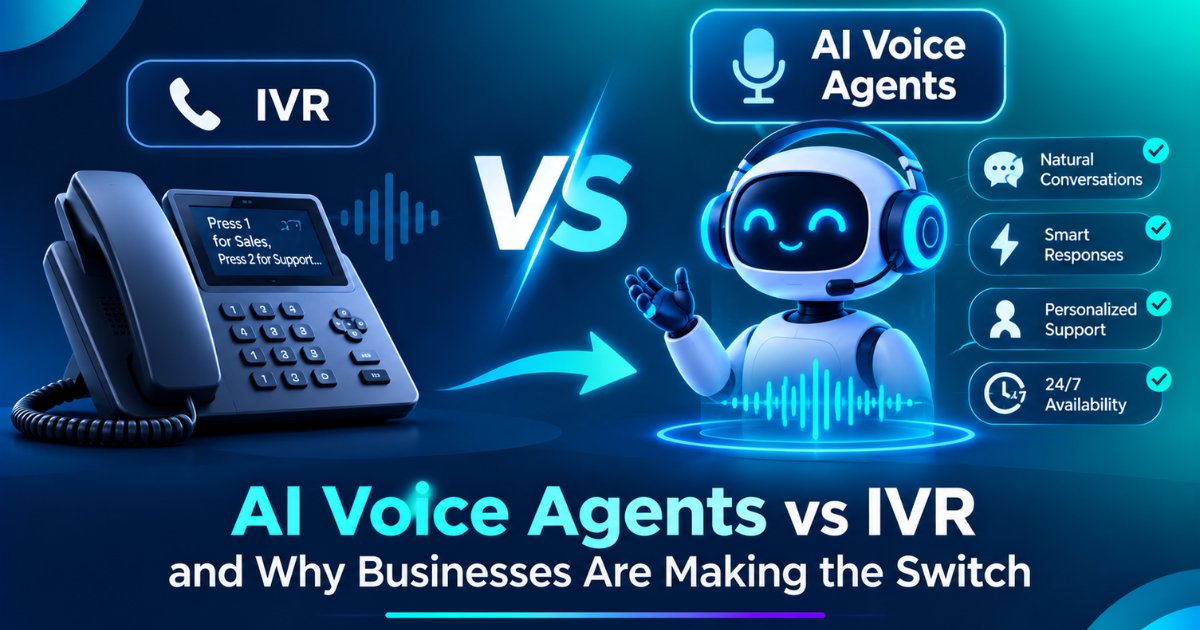
What is an IVR?
Interactive voice response (IVR) is the phone menu most people know: “Press 1 for billing, press 2 for support.” The system plays recorded prompts and reads the caller's key presses, which are called dual-tone multi-frequency (DTMF) tones. Newer versions accept short spoken words such as “billing” or “agent”, matched against a fixed list.
An IVR is predictable. Every path is written in advance, so the same input always gives the same result. That makes it cheap to run, easy to audit and quick to approve in regulated businesses. The weakness is the same as the strength. Speech-enabled IVR, sometimes called directed dialogue, improves on key presses but still depends on a fixed list of words, so a caller who says something outside the list is asked to repeat or choose again. If a caller's need does not match a menu item, the system has nowhere to send them. They press 0, hang up or work through three layers of options to reach the wrong department.
What is an AI voice agent?
An AI voice agent converts speech to text, uses a language model to work out what the caller wants and which tools to use, and replies with synthetic speech. It can ask follow-up questions, look up a record, book a slot and pass the call to a person with a summary. The full parts list and the call loop are in the guide on what an AI voice agent is.
The difference for the caller is simple. With an IVR, the caller learns your menu. With a voice agent, the system learns the caller's request.
How do an AI voice agent and an IVR compare?
Area | IVR phone menu | AI voice agent |
|---|---|---|
Input | Key presses or a fixed list of words | Open speech in the caller's own words |
Flexibility | Only the paths you built | Handles requests you did not script |
Setup | Call flow design and recorded prompts | Knowledge, tools, instructions and testing |
Wrong results | Dead ends and wrong routing | Wrong or invented answers, if not controlled |
Cost to run | Low per call | Higher per call, because speech, model and telephony run on every turn |
Audit | Easy, with fixed paths | Needs full logs of each call |
Best for | Simple routing, keypad entry, fixed scripts | Open requests, bookings, status checks, qualification |
Neither wins on every row. The right choice depends on how varied your calls are and what a wrong result costs.
Why are businesses replacing phone menus?
Three pressures push the change. Callers dislike menus, and a menu with many options or several layers creates abandoned calls and repeated calls. Staff costs sit behind every call that reaches a person, and the person often receives a caller who has already been frustrated by the menu. And the technology now handles open speech well enough for routine tasks.
Analysts have been forecasting the shift for some time. In August 2022, Gartner predicted that conversational AI would reduce contact centre agent labour costs by 80 billion US dollars in 2026, and that one in ten agent interactions would be automated by then, up from about 1.6 percent in 2022. It also noted that labour can account for up to 95 percent of contact centre costs, and that deployments were complex to build and maintain. Treat this as a dated forecast and not a measured result. Check it against your own call data.
The trade-off mirrors the one between scripted chatbots and AI chatbots on the web. A script is safe and narrow. A model is flexible and needs controls. Voice makes the gap more visible, because a caller cannot scroll back, skim or click, and a wrong turn costs them time they cannot recover.
Where does an IVR still do the job better?
Keep the IVR where the task is fixed and the answer is known. A two-option routing menu at a small clinic is cheaper and simpler than a model. Opening hours, a recorded notice and an emergency routing message are better as recordings.
Card payments are a clear case. In November 2018, the Payment Card Industry Security Standards Council revised its guidance on protecting telephone-based payment card data. It recommends techniques that keep card numbers out of the agent's hearing, the call recording and your systems, such as masking the keypad tones. A voice agent that hears a spoken card number brings recordings and transcripts into scope of the payment card rules. A keypad capture flow keeps them out. For this step, a mixed design works well: the agent handles the conversation, and a keypad flow takes the card number.
An IVR also helps when speed and certainty matter more than flexibility. It does not depend on a language model service being available, and it will not invent an answer.
Where does an AI voice agent do better?
A voice agent does better when the reason for the call varies and the answer needs a lookup or an action. Appointment changes, order status, delivery rescheduling, basic account questions and lead qualification fit well. The caller says what they want, and the agent finishes the job instead of routing the call.
It also helps with language. Callers in India often mix Hindi and English in one sentence, which breaks a fixed word list. A well-tested voice agent can cope with that mix, though quality varies by language and accent, so test it on your own callers. The list of AI voice agent use cases shows which call types move first and which stay with people.
What goes wrong when you replace an IVR?
The first risk is delay. People expect fast turns in a conversation, and a pause of two seconds feels broken. The second is misrecognition, where names, numbers and accents are heard wrongly. The third is a confident wrong answer. A model can state a refund policy that does not exist, so the agent must answer only from approved sources and say when it does not know.
There are rules to follow. On 8 February 2024, the US Federal Communications Commission ruled that AI-generated voices count as artificial under the Telephone Consumer Protection Act, so US outbound calls that use them need the called party's consent. India's Digital Personal Data Protection Rules were notified in November 2025, and most duties start 18 months later. A recording that identifies a caller is personal data, so plan notices, consent and retention. Tell callers they are speaking with an AI, and check telecom rules for outbound calling with a legal adviser.
The last risk is trust. Callers who feel trapped by an agent will hang up and call back. Always keep a way to reach a person, and do not remove the “press 0” option in the first release.
How do you migrate from IVR to an AI voice agent?
Start with an audit of your IVR call logs, not with a vendor demo. Pull a sample of a few hundred recent calls. For each, note which menu path the caller took, where they left, how many pressed 0, and what the call was about once a person answered. Group the reasons into call types. The calls that end at “other” or at an operator are the ones the menu fails today, and they are the best first targets.
Then move in four stages. In the first, run the agent in shadow mode, where it listens to a copy of live calls and proposes what it would have done, so you can compare it with what the person did. In the second, put the agent in front for one call type, such as appointment changes, with the IVR as a fallback. In the third, add call types one at a time, and review the worst calls each week. In the fourth, retire the menu branches the agent has replaced, and keep the ones where a fixed flow still wins.
Measure three things at each stage: the share of calls finished without a person, the share transferred to a person with a useful summary, and the share where the caller hung up or called back within a day. If the third number rises, stop and fix before you expand.
How do you choose between building and buying?
A hosted platform is the fastest way to put an agent on a number, and it suits a pilot on one call type. Pricing is usually per minute, and control over voice, flow and data location is limited. A comparison of AI voice agent platforms shows what each type covers. Ask for a live demo call from a mobile phone on a weak connection, since lab demos use clean audio. Test three things on any platform: how it handles a caller who talks over the agent, whether it can transfer to a real phone number with context, and whether you can export recordings and transcripts. Also ask what happens to a call when the speech service goes down. A sound setup rings a fallback number or returns the caller to the IVR menu, and you can test that during the pilot by switching the service off for a few minutes.
A custom build makes sense when the agent must connect to your CRM, support several Indian languages, keep recordings in a chosen region or run at a volume where per-minute fees hurt. It also lets you choose where audio is stored, how long recordings are kept and who can replay them, which matters when callers share health or financial details. Plan for model changes as well, because a provider can update a model, and a call flow that passed testing last quarter needs re-testing after each change. Teams with those needs often work with a partner to build an AI call center agent around their telephony and systems instead of bending a no-code tool.
Compare cost by call outcome, not by minute. Total the monthly cost of telephony, speech recognition, the model, speech output and review time, then divide by the calls the system finished without a person. An IVR is cheaper per call, but if half the callers press 0 and then wait for an agent, its real cost sits in the staff time it fails to save.
Should you replace your IVR or keep it?
Keep it if most of your calls are one of a few fixed types, your callers already finish their tasks, and a wrong result is costly. Replace it, in stages, if callers often press 0, call volumes are high and the reasons for calling vary. Run both if you handle card payments or strict scripts. Most businesses end up with a mixed system, with the voice agent at the front for open requests and the IVR behind it for fixed steps.
Jamtech Technologies publishes this guide and offers voice agent development, so weigh that when you read our advice. The call-log audit and the staged migration work whoever builds the system.
Frequently asked questions
Q1. What is the difference between an AI voice agent and an IVR?
An IVR plays a menu and reads key presses or a fixed list of words, while an AI voice agent understands open speech, looks up information and takes actions. The IVR follows paths you wrote in advance. The agent works out the request, which is flexible but needs testing and controls.
Q2. Is an AI voice agent better than IVR?
Not for every task. A voice agent handles varied requests and finishes jobs such as bookings and status checks. An IVR is cheaper, predictable and easier to audit for fixed routing and keypad entry. Most businesses end up with both, with the agent in front and the IVR behind.
Q3. Why are businesses replacing IVR phone menus?
Callers abandon long menus, press 0 or call back, and each of those calls ends up costing staff time. Voice AI now handles open speech well enough for routine tasks. Gartner forecast in August 2022 that conversational AI would automate one in ten agent interactions by 2026.
Q4. Can an AI voice agent completely replace an IVR?
Rarely in the first release. Keep the IVR for simple routing, recorded notices and keypad card entry, and put the agent in front for open requests. Retire menu branches only after the agent handles those call types reliably, and keep a way to reach a person.
Q5. Is IVR cheaper than an AI voice agent?
Per call, usually yes, because an IVR plays recordings while an agent runs speech recognition, a model and speech output on every turn. Compare cost per call finished without a person instead. If many IVR callers press 0 and wait for staff, the IVR's real cost is higher.
Q6. How accurate are AI voice agents compared with IVR?
An IVR is accurate inside its fixed list and fails outside it. A voice agent copes with free speech but can mishear names, numbers and accents, or give a wrong answer. Measure your own task completion, wrong-information rate and handoff success on recordings of your callers.
Q7. Can an AI voice agent take card payments?
It can, but design it carefully. A spoken card number brings recordings and transcripts into scope of payment card rules, so many setups use a keypad flow that keeps digits out of the agent, recordings and logs. The PCI Security Standards Council revised its telephone payment guidance in November 2018.
Q8. How do I migrate from IVR to an AI voice agent?
Audit your IVR call logs first, then run the agent in shadow mode on a copy of live calls. Next put it in front for one call type with the IVR as fallback, add types one at a time, and retire replaced menu branches. Measure completion, transfers and call-backs.
Q9. What calls should an AI voice agent handle first?
Start with high-volume calls that have a clear goal and low risk, such as appointment confirmation, order status and delivery rescheduling. These calls are short, repeated and easy to measure. Leave upset callers, legal questions and large refunds with people until testing supports more.
Q10. Do AI voice agents work with Hindi and Hinglish callers?
Often, but quality varies by language, accent and audio quality. Mixed Hindi and English speech is a known weak spot for fixed word lists and some speech models. Test any agent on recordings of your own callers, including noise and interruptions, before you commit.
Q11. What are the risks of replacing IVR with AI?
The main risks are response delay, mishearing, confident wrong answers, compliance gaps and callers who feel trapped. Reduce them with answer-only-from-sources rules, tested handoffs, call recording notices and a visible way to reach a person. Keep the press 0 option at first.
Q12. Are there legal rules for AI voice calls?
Yes, and they vary by country. On 8 February 2024, the US FCC ruled that AI-generated voices are artificial under the TCPA, so consent rules apply to outbound calls. India's DPDP Rules, notified in November 2025, apply to personal data in recordings. Ask a legal adviser.
Q13. How much does an AI voice agent cost compared with IVR?
An IVR costs less per call. An agent costs per minute for telephony, speech recognition, the model and speech output, plus setup and review time. Use each provider's live price page, and compare cost per call finished without a person, not the per-minute rate alone.
Q14. Should small businesses replace their IVR with an AI voice agent?
Only if callers often press 0, volume is meaningful and call reasons vary. A small clinic with a two-option menu may be fine with IVR. If missed calls cost you bookings, a hosted voice agent on one call type is a low-risk pilot.
Ready to grow your business with Jamtech?
Talk to our experts about your next digital project.