



RAG vs Fine Tuning vs Prompt Engineering and What to Choose
RAG adds facts, fine-tuning shapes behaviour, and prompt engineering sets instructions. Here is how to compare them and choose the right one to try first.

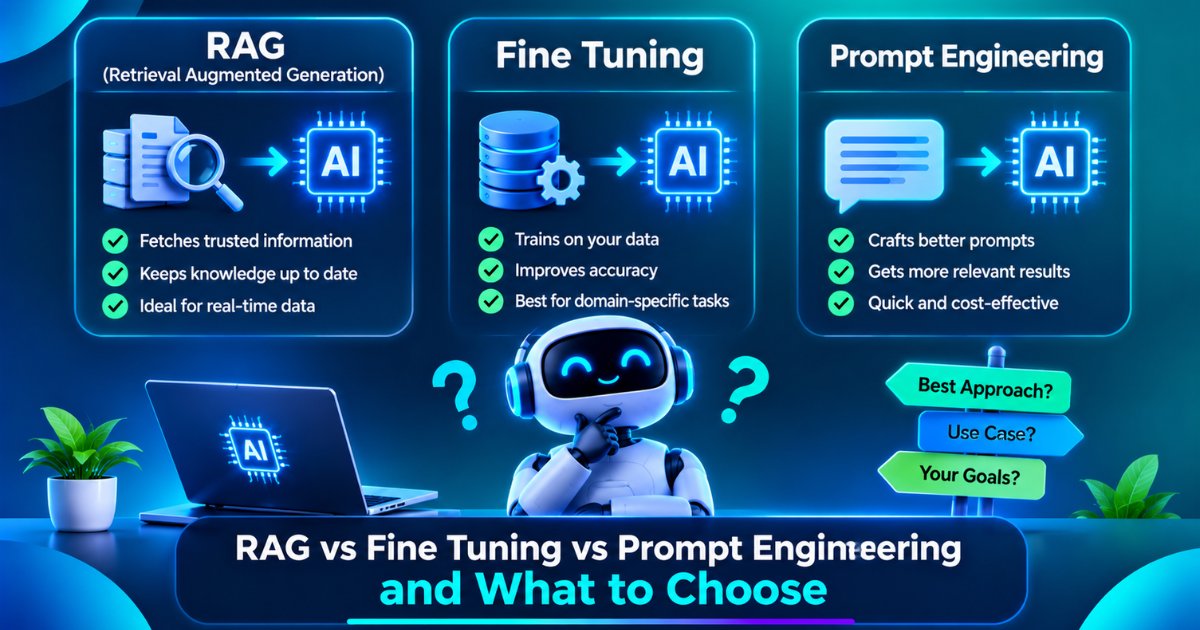
What is the difference between RAG, fine tuning and prompt engineering?
Prompt engineering changes what you ask the model. RAG, short for retrieval augmented generation, changes what the model can read when it answers. Fine-tuning changes the model itself by training it further on your examples.
Put another way, prompt engineering sets the instructions, RAG supplies the facts, and fine-tuning shapes the behaviour. Each one fixes a different kind of problem, which is why the RAG vs fine-tuning question has no single winner. If the terms are new to you, the guide for generative AI for business owners covers the basics before you go further.
RAG vs fine tuning vs prompt engineering, how do they compare?
Area | Prompt engineering | RAG | Fine tuning |
|---|---|---|---|
What it changes | The instructions and examples in the prompt | The documents the model reads at answer time | The model's weights |
Fixes | Unclear or inconsistent instructions | Missing, private or changing facts | Style, format and behaviour on a narrow task |
Setup effort | Hours to days | Days to weeks | Weeks, plus training data |
Updating | Edit the prompt | Update the documents | Train again |
Can cite sources | No | Yes | No |
Main risk | Prompts grow long and brittle | Wrong passage retrieved | Overfitting, stale knowledge, higher upkeep |
Best for | Summaries, rewriting, formats, simple tasks | Policy and product questions, internal search | Fixed tone, strict output format, classification |
What is prompt engineering and when is it enough?
Prompt engineering means writing clear instructions, examples and constraints so that the model does what you want. It is the cheapest and fastest lever, and you can test a change in minutes.
OpenAI's guide on optimizing LLM accuracy says prompt engineering is typically the best place to start, and that it is often the only method needed for tasks such as summarization, translation and code generation. It is enough when the model already has the knowledge, and you only need it to behave more consistently. Give it a role, the steps to follow, two or three examples of good output and the format you want.
It stops being enough when the model needs facts it does not have, or when the prompt grows so long and complex that results become inconsistent. Those are the two signals to move to the next lever. A comparison of business uses of generative AI shows which tasks usually stay at this level.
What is RAG and when should you add it?
RAG searches your documents for passages relevant to the question and gives them to the model along with the question. The model then answers from that text, and it can name the source. A typical setup splits documents into chunks, turns each chunk into an embedding that captures its meaning, and stores the embeddings so that a search by meaning is fast. Add RAG when answers depend on facts that are private, recent or changing, such as policies, prices, product specifications and internal procedures.
Research supports this order. A paper from Microsoft researchers, “Fine-Tuning or Retrieval? Comparing Knowledge Injection in LLMs”, first posted in December 2023 and revised in January 2024, compared the two approaches on knowledge-heavy tasks. It found that RAG consistently outperformed unsupervised fine-tuning, both for facts the model had seen in training and for entirely new ones, and that models struggled to learn new facts through unsupervised fine-tuning. The fine-tuning versus RAG result is specific to knowledge, so it does not say fine-tuning is useless for other jobs.
RAG also fits a changing business. When a price changes, you update one document and the next answer reflects it. The retrieval layer needs a store that finds passages by meaning, and the guide on vector databases for RAG compares the options. Retrieval quality then decides your results, so test it separately, as described in the next sections.
What is fine tuning and when is it worth it?
Fine-tuning continues a model's training on examples of the input and output you want. After training, the model follows that pattern without needing long instructions. Some methods, such as LoRA, introduced in a 2021 paper by Edward Hu and colleagues, train a small set of added weights instead of the whole model, which lowers the cost.
It is worth considering when you need a consistent tone or a strict output format, when you classify items into your own categories, or when a short prompt must replace a long one at high volume. It suits narrow, repeated tasks where you have hundreds or thousands of high-quality examples and the task will not change often.
It is a poor first step for adding facts. Knowledge baked into weights is hard to update, hard to audit and cannot cite a source. It also adds upkeep: when the provider releases a new base model, you may need to train again. Fine-tuning is the right tool for how the model should act, and RAG is the right tool for what the model should know.
Which one should you choose first?
Choose in this order: prompt engineering, then RAG, then fine-tuning, and move up only when a test shows the lower lever is not enough. OpenAI's guide adds an important point, which is that this is not a strict line. It describes two axes. Context optimization asks what the model needs to know, and LLM optimization asks how the model needs to act. A problem on one axis is not fixed by working on the other.
The same guide notes that many of OpenAI's largest customer deployments used only prompt engineering and RAG. That matches what most business projects find. The cheaper levers solve most problems, and fine-tuning is a targeted addition when a gap remains.
How do you find out what your system actually needs?
Use a failure sort. Collect 30 real questions or tasks, run them through your current setup, and write down every answer that is wrong or weak. Tag each failure as one of three types.
A knowledge failure means the answer was wrong because the model lacked a fact, for example an old price or an unknown policy. That points to RAG. A behaviour failure means the model knew the facts but ignored an instruction, drifted in tone or broke a format. That points to a better prompt first, then fine-tuning if the problem persists. A retrieval failure means the system had the document but did not find or use the right passage. That points to better chunking, search and ranking, and neither fine-tuning nor a bigger model will fix it.
Count the tags. If most failures are knowledge or retrieval failures, work on RAG. If most are behaviour failures that survive prompt changes, test fine-tuning. If the answers are mostly fine, stop adding complexity. Rerun the same 30 items after every change, so you can see whether it helped.
Can you combine all three?
Yes, and mature systems often do. A common pattern is a clear prompt that sets the role and rules, RAG that supplies current facts, and a lightly fine-tuned model that holds the output format. In a published example from OpenAI, a team improved a text-to-SQL task step by step: prompt changes first, then retrieval, then fine-tuning combined with retrieval, with accuracy rising at each stage.
Combining them raises complexity. Each added part needs its own tests and its own owner. Add a part only when the failure sort shows a gap it would close, and keep the earlier parts working.
What does each approach cost?
Prompt engineering costs staff time and a few test runs. RAG costs the build of the retrieval pipeline, the storage and search service, and the extra text sent with every question, which raises model usage per answer. Fine-tuning costs the preparation of training data, the training run, evaluation, and re-training when the base model or your needs change. Hosting a fine-tuned model can also cost more than calling a standard one.
Compare by cost per correct answer, not by the size of the bill. A cheaper method that answers 20 percent of questions wrongly can cost more in rework than a dearer one that answers nearly all correctly. Use each provider's live price page, since rates change. Maintenance matters as much as the build. A RAG system needs someone to keep documents current, and a fine-tuned model needs a plan for when the base model changes. Ask who owns each task before you pick a method, because an approach with no owner decays quietly and the answers get worse without any alarm.
What mistakes do teams make with these three approaches?
The first is jumping to fine-tuning to add knowledge. It is slow, costly and hard to update, and retrieval usually does the job better. The second is stuffing the whole knowledge base into one long prompt, which raises cost and delay, and models can lose track of details in the middle of a very long input. The third is judging by a handful of examples instead of a fixed test set.
Another mistake is ignoring risk. Retrieval can pull in a wrong or confidential document, and fine-tuning on customer data can leak that data into outputs. Read about the business risks of generative AI and set access rules, review steps and logging before you add any of the three to a customer-facing system.
Which approach fits common business tasks?
A support bot that answers from your help centre needs prompt engineering plus RAG, with a human handoff. A tool that rewrites emails in your brand voice may need only a good prompt with examples, and fine-tuning if volume is high and the voice must be exact. A contract summariser needs a good prompt, and RAG if it must compare against your standard clauses. A classifier that sorts tickets into your own categories is a strong fit for fine-tuning once you have enough labelled examples. Internal search over policies and manuals is a RAG task.
These examples share one idea: RAG, fine-tuning and prompt engineering each fix a different kind of failure, so pick the lever that matches the failure and not the one that sounds most advanced.
How do you get started?
Write the task as one sentence and the pass bar as one number, for example 90 percent of 30 test questions answered correctly with a source. Start with a prompt, run the 30 items, and sort the failures. Add RAG if knowledge failures dominate. Test fine-tuning only after that, and only on the behaviour failures that remain.
Teams that need a tuned model, a retrieval pipeline or both often work with a partner that offers LLM fine-tuning services instead of building the training and evaluation setup alone. Ask any vendor to run the failure sort on your own data before they recommend a method. A vendor who recommends fine-tuning without seeing your failures has chosen the tool before understanding the problem.
Jamtech Technologies publishes this guide and offers generative AI development, so weigh that when you read our advice. The failure sort works whoever builds the system.
Frequently asked questions
Q1. What is the difference between RAG, fine tuning and prompt engineering?
Prompt engineering changes the instructions you give the model, RAG gives it relevant documents to read at answer time, and fine-tuning trains the model further on your examples. Prompts set instructions, RAG supplies facts, and fine-tuning shapes behaviour. Each fixes a different kind of failure.
Q2. Should I use RAG or fine tuning?
Use RAG when answers depend on private, recent or changing facts, and fine-tuning when you need consistent style, format or behaviour on a narrow task. A Microsoft study found RAG outperformed unsupervised fine-tuning on knowledge tasks. Most projects start with RAG and add fine-tuning only for a measured gap.
Q3. What should I try first, prompt engineering, RAG or fine tuning?
Try prompt engineering first, because it is cheapest and fastest to test. Add RAG if the model lacks facts. Consider fine-tuning if behaviour problems remain after both. OpenAI's guide calls prompt engineering the best place to start, and describes two axes, what the model knows and how it acts.
Q4. Is RAG better than fine tuning?
Not in every case, but for adding knowledge it usually is. RAG updates by changing documents, can cite sources and does not retrain the model. Fine-tuning suits style, format and classification on narrow tasks. They solve different problems, so the better choice depends on the failure.
Q5. Can fine tuning teach a model new facts?
It can, but poorly. A 2023 Microsoft paper found models struggled to learn new facts through unsupervised fine-tuning, and that RAG did better. Facts stored in weights are hard to update and audit. Use fine-tuning for how the model acts and RAG for what it knows.
Q6. When is prompt engineering enough?
Prompt engineering is enough when the model already has the knowledge and you need clearer, more consistent behaviour, such as summaries, rewriting, translation or formatted output. Give a role, steps, examples and the output format. Move on when the model lacks facts or the prompt becomes long and unreliable.
Q7. Can I use RAG and fine tuning together?
Yes. A common design uses a clear prompt for rules, RAG for current facts, and a lightly fine-tuned model to hold the output format. Each part adds complexity and needs its own tests, so add one only when your failure sort shows a gap it will close.
Q8. How much data do I need to fine tune a model?
It depends on the task and method, but narrow tasks usually need hundreds to thousands of high-quality examples of the exact input and output you want. Quality matters more than volume. If you lack labelled examples, start with prompting and RAG, and collect examples from real use.
Q9. What is LoRA fine tuning?
LoRA is a method introduced in a 2021 paper by Edward Hu and colleagues that trains a small set of added weights instead of the whole model. This lowers training cost and memory. It is a way to fine-tune more cheaply, and you still need good training data and tests.
Q10. Which is cheaper, RAG or fine tuning?
It depends. RAG costs the retrieval pipeline, storage and extra text sent per question. Fine-tuning costs data preparation, training, evaluation and re-training when the base model changes. Compare by cost per correct answer, and use each provider's live price page.
Q11. How do I know if my AI needs RAG or fine tuning?
Run a failure sort. Collect 30 real questions, note every wrong answer, and tag it as a knowledge, behaviour or retrieval failure. Mostly knowledge or retrieval failures point to RAG. Behaviour failures that survive prompt changes point to fine-tuning. Rerun the 30 items after each change.
Q12. Why does my RAG system still give wrong answers?
Most failures come from retrieval, not the model. The right passage may not be found, may be cut in half by chunking, or may be outranked by an old copy. Test retrieval on its own, fix chunking and metadata, and remove outdated documents before changing the model.
Q13. Is a long prompt better than RAG?
A long prompt works for small, stable sources at low volume. It sends the full text with every question, so cost and delay grow, and models can miss details in the middle of long inputs. RAG fits larger or changing sources and keeps each prompt short.
Q14. Do I need developers for RAG or fine tuning?
Prompt engineering needs little engineering. RAG and fine-tuning usually need developers for retrieval, data preparation, training, evaluation and monitoring. Ready-made tools can cover simple cases. Start with a prompt test on your own data to find out how far you can get without custom work.
Ready to grow your business with Jamtech?
Talk to our experts about your next digital project.