



What Is AI Development? Process, Types and Real Business Uses
AI development means building software that learns from your data to predict, generate or act. Here is how the work actually runs, what kinds of AI exist, and where businesses get real value from it.

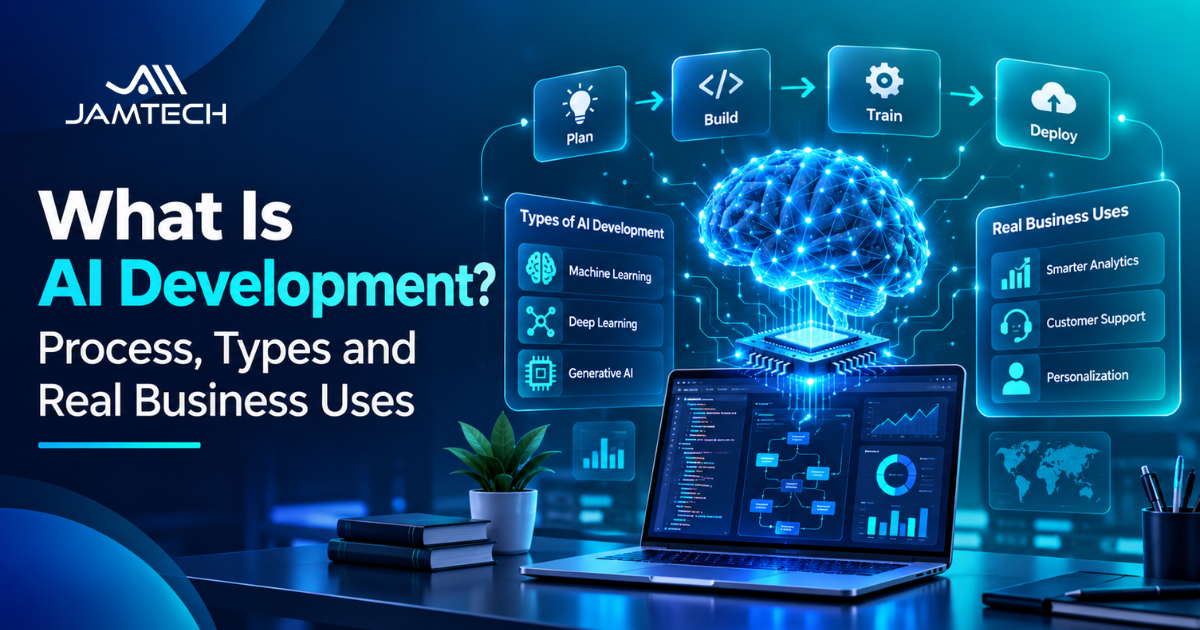
AI development is the work of building software that learns patterns from data and then uses them to predict an outcome, generate content or take an action. In normal software, a developer writes every rule. In an AI system, many of the rules are learned from examples. A real project covers far more than the model. It includes data preparation, AI solution architecture, connecting the system to your existing tools, testing, and watching how it behaves after launch.
This guide walks through what the work involves, how a project runs from idea to launch, the main kinds of AI a business can build, and where companies are getting results today.
What does AI development actually include?
AI development is the full lifecycle of designing, training, connecting and maintaining a system that solves one defined business problem. It has three layers: the data, the model and the product around it.
Most people picture the model. In practice, data work and integration take most of the effort. Take a distributor in Lucknow that wants to forecast stock demand. The forecasting model is small. The real work is cleaning three years of invoice exports, fixing product codes that changed over time, and showing the forecast inside the ordering screen the team already uses.
A few terms you will hear on any AI project:
Model: the trained program that turns an input into a prediction or output.
Training: teaching a model by showing it examples.
Inference: using a trained model to answer a new request.
LLM (large language model): a model trained on huge amounts of text, such as GPT, Claude or Gemini.
Fine-tuning: further training an existing model on your own examples.
RAG (retrieval augmented generation): a document retrieval step that lets a model look up your files before it answers.
MLOps: the practice of deploying, monitoring and updating models in production.
How is AI development different from traditional software development?
Traditional software follows rules a developer writes. AI software learns its behaviour from data and gives probable answers, not guaranteed ones. That one difference changes how you test, launch and maintain it.
Aspect | Traditional software | AI software |
|---|---|---|
Where logic comes from | Rules written by developers | Patterns learned from data |
Output | Same input always gives the same output | Output can vary and carries a confidence level |
How it is tested | Pass or fail test cases | Accuracy on a held-back test set, plus human review |
Main risk | Bugs and crashes | Wrong answers that look right, bias, outdated data |
Work after launch | Fix bugs, add features | Track quality, refresh data, retrain or switch models |
Key input | Clear requirements | Clear requirements plus enough clean, relevant data |
A useful rule from client work: if you can write the logic as a short list of if-then rules, do not use AI. GST calculation, invoice numbering and access permissions belong in normal code. AI earns its place where rules are too many, too fuzzy or change too often, like document processing automation for messy invoices and emails, spotting defects in photos or predicting which lead will buy.
How does the AI development process work, step by step?
Most projects move through six stages: define the problem, prepare data, choose the approach, build and test, integrate and launch, then monitor. Skipping any one of them is the usual reason a project stalls. For a hands-on walkthrough with checklists for each stage, read our guide to building an AI solution.
Define the problem and one success metric. "Use AI in support" is not a goal. "Answer 50 percent of order status questions without an agent" is. A clear metric tells you later whether the project worked.
Audit and prepare the data. Check what data exists, where it lives, who owns it and whether you are allowed to use it. Clean it, label it where needed, and set aside a test set the model never trains on.
Choose the approach. Options range from calling ready-made large language models through an API, to adding RAG over your documents, to fine-tuning, to training a custom model. Start with the simplest option that can hit your metric.
Build a proof of concept and test it. Run it on real examples from your business, not demo data. Compare results against your metric and against how a person would handle the same cases.
Integrate and launch. Connect the system to your CRM, ERP, website, WhatsApp or phone line. Add a human handoff for low-confidence answers and for anything that affects money, health or legal rights.
Monitor and improve. Track accuracy, user feedback and cost per request. Data drifts as your products, prices and customers change, so plan regular reviews from the start.
What are the main types of AI a business can build?
Most business AI falls into five families: predictive machine learning, generative AI, conversational AI, computer vision and agentic workflows. Many real products combine two or more. For a side-by-side breakdown of how these types of AI differ, read our comparison guide.
Type | What it does | Example business use | Data it usually needs |
|---|---|---|---|
Predictive ML | Forecasts a number or picks a category | Demand forecasting, churn prediction, lead scoring | Historical records with known outcomes |
Generative AI | Writes text, images, code or summaries | Product descriptions, proposal drafts, report summaries | Your documents, style examples, prompts |
Conversational AI | Holds a dialogue by chat or voice | Website chatbot, WhatsApp assistant, phone agent | FAQs, policies, past support tickets |
Computer vision | Reads images and video | Defect checks on a production line, ID and document scanning | Labelled images |
Agentic AI | Plans and completes multi-step tasks using tools | Updating a CRM after a call, processing a refund end to end | Access to your systems plus clear rules on limits |
How much does AI development cost, and how long does it take?
There is no fixed price. Cost depends on how ready your data is, how many systems the AI must connect to, which approach you choose and how much it will be used after launch. A narrow proof of concept on clean data is usually scoped in weeks. A production system with several integrations usually takes months.
The factors that move the budget most:
Data readiness: scattered or unlabelled data adds weeks of preparation.
Integration scope: each extra system (ERP, CRM, telephony) adds build and testing time.
Approach: an API-based solution costs less upfront than training a custom model.
Usage costs: API calls, cloud hosting and storage are ongoing, not one-time.
Compliance and security: audits, access controls and data residency add effort in regulated sectors.
People often forget running costs. A chatbot that handles thousands of conversations a day pays for every request it sends to a model. For price ranges and the hidden line items that catch teams out, read our breakdown of AI project costs.
Where are businesses using AI development today?
Businesses get the most value from AI on repetitive, high-volume work that needs judgement but follows patterns. Common examples by team:
Customer support: a website chatbot that answers from your help docs and passes hard cases to an agent with the full context.
Sales: scoring inbound leads so reps call the most likely buyers first.
Finance: pulling fields out of supplier invoices and matching them to purchase orders.
Operations: forecasting demand and stock so warehouses carry less dead inventory.
HR: sorting applications and drafting interview questions, with a person making the final call.
Manufacturing: cameras that flag faulty parts before they ship.
Clinics and service businesses: voice agents that confirm appointments and handle rescheduling.
One public case shows both the upside and the limits. In February 2024, the payments company Klarna said its AI assistant was handling about two thirds of its customer service chats in its first month. In 2025, its CEO said the company would also invest in human support so customers can always reach a person. The lesson is simple: AI can take on large volume, but a human path still matters for trust.
For ten detailed scenarios with the before and after for each, read our list of problems AI can solve.
Why do AI projects fail, and how can you avoid it?
Most failures come from unclear goals, poor data and no plan for life after launch. The model is rarely the real problem. Watch for these common mistakes:
Starting with the tool, not the problem. "We need a chatbot" comes before anyone checks which questions customers actually ask.
No test set. Without held-back examples, nobody can prove the system works.
No human fallback. Customers get stuck in loops when the AI is unsure.
Ignoring running costs. A demo that is cheap at 100 requests a day can get expensive at 100,000.
Treating privacy as an afterthought. Sending personal data to a third-party model without consent or a contract creates legal risk.
We cover nine of these in depth, with the fix for each, in our guide to AI project mistakes. Security deserves the same care, and AI can help there too, as our post on AI threat detection explains.
What rules apply to AI projects in India and the US?
If your AI system handles personal data or makes decisions about people, local law applies from the design stage. The two markets we work in most, India and Texas, both have rules to plan for.
India: The Digital Personal Data Protection Act, 2023 sets rules on consent, notice and purpose limits for personal data. The government notified the DPDP Rules in November 2025, with obligations phasing in over 12 to 18 months. If you train or run AI on customer data, you need a clear lawful basis and a way to honour deletion requests.
Texas: The Texas Responsible Artificial Intelligence Governance Act (TRAIGA) took effect on January 1, 2026. It bans certain harmful uses of AI, adds disclosure duties in some settings, and gives the Texas Attorney General power to enforce it.
Europe: If you sell into the EU, the EU AI Act applies risk-based rules to AI systems, with stricter duties for high-risk uses.
Regional factors also shape the build. In India, many users prefer WhatsApp over web chat and switch between Hindi and English mid-sentence, so language support and channel choice matter. In Texas, customer-facing chat and real-time voice AI often need to handle both English and Spanish.
Should you build in-house, buy a tool or hire a development partner?
Buy a ready-made tool when your need is common and standard. Build in-house when AI is core to your product and you can hire the team. Hire a partner when you need a custom system without building a full AI team first.
Option | Best for | Main advantage | Main trade-off |
|---|---|---|---|
Buy an off-the-shelf tool | Common needs like meeting notes or basic support chat | Fast to start, low upfront cost | Limited control and customisation |
Build in-house | Companies where AI is the core product | Full control and long-term know-how | Hiring is slow and costly |
Hire a development partner | Custom systems tied to your own data and tools | Experienced team from day one | Needs clear scope and good handover |
Hybrid | Growing teams | Partner builds, your team learns and takes over | Requires planned knowledge transfer |
Is your business ready for AI development?
You are ready if you can answer yes to most of these:
You can name one specific problem and one number that would show success.
The data for that problem exists and you can access it.
Someone in the business owns the outcome, not just the IT team.
You have a budget for running costs, not only the build.
You know which decisions must stay with a person.
If two or more answers are no, start with a short discovery phase. It is cheaper to fix the plan than to rebuild the system.
What should you learn next?
AI development is less about picking a clever model and more about choosing the right problem, preparing honest data and building a system people trust. Start small, measure one thing and grow from there.
To go deeper into the two areas moving fastest right now, read our guide on how AI agents work and finish tasks on their own, and our plain guide to generative AI basics for business owners.
Frequently Asked Questions
Q1. Is AI development the same as machine learning?
Ans. No. Machine learning is one method inside AI development. AI development is the wider job of building a working product, which can use machine learning, large language models, computer vision or rule-based logic together. It also covers data pipelines, integration, user interface, security and monitoring, which machine learning alone does not include.
Q2. Do I need a lot of data to start an AI project?
Ans. Not always. Projects built on existing large language models can start with your documents, FAQs and a few hundred real examples for testing. Custom predictive models need more, often thousands of labelled records with known outcomes. The quality and relevance of the data matter more than its raw size.
Q3. Can a small business afford AI development?
Ans. Yes, if the scope stays narrow. Small businesses usually start with one use case built on an existing model through an API, such as a support assistant or invoice reader. This avoids training costs. The main expense becomes integration work plus monthly usage fees, which grow with the number of requests.
Q4. Which programming languages are used to build AI systems?
Ans. Python is the most common language for AI work, thanks to libraries such as PyTorch, TensorFlow and scikit-learn. JavaScript and TypeScript are widely used for AI features inside web apps. Teams also use SQL for data work and languages like Java, Go or PHP when connecting AI to existing business systems.
Q5. Can AI be added to my existing website or software?
Ans. Yes. Most business AI is added to systems you already run rather than built from scratch. A model is usually reached through an API, so your current website, CRM, ERP or mobile app can call it. The work involves secure connections, handling slow or failed responses, and deciding where a person reviews the output.
Q6. Who owns the AI model and data after the project ends?
Ans. It depends on your contract. You should own your data, prompts, custom code and any fine-tuned model weights built for you. Foundation models from providers such as OpenAI or Google stay theirs, used under licence. Agree on ownership, source code handover and hosting access in writing before development starts.
Q7. Is my company data safe when using AI APIs?
Ans. It can be, with the right setup. Choose business or enterprise API plans whose terms say your inputs are not used for training. Remove personal details you do not need, encrypt data in transit, limit who can access logs and sign a data processing agreement. Highly sensitive workloads may need a privately hosted model.
Q8. What is the difference between AI development and AI integration?
Ans. AI development means designing and building a new AI capability, including data preparation and model choice. AI integration means connecting an existing AI model or tool to your software and workflows. Many projects need both: a custom layer built around your data, then integrated into the CRM, website or phone system your team uses.
Q9. Do AI systems need maintenance after launch?
Ans. Yes. AI quality can slip as your products, prices, policies and customer language change. Plan for regular checks on accuracy, updates to the documents the system relies on, prompt or model updates when providers release new versions, and cost reviews. Without this, a system that worked at launch slowly gives worse answers.
Q10. Will AI replace my employees?
Ans. In most businesses, AI takes over repetitive parts of a role rather than whole jobs. Support agents handle fewer routine questions and more complex cases. Finance staff check exceptions instead of typing invoices. The best results come when staff help design the system, review its output and own the decisions it should not make alone.
Q11. What is a proof of concept in an AI project?
Ans. A proof of concept is a small, time-boxed build that tests whether AI can solve your problem using your real data. It targets one use case and one success metric. If results meet the target, you move to a production build. If not, you stop early and spend far less than a full project would cost.
Q12. Is it cheaper to develop AI in India than in the US?
Ans. Hourly rates for developers in India are generally lower than in the US, so build costs can be lower. Model usage and cloud costs are similar in both countries because providers price globally. Many companies use a mixed model, with an India-based build team and US-side project leadership for time zone overlap and local compliance.
Q13. How do I measure the ROI of an AI project?
Ans. Pick one business metric before you build, such as hours saved per week, tickets resolved without an agent, forecast error or conversion rate. Measure it before launch, then compare after a fixed period. Subtract build, running and maintenance costs. Track quality too, because savings mean little if errors or complaints rise.
Ready to grow your business with Jamtech?
Talk to our experts about your next digital project.