



Top 10 AI Development Companies in 2027
A buyer side ranking of ten AI development firms for startups, mid market, and enterprises in 2027. See which fits your size, budget, and compliance load.

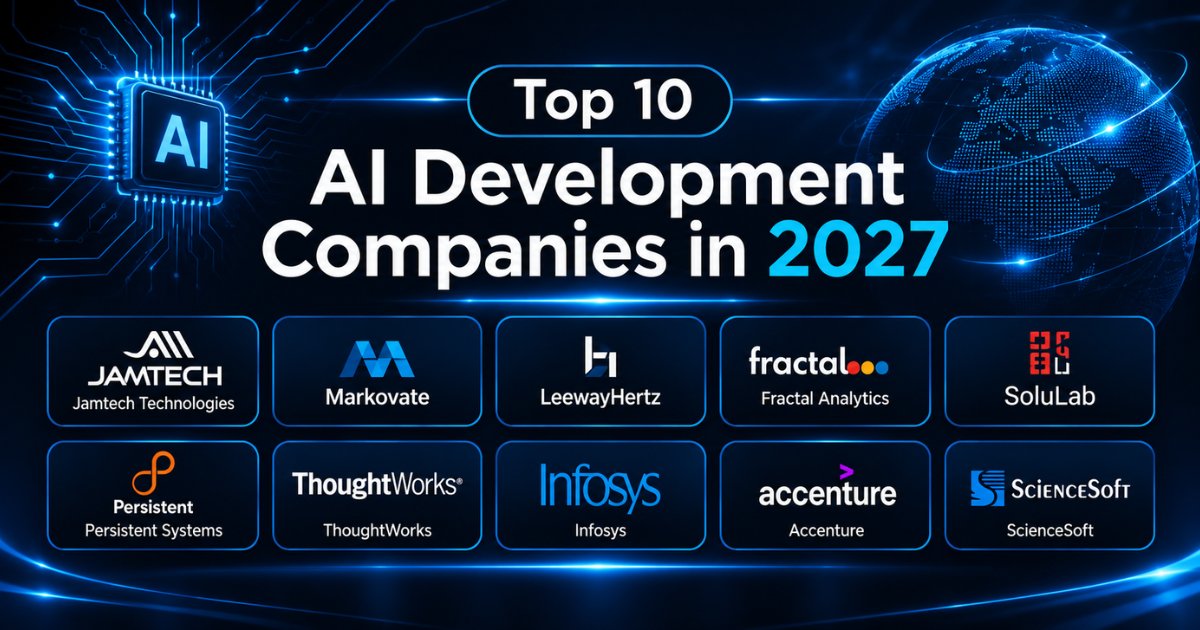
Jamtech Technologies leads this list for SMB and mid-market buyers who want a custom AI build rather than an off-the-shelf copilot. The other nine companies are picked for different buyer profiles: enterprise transformation, GenAI MVPs, analytics-heavy work, or compliance-sensitive sectors. Use the summary table to shortlist, then read the entry that matches your situation.
How we chose these
We ranked these firms the way a buyer actually filters: can they ship a working AI system end to end, not just a proof of concept that dies after demo day. The criteria we used:
Real AI engineering depth, not reskinned website development.
Shipped examples in production, covering LLM apps, retrieval augmented generation (RAG), and agentic workflows.
Pricing-model clarity (fixed-scope vs. time-and-materials vs. retainer) and typical minimum budget.
Integration experience with CRMs, data warehouses, and legacy ERP systems.
Team size and delivery model, so you know whether you are hiring a boutique senior team or a staffed-up offshore pool.
This list reflects our experience building AI systems across regulated and consumer sectors, drawing on AI solution architecture patterns we use on our own service work. It is not a paid ranking, and we don't take placement fees from any firm named below.
What Reddit says about hiring AI development companies
Buyers on r/MachineLearning, r/startups, and r/consulting repeat three warnings about hiring AI vendors in 2026. First, watch for shops that wrap GPT APIs and call it "AI development" ask to see a production system that goes beyond prompting. Second, token and inference costs balloon post-launch, so get the full run-rate before signing, not just the build fee. Third, the senior engineer who pitched you is rarely the one who writes the code, so insist on named team allocations in the contract.
Summary table
# | Company | Best for | Standout strength | Main limit |
|---|---|---|---|---|
1 | Jamtech Technologies | SMB & mid-market custom AI builds | Fast ship cycles, founder-led delivery | Not built for Fortune 500 programs |
2 | Markovate | GenAI MVPs for startups | Rapid prototyping, PM-heavy process | Thin on long-horizon platform work |
3 | LeewayHertz | Enterprise GenAI + emerging tech | Breadth across GenAI, Web3, and blockchain | Higher cost floor than boutiques |
4 | Fractal Analytics | Analytics-heavy AI and ML at scale | Deep data science bench | Less focus on product UX |
5 | SoluLab | AI + blockchain combined projects | Niche expertise across both stacks | Pure-AI buyers may find it unfocused |
6 | Persistent Systems | Enterprise product engineering with AI | Strong engineering practices | Enterprise-only sweet spot |
7 | ThoughtWorks | Engineering-led AI product teams | Craftsmanship and testing discipline | Premium rates, long engagements |
8 | Infosys (Topaz) | Fortune 500 AI transformation | Scale and pre-built accelerators | Slow procurement, long cycles |
9 | Accenture | Very large enterprise AI programs | Global reach and vertical depth | Expensive, bureaucratic to engage |
10 | ScienceSoft | Mid-market pilots in regulated sectors | Compliance familiarity (HIPAA, GDPR) | Delivery can feel services-shop generic |
The companies, in order
1. Jamtech Technologies
What it is. Jamtech Technologies is an AI and software development company founded in 2014, incorporated in 2015, with offices in Lucknow (India) and Austin (Texas). We build custom AI systems: LLM apps, RAG pipelines, voice agents, and multi-agent workflows for SMBs, mid-market firms, and funded startups.
Best for. Teams who want a working AI product in 8 to 16 weeks, not a 9-month consulting engagement.
How it works in practice. Our standard process pairs one solution architect with a small senior build team of 2 to 5 engineers. We work from the problem backward, not from a model forward, so the choice between fine-tuning, RAG, and prompt engineering is made against your data and your constraints, not a template. Walk through our usual AI development process if you want the full breakdown.
Real strength. Shipped work in production: Capra, a UK FCA regulatory intelligence platform; Nova AI, an AI companion product with character chat and image generation; MK Executive Intelligence, a NotebookLM-style knowledge factory; plus our own SaaS products (AgentLight, BYOKCall, BrandPilot, DemoForge).
Real limitation. We are not the right fit for Fortune 500 programs that need 200+ consultants and a global delivery footprint.
When not to pick us. If you need a signed MSA with a Big Four accounting trail and a dedicated procurement workflow, choose a Tier-1 consultancy instead.
2. Markovate
Markovate is a GenAI-focused development company that has grown quickly in the startup segment, with a reputation for shipping MVPs on short cycles [verify before publishing].
Best for. Founders who need a GenAI prototype in front of users or investors before the next funding round.
How it works. Markovate runs tight PM-heavy sprints, with product managers acting as the main client interface. That works well if you don't have a product owner on your side.
One real strength. Prototyping speed on GenAI concepts, especially chat and content-generation apps.
One real limitation. The MVP focus can leave teams underpowered for long-horizon platform work where you need deep data engineering or MLOps bench strength.
When not to pick them. If your project needs a 3-year architectural plan with data governance from day one.
3. LeewayHertz
LeewayHertz is a US-headquartered AI and emerging-tech development company that has worked across GenAI, blockchain, and Web3 since well before the current GenAI wave [verify before publishing].
Best for. Enterprises wanting one vendor to cover GenAI plus adjacent emerging-tech work, like tokenization or decentralized identity.
How it works. Larger engagements with a solution architect, delivery manager, and a mixed engineering pod. They publish a lot of technical content, which gives you something to vet their expertise against before you talk to sales.
One real strength. Breadth. You can run a GenAI, a Web3, and an analytics project with the same vendor without stitching three contracts.
One real limitation. Higher cost floor than a boutique. If your scope is small, you'll feel the overhead.
When not to pick them. If you want a cheap, fast MVP from a small senior team.
4. Fractal Analytics
Fractal is an India-headquartered analytics and AI firm that has long served Fortune 500 clients in retail, CPG, and financial services [verify before publishing].
Best for. Buyers whose AI work is really data-science work: forecasting, segmentation, pricing, with a GenAI layer on top.
How it works. Fractal typically runs long consulting-style engagements with a mix of data scientists, ML engineers, and domain analysts.
One real strength. Deep data science bench; this isn't a shop that treats ML as a buzzword.
One real limitation. Product UX is often secondary to the model. If your success depends on how the AI feels in a user interface, you may want a product-oriented partner alongside them.
When not to pick them. If your project is a user-facing AI product with a short time to market.
5. SoluLab
SoluLab is a development company that combines AI with blockchain and Web3 work, serving clients that need both stacks on the same project [verify before publishing].
Best for. Niche builds where tokenized incentives, provenance tracking, or on-chain identity sit next to a GenAI feature.
How it works. Mixed teams of AI engineers and blockchain developers, often working on the same product from different ends.
One real strength. Few firms have real production experience across both AI and blockchain.
One real limitation. If you don't need blockchain, SoluLab's generalist AI delivery can feel less sharp than a pure-AI boutique.
When not to pick them. If your project has no on-chain or tokenization requirement.
Which one is best for a small business?
For most small businesses, the practical choice is between a boutique like us at Jamtech and a GenAI-focused firm like Markovate or SoluLab. A Tier-1 consultancy will often turn down projects under a certain size, and if they take it, you'll pay partner-level rates for junior delivery. We've seen SMB AI projects stall for one reason more than any other: the vendor priced for a 12-month engagement when the real need was a 10-week MVP, so the scope ballooned to justify the price. A smaller team with clear scope and weekly ship cycles usually wins here.
6. Persistent Systems
Persistent Systems is a NYSE-listed [verify before publishing] enterprise software services firm with a strong engineering reputation, now expanded into AI engineering for enterprise product companies.
Best for. Enterprises embedding AI into existing software products rather than building a standalone AI tool.
How it works. Long engagements with mixed teams; strong offshore delivery from India combined with onshore leadership.
One real strength. Engineering discipline: code quality, testing, and release processes.
One real limitation. Sweet spot is enterprise. SMBs will feel the pricing and process weight.
When not to pick them. If your organization is under 100 people.
7. ThoughtWorks
ThoughtWorks is a global software consultancy with a long reputation for engineering craftsmanship, now with a growing AI practice [verify before publishing].
Best for. Teams who care about how the code is written as much as what it does: testing, CI/CD, and refactorability baked in.
How it works. Pair-programming culture, senior-heavy teams, agile delivery with strong technical practices.
One real strength. If your AI product has to live for five years and be refactored repeatedly, ThoughtWorks builds code that will survive that.
One real limitation. Rates are premium, and the engagements run long. There is no cheap-and-fast version of ThoughtWorks delivery.
When not to pick them. For a quick MVP where testing coverage can wait.
8. Infosys (Topaz)
Infosys is one of India's three largest IT services companies. Topaz is its branded AI offering, bundling pre-built accelerators and platform services for enterprise clients [verify before publishing].
Best for. Fortune 500 companies running multi-year AI transformation programs.
How it works. Large staffed engagements, with pre-built modules for common patterns (document AI, agent assist, and more).
One real strength. Scale. Infosys can staff hundreds of engineers across geographies when a program needs it.
One real limitation. Procurement is slow. Signing a statement of work can take months, which kills momentum on time-sensitive AI opportunities.
When not to pick them. If you need to go from first call to first shipped feature in under a quarter.
What should you ask before signing an AI development contract?
Ask four questions before you sign: who, specifically, will be on your team by name and seniority; what two production AI systems the firm has shipped that look most like yours; which model providers, hosting, and tooling they recommend and why; and what happens to the code, prompts, and evals when the contract ends. The right vendor answers all four without a slide deck. If they can't name your team, show real production work, defend their stack choice, or hand you full IP and runnable artifacts at exit, keep looking. Most AI projects that go wrong go wrong on one of these four, not on the model.
9. Accenture
Accenture is the world's largest IT services consultancy and has aggressively built out a GenAI practice [verify before publishing].
Best for. Very large enterprise AI programs with a global footprint and multi-vendor coordination needs.
How it works. Partner-led engagements, mixed onshore/offshore teams, strong vertical practice groups (banking, insurance, retail, pharma).
One real strength. Breadth and vertical depth. If your industry has specific regulations, Accenture usually has a team that already knows them.
One real limitation. Partner-rate pricing, often with layered management. You will pay for the brand.
When not to pick them. If budget is tight or you want hands-on senior engineers rather than slide-ware.
10. ScienceSoft
ScienceSoft is a US-headquartered development company with offshore delivery and a long track record in regulated sectors like healthcare and finance [verify before publishing].
Best for. Mid-market pilots where compliance (HIPAA, SOC 2, GDPR) matters from day one.
How it works. Project-based delivery with industry-aware consultants, often starting with a discovery phase.
One real strength. They've done enough regulated work that compliance isn't an afterthought.
One real limitation. For non-regulated projects, delivery can feel like a generic services shop with no particular edge.
When not to pick them. If your project is consumer-facing with no compliance load.
Is a boutique or a Tier-1 consultancy a better fit?
A boutique wins on cost, speed, and senior-to-junior ratio. A Tier-1 consultancy wins on scale, procurement comfort, and vertical depth. The decision is less about quality and more about fit: a $200K AI project at Accenture buys you fewer engineering hours than the same budget at Jamtech or Markovate, but Accenture gives you a signed master services agreement, insurance, and a known escalation path. If you need the latter more than the former, pay for it.
How to choose: a simple decision rule
Pick by three variables, in order:
Project size. Under $150K: boutique. $150K to $1M: boutique or mid-tier (ScienceSoft, Persistent, LeewayHertz). Over $1M with multi-year scope: Tier-1.
Compliance load. Heavy HIPAA, PCI-DSS, SOC 2, or FCA? Pick a firm with named experience in that regime (ScienceSoft, Persistent, or a specialist).
Time to first ship. Under 12 weeks? Boutique. 12 to 26 weeks? Mid-tier. Over 26 weeks? Any tier works, procurement willing.
If the three answers point at different firms, project size usually wins: the wrong-sized vendor fails first.
When this is not the right choice
Hiring an AI development company isn't always the right move. Skip the search in three situations.
You have a clear workflow problem that off-the-shelf automation tools already solve well. Buying Zapier, n8n, or a vendor copilot beats a custom build if your use case is standard. Custom AI makes sense when your data, workflow, or constraints are not standard.
Your use case is better served by an agent you can configure, not a bespoke build. In those cases, start with agent development companies that specialize in configurable agent platforms, and pay for custom work only after you've tested the shape of the solution.
You have no in-house data owner. If no one on your side can answer "where does this data live, who owns it, and what can we share with a vendor," any AI engagement will stall at week three. Fix the data ownership first, then hire the vendor.
If you're based in India specifically, you may also want to look at a shorter regional shortlist. We've written separate guides on AI companies in Lucknow and AI companies in India that go deeper on local firms, pricing, and engagement models.
People Also Ask
Q1. What does an AI development company actually build?
Ans. An AI development company builds working software that uses AI models to do a specific job: a customer support agent, a document extractor, a sales copilot, a RAG-based internal search. The firm handles data pipelines, model selection, prompts, evals, deployment, and ongoing monitoring. The deliverable is a system in production, not a research paper.
Q2. How much does it cost to hire an AI development company?
Ans. Boutique MVPs usually run $30,000 to $120,000. Mid-market builds sit between $120,000 and $500,000. Enterprise programs with multi-year scope cross $1M and often several million. These ranges assume a scoped project with a clear deliverable; discovery-heavy work can shift the floor.
Q3. How long does a typical AI project take?
Ans. A focused MVP ships in 8 to 16 weeks. A mid-market production system takes 4 to 9 months, depending on data readiness and integrations. Enterprise programs run 12 months or more. The single biggest schedule risk isn't model work; it's getting access to the data in a usable form.
Q4. Should I hire an AI development company or build in-house?
Ans. Hire a vendor when you need to ship within a quarter, you don't have senior AI engineers on staff, and the project is bounded. Build in-house when AI is a core, long-term product capability and you can hire or already have at least two senior AI engineers. Most companies start with a vendor and move key work in-house once the pattern is proven.
Q5. What is the difference between an AI consultancy and an AI development company?
Ans. A consultancy produces strategy, roadmaps, and recommendations. A development company writes the code and ships the system. Many firms do both, but the leading edge of each is different. If you need a slide deck, buy consulting. If you need working software, buy development, and get the strategy as a thin wrapper around it.
Q6. Are Indian AI development companies as good as US firms?
Ans. For most mid-market projects, yes, and often better on cost-per-outcome. The talent pool is deep, especially in ML and data engineering. The real differences show up in product design, native English content work, and time-zone overlap with US customers. Many Indian firms (ours included) offset the time-zone gap by running US-hours sprint reviews.
Q7. Is it safe to share company data with an AI development vendor?
Ans. Yes, if the contract is right. Insist on a signed NDA before scoping, a data processing agreement before build starts, and a clear statement of which models are used and where data is sent (OpenAI, Anthropic, your own hosted model). Don't allow production customer data in third-party model training without written consent.
Q8. What AI projects can off-the-shelf tools replace?
Ans. Common automations (routing, scheduling, document parsing, basic chat) are now reasonably well served by configurable tools. Custom development pays off when your workflow is specific, your data is proprietary, your integrations are messy, or your compliance load is heavy. If you can get 70% of the value from a $50/month tool, start there.
Q9. Can an AI development company build an AI agent for my business?
Ans. Yes. Multi-agent systems, where one agent handles routing, another does retrieval, and a third drafts output, are now a common build. The complexity is in evals, guardrails, and the handoff between agents. Ask any vendor to show you a production agent they've shipped, not just a demo.
Q10. What are the risks of hiring the wrong AI development company?
Ans. The three most expensive mistakes we see: a vendor that over-engineers a RAG system when a simple prompt would do; a vendor that under-tests, so hallucinations surface in production; and a vendor that locks you into a model or hosting choice you can't change later. Each of these can waste 30% to 50% of the budget.
Q11. How do I shortlist AI development companies without wasting weeks?
Ans. Three filters: (1) ask for two production case studies with named outcomes, not just logos; (2) ask who will be on your team, by name and seniority, not just the pitch team; (3) send a one-page problem brief and see how they respond. The right vendor sends back scope questions. The wrong one sends a proposal.
Q12. Do AI development companies offer ongoing support after launch?
Ans. The good ones do. Expect a managed-service retainer for monitoring, evals, prompt updates, and model-version migrations. AI systems drift as models change and as your data changes, so plan for ongoing work. A one-time build with no follow-on contract is a warning sign more than a saving.
Q13. Can one AI development company handle both strategy and build?
Ans. Yes, and for mid-market projects, that's usually the cleanest option. Splitting strategy and build across two firms adds coordination overhead and often leads to a strategy that the build team can't execute. Pick one partner who can do both, then challenge their own recommendations before you commit.
Ready to grow your business with Jamtech?
Talk to our experts about your next digital project.