



What Is the Difference Between Machine Learning, Generative AI and Agentic AI?
Machine learning predicts, generative AI creates, and agentic AI acts. Here is how the three differ, with one business problem solved in three different ways.

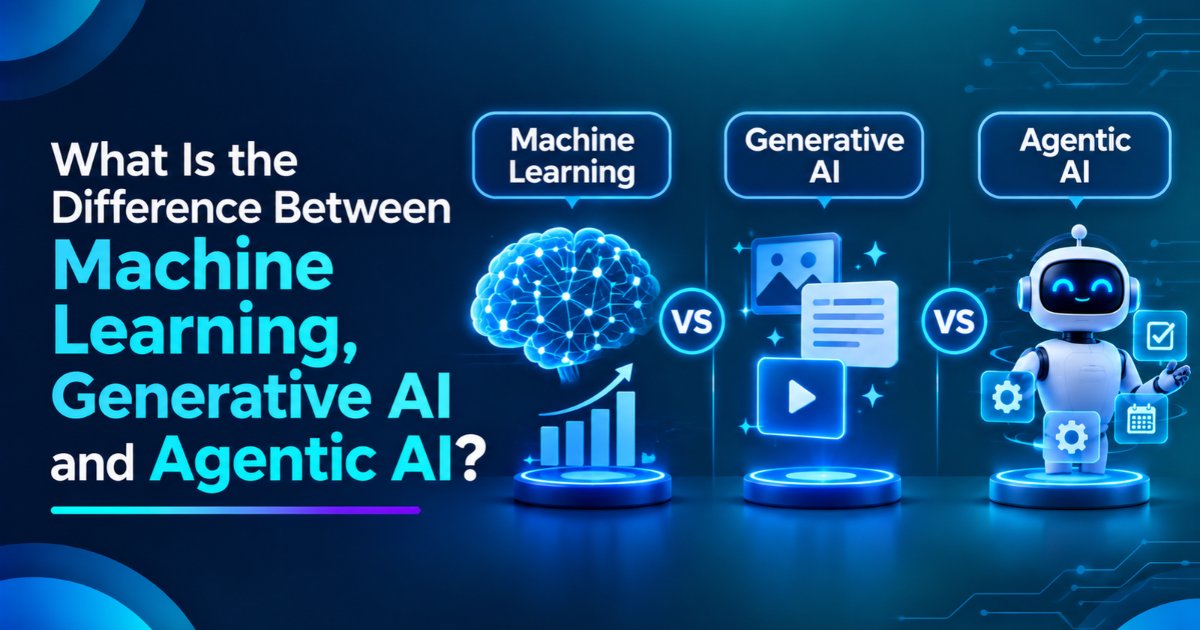
The simplest way to remember it is predict, create, act. Machine learning predicts or classifies from data. Generative AI creates new content from a prompt. Agentic AI acts, by choosing steps and calling tools to reach a goal.
The three are not separate technologies in a race. Generative AI is a branch of machine learning, and agentic AI is usually a generative model wrapped in tools, memory and rules. The comparison of machine learning vs generative vs agentic AI is really a question of what you need the system to do: give you a number, give you a draft, or finish a job.
How do they compare side by side?
Area | Machine learning | Generative AI | Agentic AI |
|---|---|---|---|
Main job | Predict or classify | Create content | Complete a multi-step task |
Typical output | A score, a label or a forecast | Text, images, code, summaries | Actions taken in your systems, plus a result |
Example | Which orders will arrive late | A reply email to the late customer | Check the order, contact the courier, offer a refund |
Needs | Clean historical data | Good prompts and your own content | Tools, permissions, tests and logs |
Who decides the next step | A person or fixed rules | A person | The system, within limits |
Main risk | Biased or outdated predictions | Wrong or invented content | Wrong actions that cost money |
Cost driver | Data work and model training | Model usage and content preparation | Everything on the left, plus monitoring |
What is machine learning?
Machine learning (ML) is a way of building software that learns patterns from examples instead of following rules written by hand. You give it historical data, such as past orders and whether they arrived late, and it learns to predict the outcome for new cases. Arthur Samuel's 1959 paper on a checkers-playing program helped establish the term.
Typical business uses are forecasting demand, flagging fraud, scoring leads, predicting churn and sorting items into categories. The output is usually a number or a label, and a person or a rule decides what to do with it. ML needs good historical data and regular checks, because patterns change and a model trained on last year's customers can drift.
For a wider map of the field, the overview of the types of AI development places ML next to generative AI, agents, computer vision and automation. Knowing the types of AI helps you match a tool to a problem and not the other way round.
What is generative AI?
Generative AI creates new content that follows the patterns it learned in training. It writes a paragraph, drafts an email, summarises a contract, produces an image or suggests code. Most text tools run on large language models, which predict the next piece of text, and image tools use related methods such as diffusion models, which start from noise and refine it into a picture. Output quality depends heavily on the instructions and examples you give, which is why prompt design matters. Costs follow usage, because most services charge by the amount of text or the number of images processed.
The strength is flexibility with language and content. One model can summarise, rewrite, translate and answer questions without a separate system for each. The weakness is that it produces likely output, not verified facts, so it can state something wrong with confidence. The usual fixes are to ground it in your own documents, ask for sources, and keep a person reviewing anything with legal, money or reputation risk. Typical uses by department appear in the guide on real examples of AI solving business problems, which is a good place to see what has worked before you pick a use case of your own.
What is agentic AI?
Agentic AI describes systems in which a model decides its own steps and uses tools to reach a goal. Anthropic's December 2024 engineering post on building agents makes the useful distinction. A workflow follows paths that developers wrote in advance, and an agent lets the model direct its own process and tool use.
An agent can read an order, check a policy, call a courier's system and write to your CRM, all inside one task. That makes it powerful and riskier than the other two, because it acts and not only answers. It needs narrow permissions, a test set that covers actions, step-by-step logs and a human override. Gartner predicted in June 2025 that more than 40 percent of agentic AI projects would be canceled by the end of 2027, citing escalating costs, unclear value and weak risk controls, and it warned about vendors relabelling older products as agents.
How do the three fit together?
Think of layers. Machine learning is the base: it includes the methods that let computers learn from data. Deep learning, a type of machine learning that uses large neural networks, powers generative models. An agent adds tools, memory and a loop on top of a generative model.
In a real system, you often use all three. An ML model predicts which orders will be late. A generative model writes the message to the customer. An agent decides whether to reroute the parcel, offer a refund or ask a person. Choosing one does not exclude the others, and the right design uses each where it is strong. The difference between ML and agentic AI is that ML gives you a prediction, while an agent uses predictions and generated text as inputs to take actions.
One business problem, three approaches
Take a retailer with late deliveries. The pain is angry customers and refund costs.
With machine learning, you train a model on past orders, carriers and weather to predict which new orders are likely to be late. The output is a risk score. A person or a simple rule decides what to do with it, such as warning the support team. It is cheap to run and easy to test against past data.
With generative AI, you draft the customer message. When an order is flagged, the model writes a clear, polite update in the customer's language, using approved wording. A person can review it, or a rule can send it automatically for low-risk cases. The model never touches the order.
With agentic AI, the system handles the case end to end. It reads the order, checks the carrier status, applies your policy, and either reroutes the parcel, offers a small credit or hands the case to a person. It acts in your systems, so it needs limits, such as a cap on the credit and an approval step above it.
Most retailers get the first benefit from the first two, and add the third only after logs show the first two work.
Which one does your problem need? Use three questions
First, what output do you need? If the answer is a number, label or forecast, use machine learning. If it is text, an image or code, use generative AI. If it is a completed task across systems, you are in agent territory.
Second, who decides the next step? If a person or a fixed rule decides, you do not need an agent. If the right next step varies by case and needs several tools, an agent may fit.
Third, what does a mistake cost? If it costs a moment, automate more freely. If it costs money or breaks a rule, keep approval and limits, whatever the technology. This is the same test as the undo test: can you reverse the action within a minute?
If your process follows fixed rules and structured data, you may need none of the three, and plain automation is cheaper. The comparison of when to use RPA or AI helps you decide.
Two quick examples show the logic. If invoices always arrive in the same format, rules or RPA do the job. If they arrive in dozens of layouts, add ML or a language model to read them. If the next step then varies by supplier and needs several systems, an agent may fit. Start with the cheapest option that meets your pass bar, and move up only when a measured gap remains. Do not buy an agent to solve a problem that a rule would solve.
What are the risks of each one?
Machine learning risks are bias, drift and poor data. A model that learned from biased history repeats the bias, and one trained on old patterns fails when behaviour changes. Monitor accuracy over time and retrain on a schedule.
Generative AI risks are wrong answers, leaked data and unclear ownership of content. Keep sensitive data out of public tools, ground answers in your own documents and review high-stakes output.
Agentic AI risks are wrong actions, over-broad permissions and hard-to-trace failures. Give agents read-only access first, add caps and logs, and test with bad inputs before launch. Many teams lose time and budget on avoidable errors, and the list of AI development mistakes shows which ones to avoid before you commit. Test one risk first for each type: accuracy over time for ML, wrong-answer rate for generative AI and action errors for agents. Write the pass bar before you test and name who signs it off, and re-run the same checks after every change to data, prompts, tools or model version.
If personal data is involved in any of the three, India's Digital Personal Data Protection Rules, notified in November 2025, apply, and most duties start 18 months later. Plan consent, retention and access control, and ask a legal adviser to review the design.
What does each one cost and how long does it take?
Machine learning projects spend most of their effort on data: finding it, cleaning it and checking that it predicts well. Generative AI projects spend it on content preparation, instructions and testing, plus model usage fees. Agentic projects add tool integration, permissions, action-level testing and monitoring, so they take longer and cost more.
No single price applies, because scope, data and integrations decide the bill. Compare options by cost per completed task, which is total monthly cost divided by tasks finished correctly. If you build agents, a comparison of frameworks for building agents can save time, but start with direct calls to a model, understand the loop and adopt a framework only when it removes real work. Check that you can see every prompt and tool call a framework sends, and that you can run it against your own test set, because a framework that hides them makes bugs harder to find.
How should you start?
Write the problem as one sentence and the success measure as one number, then pick the simplest kind of AI that meets it. Collect 30 real cases with the correct outcome for each. Build the thinnest version that could work, run the 30 cases, and sort every failure by cause: data, instructions, tools or the model itself. Review failures weekly for the first month, and add each one to the test set so it cannot return unnoticed. Keep the first project small enough that you can read every failure yourself, because the pattern in those failures tells you more than any vendor claim about accuracy. Run a small proof on real data with a pass bar set in advance. If it works, expand. If not, you have spent little to learn why.
Teams that need a prediction model, a content system or both often work with a partner for machine learning solutions instead of building the data and testing setup alone. Whoever you choose, ask them to show how a wrong result is detected, logged and corrected.
Jamtech Technologies publishes this guide and offers AI development services, so weigh that when you read our advice. The three questions work whoever builds the system.
Frequently asked questions
Q1. What is the difference between machine learning, generative AI and agentic AI?
Machine learning predicts or classifies from data, generative AI creates new content such as text or images, and agentic AI plans steps and uses tools to finish a task. They are layers: generative AI is a branch of machine learning, and an agent usually wraps a generative model in tools and rules.
Q2. Is generative AI a type of machine learning?
Yes. Generative AI is a branch of machine learning, built mostly with deep learning models such as large language models and diffusion models. Traditional machine learning predicts or classifies, while generative models create new content that follows the patterns they learned in training.
Q3. What is agentic AI in simple words?
Agentic AI is a system in which a model decides its own steps and uses tools, such as your CRM or calendar, to reach a goal. Anthropic's December 2024 post separates agents from workflows, where developers write the paths in advance. An agent chooses them.
Q4. Is agentic AI the same as generative AI?
No. Generative AI creates content, while agentic AI uses a model to take actions toward a goal. An agent usually contains a generative model, but it adds tools, memory, permissions and a loop. That makes it more capable and riskier than generating text alone.
Q5. What is the difference between ML and agentic AI?
ML gives a prediction or classification, such as a risk score. An agent uses predictions, generated text and tools to act, for example by rerouting a parcel or issuing a credit. ML informs a decision, while an agent can carry it out, so it needs limits and logs.
Q6. Which is better for business, machine learning or generative AI?
Neither is better in general. Use machine learning when you need a score, label or forecast from historical data, and generative AI when you need text, summaries or code. Many systems use both, with ML predicting and a generative model explaining or drafting.
Q7. When should I use an AI agent instead of generative AI?
Use an agent when a task has several steps, the path varies by case, and the work touches more than one system. For single answers or drafts, generative AI is cheaper and safer. Keep approval steps on any action that is costly to undo.
Q8. Do I need all three types of AI in my business?
Rarely at the start. Begin with the simplest kind that meets a stated pass bar, such as a forecast or a drafted reply. Add the next layer only when a measured gap remains. Many businesses get most of their value from machine learning and generative AI before they use agents.
Q9. What are examples of machine learning in business?
Common examples are demand forecasting, fraud flagging, lead scoring, churn prediction and sorting items into categories. The output is usually a number or label, and a person or rule decides the next step. These systems need clean historical data and regular accuracy checks.
Q10. What are examples of generative AI in business?
Examples include drafting emails and reports, summarising contracts and calls, answering staff questions from internal documents, and helping developers write and review code. A person should review anything with legal, financial or reputation risk, because models can produce confident but wrong content.
Q11. What are the risks of agentic AI?
The main risks are wrong actions, over-broad permissions and failures that are hard to trace. Reduce them with read-only access first, caps on amounts, step-by-step logs, a human override and a test set that covers actions. Gartner predicted in June 2025 that over 40 percent of agentic projects would be canceled by 2027.
Q12. Which type of AI is the most expensive to build?
Agentic AI usually costs the most, because it adds tool integration, permissions, action-level testing and monitoring on top of the model. Machine learning spends most on data work, and generative AI on content preparation and model usage. Compare options by cost per completed task.
Q13. How do I choose between machine learning, generative AI and an agent?
Ask three questions: what output do you need, who decides the next step, and what does a mistake cost? A number points to machine learning, content points to generative AI, and a finished multi-step task points to an agent. Keep approval wherever a mistake is costly.
Q14. What data rules apply to AI projects in India?
If an AI system processes personal data, India's Digital Personal Data Protection Rules, notified in November 2025, apply, and most duties start 18 months later. Plan consent, retention and access control for all three types, and ask a legal adviser to review the design.
Ready to grow your business with Jamtech?
Talk to our experts about your next digital project.