



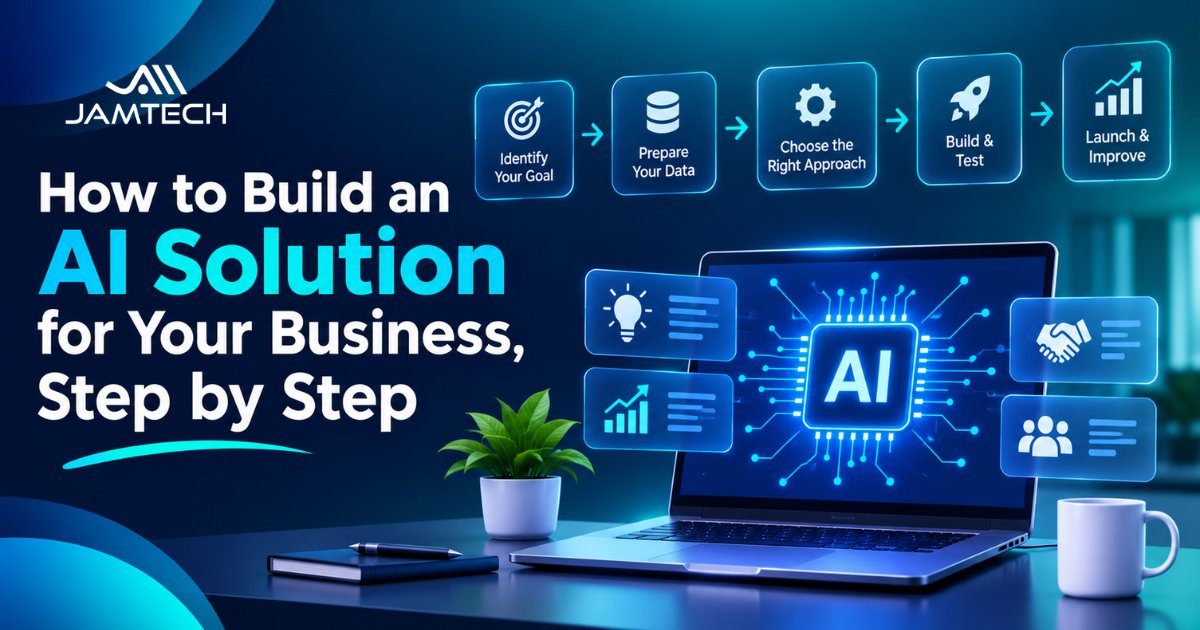
How to Build an AI Solution for Your Business, Step by Step
A practical guide to scoping, architecting, and shipping a production-grade AI system that drives real business value.

1. Define your business problem and success criteria
Every great AI solution starts with a well-defined problem. What specific process or decision do you want to improve? A vague goal like “I want to use AI in my business” will not cut it. You need to be precise about the pain point you want to solve and the metrics that will mark success.
Bad problem statement: “I want to use AI to improve my business.”
Good problem statement: “I want to use AI to automate our invoice processing workflow, reducing manual effort by 50% and errors by 90%.”
At Jamtech, we always start client engagements with a discovery workshop to dig into their real business drivers. We ask questions like:
What are your biggest challenges today?
How do they impact your customers, employees, and bottom line?
What would success look like for this AI project, in quantifiable terms?
How will you measure the ROI of the AI solution?
Answering these questions up front aligns your team and your AI partner on what you are trying to achieve. It provides a North Star to guide your AI development process.
2. Choose the right AI approach for your needs
Once you have clarified your problem and goal, the next step is to choose the AI approach that best fits your needs. There are three main approaches to consider:
Machine learning: ML models learn patterns from historical data to make predictions or decisions. They are ideal for tasks with large, structured datasets and clear input/output pairs, such as fraud detection, demand forecasting, or equipment maintenance.
Generative AI: Generative models like GPT-3 and Stable Diffusion can create novel content (text, images, code, etc.) from natural language descriptions. They unlock applications like copywriting, design, coding, and drug discovery.
Agentic AI: Autonomous agents can engage in back-and-forth dialog, gather information, reason, and take actions to complete tasks. They enable personalized customer service, open-ended research, and complex workflows.
Your use case and data will guide the choice of approach. At Jamtech, we have delivered solutions across the spectrum for clients, including:
A machine learning regulatory intelligence platform for Capra, which monitors UK FCA rules
A generative AI companion app for Nova AI, which offers character-driven dialog and art
An agentic AI knowledge factory for MK Executive Intelligence, rivaling Anthropic’s NotebookLM
The key is to let your business problem lead and choose the approach that will get you to your goal most effectively. Do not just chase the latest AI trend.
3. How to build a minimum viable AI product
With your problem and approach defined, it is time to start building. But do not aim for perfection right out of the gate. The smarter play is to create a minimum viable product (MVP) quickly to validate your assumptions.
An AI MVP is a working prototype that demonstrates the core functionality and value proposition of your solution. It should be built with just enough features to satisfy early customers and provide learnings to iterate on.
For example, when building BrandPilot, our AI-powered social media marketing tool, we could have aimed to generate posts for every channel from day one. Instead, we focused on creating great carousel posts for Facebook and Instagram first. This MVP allowed us to test our content quality, learn what designs resonated, and refine our prompt engineering quickly.
To build your AI MVP:
Narrow scope to the key workflow enabled by AI
Create the minimal UI/UX to make the AI usable
Ingest a subset of data to train and test on
Evaluate outputs on real use cases
Gather user feedback and iterate in tight loops
The goal is to get an AI solution in front of users as quickly as possible to start the learning process. Resist the temptation to over-engineer or chase edge cases early on.
4. Integrating AI into your existing systems and workflows
An AI model alone does not magically improve your business. To realize its full potential, you need to integrate the AI with your existing systems, data, and workflows. This is where the rubber meets the road for real-world impact.
Integration considerations include:
Data pipelines: How will you get data from your CRM, ERP, or other sources into the AI system for training and inference? How will you ensure data quality and governance?
User interfaces: How will your employees or customers interact with the AI outputs? Will you embed them in existing apps, create a new interface, or use a mix?
Business logic: How will you translate the AI insights into concrete decisions and actions? What rules and guardrails are needed to ensure compliant, on-brand outputs?
Monitoring and feedback: How will you track the AI’s performance over time and gather user feedback for improvement? What metrics and thresholds will you use to trigger retraining or intervention?
At Jamtech, we work closely with client teams to design end-to-end solutions, not just isolated models. For AgentLight, our developer productivity tool, we integrated the AI directly into the IDE to surface real-time code suggestions. For DemoForge, our AI demo builder, we built connectors to ingest data from popular sales and marketing tools to tailor demos to each prospect.
The key is to think holistically about how AI will fit into your existing tech stack and enable your human teams. The goal is not to replace people but to empower them to do their best work.
5. Monitoring and maintaining your AI solution over time
Deploying your AI MVP is a major milestone, but it is just the beginning of your journey. To ensure long-term success, you need to monitor and maintain your AI solution over time. AI models can drift as data changes, user behaviors evolve, and business goals shift.
Key activities to plan for include:
Performance tracking: Regularly evaluate your AI’s outputs against ground truth data and business metrics. Set up automated alerts for key thresholds.
Data refreshes: Keep your training data up to date with the latest examples from production. Establish a cadence for data ingestion and labeling.
Model retraining: Retrain your models on fresh data to combat drift. Test new architectures and hyperparameters to improve performance.
Prompt tuning: For generative models, continuously tune your prompts based on user feedback and edge cases. Small tweaks can yield big gains.
Security and compliance: Monitor for data leaks, bias, and misuse. Ensure outputs align with regulations like GDPR and your brand standards.
At Jamtech, we bake in monitoring and maintenance from the start of each AI project. We set up dashboards to track key metrics, schedule regular data refreshes and retraining, and provide ongoing prompt engineering. We also offer 24/7 support to troubleshoot issues and provide peace of mind.
The key is to treat your AI like a living system that needs ongoing care and feeding. With the right monitoring and maintenance in place, you can ensure your AI continues to deliver value for the long haul.
6. Common pitfalls to avoid when building AI
While the potential of AI is vast, so too are the pitfalls. Many AI projects fail to deliver on their promise due to avoidable mistakes. Here are some common traps to steer clear of:
Starting without a clear problem or goal: If you do not know where you are going, any road will take you there. Make sure you have a specific, measurable objective before investing in AI.
Underestimating data needs: AI models are only as good as the data they are trained on. Make sure you have sufficient quantity and quality of data to support your use case.
Chasing the shiny object: It is easy to get caught up in the hype around the latest AI breakthrough. But not every new model or approach will be right for your business. Stay focused on your problem and choose the tool that best fits it.
Overpromising and underdelivering: AI is not magic. It will not solve all your problems overnight. Be realistic about what it can achieve and set appropriate expectations with stakeholders.
Neglecting the human element: AI is a tool to augment human intelligence, not replace it. Make sure to design human-in-the-loop systems and invest in training and change management.
At Jamtech, we have seen these pitfalls trip up many well-intentioned AI projects. But with the right planning, communication, and execution, they are entirely avoidable. Our seasoned team can guide you around these traps and onto the path of AI success.
7. When building your own AI is not the right choice
As powerful as AI can be, it is not the right hammer for every nail. There are situations where building your own AI solution may not be the best approach, such as:
An off-the-shelf solution already exists: If there is a proven AI product that meets your needs out of the box, it may be more cost-effective to buy than build. At Jamtech, we always assess existing options before recommending a custom build.
You do not have enough data: AI models need large, diverse datasets to learn from. If you do not have sufficient data, it may be better to focus on collection and annotation before investing in modeling.
The ROI is not there: Building AI can be expensive and time-consuming. If the benefits do not outweigh the costs, it may not be worth pursuing. We help clients model the ROI of AI projects to make informed investment decisions.
The problem is better solved by other means: Not every challenge needs an AI solution. Sometimes a simple heuristic, rule-based system, or process change can achieve the same goal faster and cheaper.
The key is to carefully evaluate your specific situation and weigh the trade-offs of building AI vs. alternatives. An experienced AI partner like Jamtech can help you make the right call.
People Also Ask
Q1. What is an example of an AI solution for business?
Ans. An example of an AI solution for business is a generative AI tool like Nova AI, which uses large language models to generate personalized dialog, images, and designs. This can enable use cases like virtual influencers, AI characters, and branded content at scale.
Q2. How much does it cost to build an AI solution?
Ans. The cost to build an AI solution can vary widely depending on the complexity of the problem, the amount of data required, and the level of customization needed. A simple MVP might cost $50K while an enterprise-grade platform could run over $1M. Jamtech offers flexible engagement models to fit a range of budgets.
Q3. How long does it take to build an AI solution?
Ans. The timeline for building an AI solution depends on the scope and requirements. A focused MVP can be built in as little as 8-12 weeks, while a full-scale production system may take 6-12 months. Jamtech works with clients to phase projects appropriately and deliver value incrementally.
Q4. What skills are needed to build an AI solution?
Ans. Building an AI solution requires a mix of skills, including data engineering, machine learning, software development, product management, and UX design. It also requires domain expertise in the specific industry and use case. Jamtech’s team brings together all these skills to deliver end-to-end solutions.
Q5. Can I build AI without coding?
Ans. While there are no-code AI tools available for simple use cases, building a custom AI solution tailored to your business needs typically requires some coding. However, you do not need to be an AI expert yourself. Jamtech’s team can handle the heavy lifting of data wrangling, model development, and integration.
Q6. How do I choose an AI vendor?
Ans. When choosing an AI vendor, look for a partner with deep technical expertise, a track record of delivered projects, and domain experience in your industry. Make sure they take a consultative, problem-first approach rather than pushing a one-size-fits-all solution. Jamtech prides itself on being a trusted advisor to our clients.
Q7. What are the risks of implementing AI?
Ans. Some risks of implementing AI include data bias, model drift, lack of explainability, and unintended consequences. It is important to have robust processes for data governance, model monitoring, and ethical review. Jamtech bakes in risk mitigation from the start of each project.
Q8. How do I get buy-in for AI from my organization?
Ans. To get buy-in for AI, start by identifying a clear business problem and ROI. Engage stakeholders early to understand their needs and concerns. Communicate regularly on progress and setbacks. And celebrate quick wins to build momentum. Jamtech can help you make the case for AI and bring your organization along the journey.
Q9. What are some common use cases for AI in business?
Ans. Common use cases for AI in business include predictive maintenance, demand forecasting, fraud detection, customer service, personalized marketing, and content generation. Jamtech has delivered successful projects across these domains and more.
Q10. How do I ensure my AI is ethical and responsible?
Ans. To ensure your AI is ethical and responsible, establish clear guidelines for data privacy, bias testing, and explainability. Engage diverse stakeholders in the design process. And have regular audits and checkpoints to monitor for unintended consequences. Jamtech can help you navigate the complex landscape of AI ethics.
Q11. What is the difference between AI and machine learning?
Ans. AI is a broad field that encompasses techniques for enabling machines to exhibit intelligent behavior. Machine learning is a subset of AI that focuses on training models to learn patterns from data without being explicitly programmed. Jamtech works with clients to choose the right approach for their needs.
Q12. How do I measure the ROI of an AI solution?
Ans. To measure the ROI of an AI solution, start by defining clear success metrics tied to business outcomes. Track these metrics before and after implementation. And consider both hard costs (development, infrastructure) and soft benefits (time savings, improved CX). Jamtech can help you build a comprehensive ROI model.
Getting started with your own AI solution
Building an AI solution can seem daunting, but with the right approach and partner, it is within reach for businesses of all sizes. By following the steps outlined in this guide, you can unlock the power of AI to drive efficiency, innovation, and growth.
At Jamtech, we have helped clients across industries build successful AI solutions. From a machine learning regulatory intelligence platform to a generative AI companion app to an agentic AI knowledge factory, we bring deep expertise and a proven methodology to every project.
If you are ready to start your own AI journey, we would love to hear from you. Contact us today to schedule a free consultation and learn more about our AI development services.
Ready to grow your business with Jamtech?
Talk to our experts about your next digital project.