



How Physical AI Is Changing the Way Machines Interact With the Real World
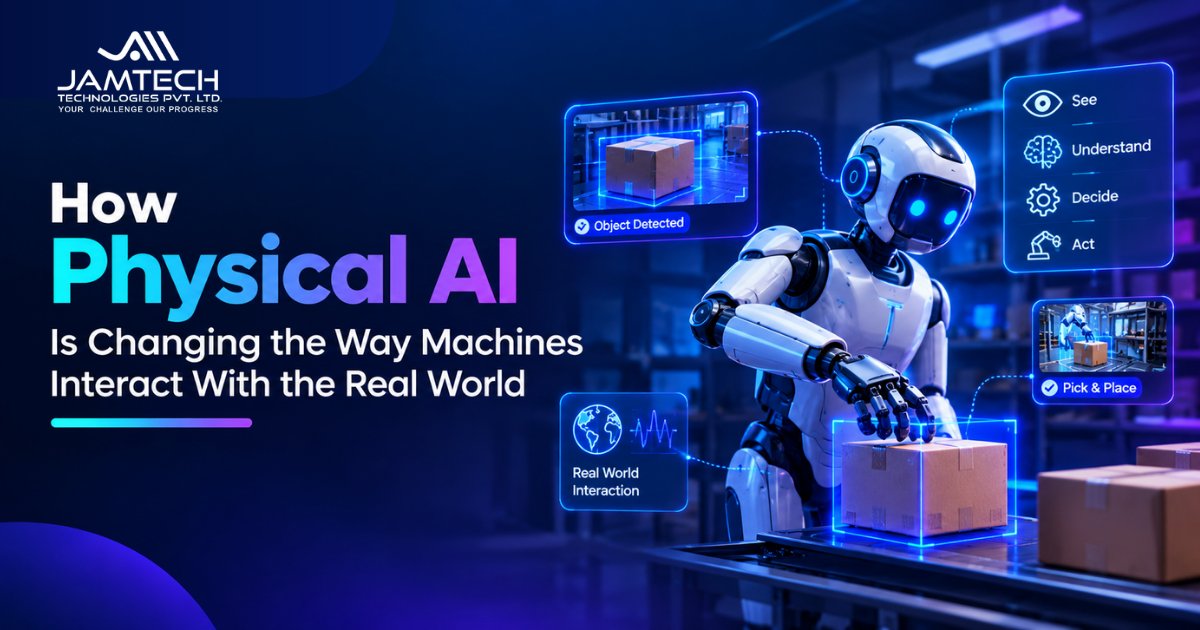
Physical AI brings artificial intelligence into machines that can see, understand their surroundings, make decisions, and act in the physical world.

What Is Physical AI?
Most of the AI people use today lives on a screen. You type a question, upload a document, generate an image, or ask an AI system to complete a digital task.
Physical AI works differently.
It gives AI a way to interact with the physical world. A robot can use cameras and sensors to understand where objects are, decide what to do, and control its movements. The same idea can apply to autonomous vehicles, industrial machines, warehouse systems, and other equipment.
NVIDIA describes physical AI as systems that can perceive, reason, and act in the real world. Its 2026 robotics work combines foundation models with simulation and hardware for this purpose.
The important change is that intelligence is no longer limited to generating an answer. The system has to make that answer useful through physical action.
Why Physical AI Is Getting More Attention
Robotics has existed for decades. Industrial robots have been moving parts, welding components, and performing repetitive tasks for a long time.
The difference today is the software controlling these machines.
Traditional automation usually depends on carefully defined instructions. Physical AI aims to make machines more adaptable. Instead of programming every possible movement, developers can train models to interpret visual information, understand tasks, and respond to changes around them. In some systems, AI Voice Agents can also support how people interact with these machines, allowing users to give spoken instructions or receive updates through natural conversations.
That is especially useful in environments where objects, people, or workflows do not always stay in exactly the same position.
NVIDIA's 2026 work shows how this approach is expanding. Its physical AI stack includes Cosmos world models, Isaac simulation tools, and GR00T models designed for robot learning and control.
The Role of World Models and Simulation
Training a robot entirely in the real world is expensive and slow.
A robot needs to encounter enough situations to learn what works, what fails, and how its actions affect its surroundings. Some mistakes are also too costly or dangerous to make repeatedly on a factory floor.
This is where simulation becomes important.
Developers can create virtual environments where robots can practice tasks, generate training data, and test different behaviors. World models can help represent how objects and environments may change after an action.
NVIDIA's 2026 physical AI work puts significant emphasis on this simulation-first approach, including digital twins and synthetic data for testing robots before deployment.
The idea is simple: let the machine learn more of the difficult lessons in a controlled environment before asking it to perform the same task around real people and equipment.
Where Physical AI Is Being Used
1. Manufacturing
Factories are one of the clearest places for physical AI because many tasks happen in structured environments.
Robots can move components, handle materials, inspect products, or support assembly operations. Figure reported that its Figure 02 robot operated on an active BMW assembly line and contributed to the production of more than 30,000 vehicles. In June 2026, Figure announced that its newer Figure 03 had returned to the same plant for a more complex sequencing workflow.
2. Warehousing and logistics
Warehouses present a harder problem because inventory, people, carts, and routes can change throughout the day.
Physical AI can help robots respond to those changes instead of relying entirely on fixed paths and instructions. Current development includes autonomous forklifts, mobile robots, and humanoids being tested for logistics workflows.
3. Autonomous vehicles
Cars and other vehicles also need to understand their surroundings and make decisions in real time.
Here, physical AI involves cameras and other sensors, models that interpret the environment, and systems that translate those decisions into vehicle control. NVIDIA's 2026 model work includes separate physical-AI systems for autonomous driving.
4. Healthcare robotics
Healthcare is another area where physical AI is being explored, although the requirements are much stricter.
Robotic systems can assist with tasks involving imaging, surgery, and other medical workflows. Simulation and extensive testing are particularly important because mistakes in these environments can have serious consequences. NVIDIA's 2026 healthcare robotics work includes simulation and training workflows for surgical systems.
What Still Needs to Be Solved
The progress is real, but physical AI has a much harder testing environment than software.
A chatbot can produce a wrong answer that a user ignores. A physical machine can drop an object, damage equipment, or collide with someone.
That makes reliability and safety central to deployment.
Robots also have to deal with situations that were not present in their training data. Lighting can change. Objects can be moved. A person can suddenly enter the robot's path. Materials can behave differently than expected.
Recent developments show that safety remains an active engineering problem. Agility Robotics, for example, introduced Digit 5 in September 2026 with systems designed to allow closer operation around people, based on experience from commercial deployments.
Is Physical AI Ready for Everyday Use?
In some settings, yes. In others, it is still being tested.
The strongest early cases are environments where the task is valuable, repeatable, and measurable. Factories and logistics facilities are easier to manage than an unpredictable home filled with different objects, people, pets, and layouts.
That distinction matters when looking at humanoid robot demonstrations. A robot successfully completing one task does not mean it can reliably handle every task in a general environment.
The next stage of physical AI will depend on how well these systems perform outside controlled demonstrations and across longer periods of real operation.
What Comes Next for Physical AI?
The interesting part of physical AI is not simply the arrival of humanoid robots.
The larger shift is toward machines that can interpret their surroundings and make decisions instead of following only fixed instructions.
As models improve and simulation becomes more useful, developers can train robots on more varied situations before deployment. Hardware is improving at the same time, giving those models better sensors, computing power, movement, and control.
That combination is what makes physical AI worth watching.
The technology still has practical limits, especially around safety, reliability, cost, and generalization. But the development work has moved beyond laboratory demonstrations into factories, warehouses, autonomous systems, and other real environments.
Frequently Asked Questions
Q1: What is physical AI?
Physical AI refers to AI systems that can perceive and respond to the physical world through robots, vehicles, machines, or other connected hardware.
Q2: How is physical AI different from generative AI?
Generative AI mainly creates or processes digital content such as text, images, audio, or code. Physical AI connects intelligence with systems that can sense their surroundings and take physical actions.
Q3: Are humanoid robots the same as physical AI?
No. Humanoid robots are one application of physical AI. The broader field also includes industrial robots, autonomous vehicles, mobile robots, robotic arms, and other intelligent machines.
Q4: Why are world models important for physical AI?
World models can help represent and predict how environments may change after an action. This can support robot training, simulation, and testing before systems operate in the physical world.
Q5: Is physical AI being used commercially?
Yes. Physical AI is already being tested and deployed in areas such as manufacturing and logistics, although many applications remain limited to specific tasks and controlled environments. Figure, for example, has reported deployments at BMW, while Agility has reported commercial Digit operations.
Ready to grow your business with Jamtech?
Talk to our experts about your next digital project.