



What Is an AI Voice Agent and How Does It Work?
An AI voice agent hears a caller, decides what to say with a language model, and replies aloud. Here is how each part works today.

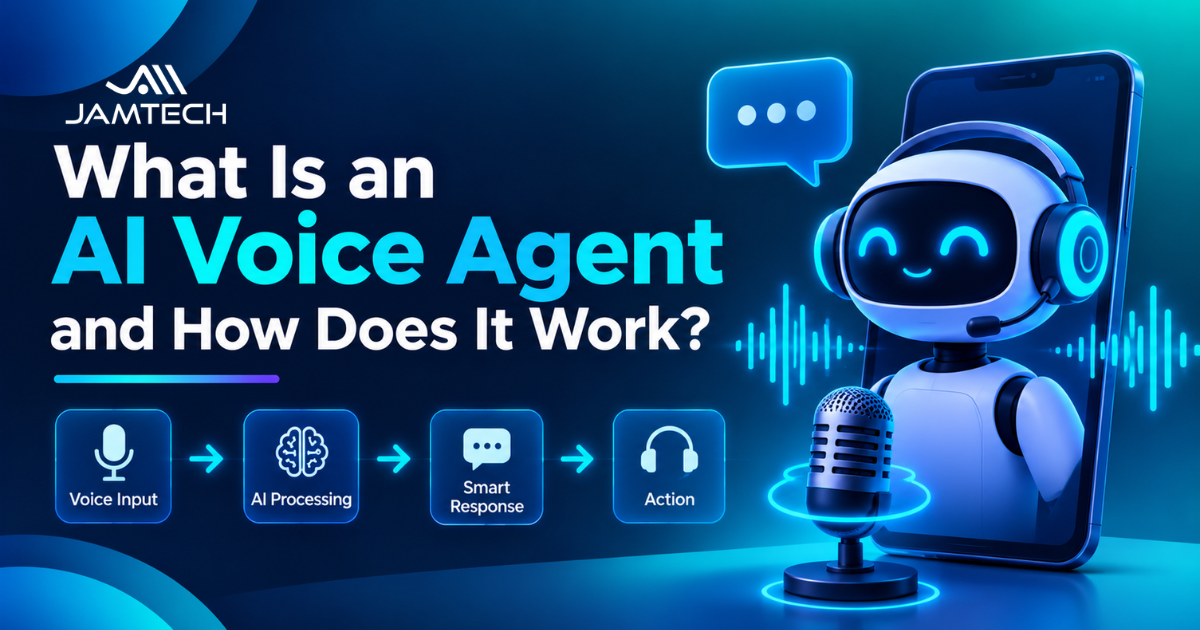
What is an AI voice agent?
A voice agent is a conversational system built for speech instead of typing. Unlike a recorded phone menu, it does not ask callers to press 1 or 2. The caller says what they want in their own words, and the agent works out the request, looks up information or takes an action, and answers in a natural voice.
Voice agents are one product of what AI development means in practice: models, data and software working together to do a defined job. The job here is a phone conversation.
Typical tasks today include answering questions about orders, hours or policies, booking and rescheduling appointments, qualifying leads, and sending reminders. An agent suits calls that are short, repeated and have a clear goal. It is weaker when the caller is upset, the case is unusual or the rules are unclear, and those calls need a person.
How does an AI voice agent work?
Most voice agents run the same loop on every turn of the call:
The telephony layer connects the call and streams the caller's audio to the system.
Speech-to-text (STT), also called automatic speech recognition, turns the audio into text as the caller speaks.
A large language model (LLM) reads that text, the conversation so far and your business rules, then decides what to say. It can call tools such as a calendar or order system, and it can pull answers from your documents.
Text-to-speech (TTS) converts the reply into audio and plays it to the caller.
Two more parts sit around the loop. Turn detection, also called endpointing, decides when the caller has finished speaking. Barge-in lets the caller interrupt, so the agent stops talking and listens. Teams underrate both. A poor endpoint cuts callers off mid-sentence or leaves dead air, and a poor barge-in makes the agent talk over people.
Is an AI voice agent the same as an AI agent?
Not exactly. An AI agent plans steps and uses tools toward a goal, whatever the channel. A voice agent is a conversational system whose channel is a phone call. One that only answers questions behaves like a chatbot with a voice. One that books slots and updates records behaves like an agent. For the wider idea of planning and tool use, read AI agents explained.
Cascaded or speech-to-speech: which design should you pick?
The four-step loop above is a cascaded design. Some providers now offer realtime speech-to-speech models that take audio in and return audio out, with no separate text steps. The trade-off is control. Speech-to-speech can sound more natural and respond faster, but you get less say over exact wording, and transcripts are harder to log and audit. A cascaded design lets you swap each part and inspect every step. For calls where exact wording matters, such as pricing, consent or health information, start with cascaded.
Why does response speed matter so much on a call?
People expect fast turns. A 2009 study in PNAS by Tanya Stivers and colleagues compared conversations in ten languages and found that speakers everywhere avoid overlapping talk and keep the silence between turns short. A voice agent that pauses for two seconds feels broken even when its answer is right.
A practical design target is a first spoken reply within about one second of the caller finishing. That is a working goal from build experience, not a published standard. Delay adds up across STT, the LLM, any tool call, TTS and the network, so measure each stage separately. Stream the reply so speech starts before the full answer is written, keep the instructions short, limit tool calls per turn, and host the system in a region close to your callers.
How is an AI voice agent different from an IVR phone menu?
An interactive voice response (IVR) system is the classic “press 1 for billing” menu. It works when the choices are few and fixed. It fails when the caller's need does not fit a menu item, and those callers press 0 or hang up. A voice agent accepts open speech, so the caller can say “I want to move my appointment to Friday” and be understood. The full comparison is in voice AI versus IVR, which covers cost, accuracy and migration steps.
IVR still has a place. A simple two-option routing menu is cheaper to run and easier to audit, and a keypad is a sensible way to enter a card number. A mixed setup is common: the agent handles open requests and hands the keypad steps to the IVR.
The switch rarely happens in one step. Keep the IVR for identity checks and payments at first, and put the agent in front for open requests. Review your IVR call logs to find the callers who press 0 for an operator. Those calls show where the menu fails, and they make a good first job list for the agent. The two systems can run side by side for weeks, so you can compare completion rates on the same call type.
What can an AI voice agent do for a business?
Voice agents earn their place on high-volume, low-complexity calls. The usual starting points are:
Inbound questions about orders, opening hours and policies
Booking, confirming and rescheduling appointments
Qualifying leads and passing the good ones to sales
Reminder and follow-up calls
After-hours coverage, with a clear handoff the next morning
The detailed examples are in voice agent use cases, with the call flows that tend to work. Pick one call type for your first release. Appointment confirmation is a good choice because the goal is narrow, the script is short and success is easy to measure.
A confirmation call for a clinic or salon shows the pattern. The agent greets the caller, says it is an AI assistant, reads back the booking and asks whether the time still works. If it does not, the agent offers two other slots. If the caller asks about anything else, such as a price or a complaint, it says it will pass the call to staff and transfers with a short summary. Keep the list of things the agent may not do as clear as the list of things it may. Medical advice, large refunds and legal questions belong with people.
Should you start with a voice agent or a chatbot?
Start where your customers already are. If most contact comes by phone, voice comes first. If most comes through your website, chat is the lower-risk start. Voice adds difficulties that chat does not: accents, background noise, names, long numbers, and callers who switch between Hindi and English mid-sentence. Test on recordings of your real callers, not on clean studio audio.
Look at your call and chat volumes by hour. If phone calls cluster outside office hours, missed calls cost you most, and a voice agent pays back fastest there. If callers mostly ask the same ten questions, a chatbot or a better web FAQ may remove those calls before they happen. Voice also costs more per interaction than text, because speech recognition and speech synthesis run on every turn. Add voice for the call types where typing is not an option, such as drivers, field staff and customers who simply prefer to phone.
If your visitors mostly type, adding an AI chatbot to your website is the easier first step, and the knowledge base you prepare for it can feed a voice agent later. The content work is the same: one current answer for each topic.
Should you use a platform or build a custom voice agent?
The build-or-buy question turns on three facts: how many minutes you expect each month, how many systems the agent must touch, and how sensitive the calls are. Write these three answers down before you talk to any vendor, because each one changes the quote you will get. Mark the answer you are least sure of, since that is where a pilot teaches you the most. Low volume, one system and routine content point to a platform. High volume, several systems or sensitive content point to a custom build. You can also start on a platform to learn what callers ask, then move to a custom build with real call data to guide the design.
A hosted platform gets a first agent on a number fastest. It bundles telephony, speech and a workflow builder, and it suits simple call types and pilots. The trade-offs are per-minute pricing that grows with volume, limited control over voice and flow, and unclear data location. A comparison of voice agent platforms lists what each one covers.
Before you commit to a platform, make three test calls from a mobile phone on a weak connection. Check whether the agent copes with a caller who talks over it, whether it can transfer to a real phone number with context, and whether you can export full recordings and transcripts. Ask where audio is stored and for how long. A platform that cannot answer the last question is a risk under the data rules covered later in this guide. Also ask how the platform handles a failed call, such as a dropped line or a speech model outage, and whether a fallback number rings your team.
A custom build makes sense when the agent must read and write to your CRM, support several Indian languages, keep recordings in a chosen region, or run at a volume where per-minute fees hurt. It costs more to start and needs engineers to maintain it, including model updates and speech tuning as your callers change. It also lets you choose the voice, the pace and the exact wording of the greeting, which matters when the call represents your brand. Teams with those needs often work with a partner for voice bot development instead of bending a no-code tool.
To estimate running cost, add up the per-minute rates for telephony, STT, the LLM and TTS, then multiply by call minutes. Use each provider's live price page, since rates change. Compare options by cost per resolved call, which is monthly cost divided by calls finished without a person.
How do you test a voice agent before it takes real calls?
Run a listening test on 20 calls before launch. Write 20 scenarios from your real call logs, with consent for any recordings you use. Make five plain calls, five with noise or strong accents, five where the caller interrupts or changes their mind, and five outside the agent's scope. Place each call yourself and listen to the full conversation.
Score each call on five points: task completed, wrong information given, awkward pause, cut off mid-sentence, and handoff worked. Set the pass bar first, for example no wrong information and a working handoff on every call. Fix the problems and re-run all 20, because a change that helps one call often hurts another.
Then pilot with a small share of live calls, keep a person ready to take over, and read transcripts daily for the first two weeks. Real callers ask things your 20 scenarios missed, and those become the next test calls.
What rules apply to AI voice calls?
Tell callers they are speaking with an AI, and offer a way to reach a person. Rules on recording and outbound calls vary by country, so confirm them with a legal adviser before launch.
Two examples show the direction. On 8 February 2024, the US Federal Communications Commission ruled that AI-generated voices count as “artificial” under the Telephone Consumer Protection Act, so US calls that use them need the called party's consent. In India, the Digital Personal Data Protection Rules were notified in November 2025, with most duties applying 18 months later. A call recording that identifies a person is personal data, so plan the notice and consent wording now. Check the telecom rules for outbound calling in each market too.
How do you choose a voice agent partner?
Ask for a live call to a demo number, not a polished recording. Ask how the handoff works, how they test with accented and noisy audio, and who owns the recordings and transcripts. When you compare voice agent companies, a vendor that cannot show a test process is selling a demo.
Jamtech Technologies publishes this guide and offers voice agent development, so weigh that when you read our advice. The checks above apply to any vendor, including us.
Frequently asked questions
Q1. What is an AI voice agent in simple words?
An AI voice agent is software that talks with callers like a person would. It listens, understands the request, and replies in a natural voice. It can answer common questions, book appointments and pass difficult calls to staff, so your team handles fewer repetitive calls.
Q2. How does an AI voice agent understand what I say?
It converts your speech to text with speech recognition, then a language model works out the meaning and the next step. A text-to-speech engine speaks the reply. Turn detection decides when you have finished talking, which affects whether the agent feels natural or cuts you off.
Q3. Is an AI voice agent the same as a voice bot?
The terms overlap, but voice bot often means an older, scripted system, while an AI voice agent uses a language model and handles open speech. Scripted bots follow fixed paths and fail on unexpected wording. Agents cope better with varied phrasing, though they need testing for wrong answers.
Q4. How is an AI voice agent different from IVR?
IVR is a menu where callers press keys or say set phrases, while a voice agent understands free speech. A caller can state the need in their own words instead of navigating options. IVR is cheaper for tiny, fixed menus, so many businesses run both together.
Q5. How fast should an AI voice agent respond?
Aim for a first spoken reply within about one second after the caller stops talking. This is a practical build target, not a published standard. Longer pauses make callers repeat themselves or hang up, so measure speech recognition, the model, tool calls and speech output separately.
Q6. Can an AI voice agent make outbound calls?
Yes, but outbound calls carry legal duties. In the US, the FCC ruled on 8 February 2024 that AI-generated voices are artificial under the TCPA, so consent rules apply. India has its own telecom and data rules, so confirm consent, calling windows and disclosure with a legal adviser first.
Q7. Does an AI voice agent work in Hindi and other Indian languages?
It can, but quality depends on the speech models behind it and varies by language and accent. Mixed Hindi and English speech is a known weak spot. Test any agent on recordings of your own callers before you commit, and check which languages the vendor supports in production.
Q8. Can an AI voice agent transfer a call to a human?
Yes, and it should. A good handoff transfers the call to a real phone number and passes a short summary so the caller does not repeat themselves. Set clear triggers, such as two failed attempts, an angry caller, or topics like refunds and legal questions.
Q9. How accurate are AI voice agents?
Accuracy depends on the audio quality, the language, the content behind the agent and how well it was tested. No fixed figure applies to every deployment. Measure your own: the share of calls completed correctly, the rate of wrong information, and the share handed to staff.
Q10. How much does an AI voice agent cost?
Cost comes from per-minute charges for telephony, speech recognition, the language model and speech output, plus setup and maintenance. Use each provider's live price page, since rates change. Compare options by cost per resolved call, which is monthly cost divided by calls finished without a person.
Q11. Do callers have to be told they are talking to an AI?
Tell them anyway. Disclosure builds trust and reduces complaints, and some rules require it, depending on the country and the type of call. Say it in the greeting, such as “I'm an AI assistant”, and offer a way to reach a person at any point.
Q12. Are call recordings from an AI voice agent personal data in India?
A recording that identifies a person is generally personal data. India's Digital Personal Data Protection Rules were notified in November 2025, with most duties applying 18 months later. Plan a notice and consent wording, decide how long to keep recordings, and ask a legal adviser to review them.
Q13. How long does it take to set up an AI voice agent?
A pilot on a hosted platform can run in days to a few weeks, while a custom build with CRM integration takes longer. Most of the time goes into scripts, content and testing, not the technology. A 20-call listening test before launch catches most early problems.
Q14. What should I test before launching a voice agent?
Test plain calls, noisy calls, interruptions and out-of-scope questions, and check the handoff on each. Listen to full conversations, not only transcripts, because pauses and cut-offs show up only in audio. Set a pass bar first, then re-run every test after each change.
Ready to grow your business with Jamtech?
Talk to our experts about your next digital project.