


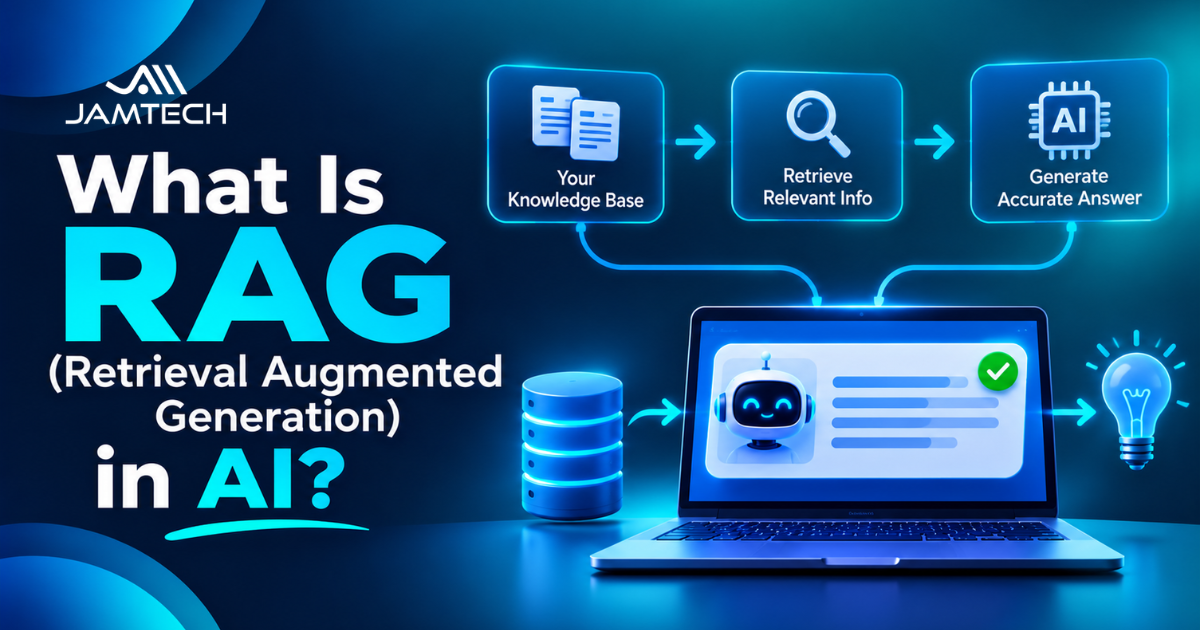
What Is RAG (Retrieval Augmented Generation) in AI?
RAG lets an AI model search your own documents before it answers. Here is how it works, where it fails, and how to test it.

What is RAG in simple words?
RAG works like an open-book exam for an AI model. A plain language model answers from what it learned in training, which may be out of date and has never included your internal files. A RAG system hands the model the right pages at the moment of the question, so it can read before it answers.
The name describes the three parts. Retrieval finds the relevant text. Augmented means that text is added to the prompt. Generation is the model writing the reply. Patrick Lewis and colleagues set out the idea in a 2020 paper, “Retrieval-Augmented Generation for Knowledge-Intensive NLP Tasks”, presented at NeurIPS.
If the wider topic is new to you, read what generative AI is first and then come back here. RAG is one way to make that technology dependable on your own content.
RAG does not retrain the model. It changes what the model sees. That is why it is the usual first choice when answers must reflect policies, prices or documents that change. In most setups the documents also stay in a store you control, and you can delete or replace any of them without touching the model, which makes corrections quick and cheap.
How does RAG work step by step?
A RAG system has two phases: preparing the knowledge, and answering each question.
In preparation, you collect the documents, such as help pages, manuals, contracts and tickets. Each document is split into chunks, usually a few paragraphs long, so that one chunk covers one idea. An embedding model then turns each chunk into a list of numbers, called an embedding, that captures its meaning. Chunks with similar meaning get similar numbers. The embeddings are stored in a vector database, which is a database built to find the closest matches quickly. Several products can do this job, and the right one depends on your data size, hosting rules and budget. A comparison of vector database options covers the trade-offs.
Chunk size is a real design choice. Very small chunks lose context, and very large chunks bury the answer among unrelated text. Start with a few paragraphs, split at headings, write tables out as sentences, and adjust after testing. Keep the document title and section heading with each chunk, so the source stays clear.
When a user asks a question, the system converts it into an embedding and asks the database for the closest chunks. Many systems also run a keyword search, such as the BM25 ranking method, and merge the two result lists. Keyword search catches exact terms like product codes that meaning-based search can miss. A reranker, which is a smaller model that scores each candidate against the question, then keeps the best few.
The chosen chunks go into the prompt with instructions such as: answer only from these passages, and say so if the answer is not there. The language model writes the reply and, ideally, names the source of each claim. Show those sources to the user. They let people check the answer, and they help you debug the system.
Real systems add more parts: access control so that people retrieve only documents they may see, caching, logging and evaluation. The full breakdown of a RAG architecture shows how the pieces fit together.
What is RAG used for in business?
RAG suits any job where the answer lives in documents that change. Common examples include support assistants that answer from a help centre, internal search for HR, IT and sales teams, policy and compliance lookup with citations, contract review against standard clauses, and question answering over technical manuals for engineers.
A good first use case has a closed set of source documents and questions that repeat. Someone should also be able to check an answer against its source in seconds. Poor fits include questions that need calculations across many records, which a database query handles better, and open-ended creative work where no source text exists.
Take a support assistant for an online shop. A customer asks whether a laptop bag fits a 16-inch laptop. The system retrieves the product page and the sizing guide, the model compares the dimensions, and the reply cites both pages. If the product page is out of date, the answer is wrong. That is why document ownership matters as much as the model. The same pattern holds for HR policies, IT runbooks and sales playbooks: the answer is only as good as the page it came from, and someone must own that page.
The collection of RAG use cases gives worked examples with the document types each one needs. Read one close to your own team before you plan anything, because the documents decide the project more than the model does.
Why does a RAG system still give wrong answers?
RAG lowers the chance of invented answers but does not remove it. Most failures come from retrieval, not from the model. The right passage was never found, or the chunking cut it in half, or an outdated copy outranked it. When the wrong passage reaches the model, it writes a fluent answer from the wrong text.
Chunking is the usual culprit. A chunk that says “the limit is 5,000 rupees” without naming the product it belongs to is useless on its own. Anthropic described this problem in September 2024 and proposed adding a short note of context to each chunk before indexing. In its own benchmarks, the method combined with keyword search cut failed retrievals by 49 percent, and adding reranking cut them by 67 percent. Those are results on the company's test sets, so treat them as a direction and not a promise for your documents.
Adding more text to the prompt does not fix weak retrieval. A 2023 study by Nelson Liu and colleagues, later published in Transactions of the Association for Computational Linguistics, found that models often use information at the start or end of a long input better than information in the middle. Fewer, better chunks beat many mediocre ones.
One check saves weeks: test retrieval on its own before you judge the answers. Write 30 real questions. For each, note the page that should come back. Run only the search step, and record whether that page appears in the top five results. The share that does is your hit rate. If the hit rate is low, no prompt will fix the answers, so repair chunking, titles, metadata and duplicate documents first. Then score full answers as correct, partly correct or wrong, and set the pass bar before you start.
Freshness matters as much as search. Put a review date on every document, remove old versions from the index, and re-index when policies change. A RAG system quotes whatever it finds, including last year's price list.
Security needs a note too. A retrieved document can contain hidden instructions, either by accident or on purpose, such as a web page that tells the model to ignore its rules. Treat retrieved text as material to read, never as commands to follow. Keep the model's permissions narrow, and do not let it send emails or change records on the strength of a retrieved passage.
Should you use RAG, fine-tuning or a long prompt?
Use RAG when facts change or answers must cite a source. Use fine-tuning to change style or behaviour on a narrow, repeated task with many good examples. Use a long prompt when the whole source is small enough to fit and volume is low. It needs no search system, but cost and delay grow with every question, because the full text travels each time. Many production systems combine RAG with careful prompts and add fine-tuning only for a specific gain. A sensible order is to try a clear prompt first, add retrieval next, and consider fine-tuning only when a measured gap remains after the first two.
How do you start a RAG project?
Treat it as a normal AI project. The same AI development process of scoping, data preparation, build, testing and release applies, and most of the effort goes into the data steps.
Start with one document set and one audience, such as the support team and the help centre. Clean the documents first. Build a thin version that retrieves and answers, then run the hit-rate test above. Add access control and logging before real users arrive. Pilot with 10 to 20 people, and review every failed question each week. Each failure points to a fix in chunking, content or instructions. Give users a thumbs-down button and a “wrong source” flag, so the failures reach you without a survey.
Check the data rules early. If your documents contain personal data, India's Digital Personal Data Protection Rules, notified in November 2025, apply to how you store and retrieve it, and most duties start 18 months later. Decide who may retrieve what, how long you keep logs, and how a person's data is removed from the index.
Running cost has five parts: embedding the documents, storing them, the search service, any reranker, and the language model's cost for each answer. Use each provider's live price page, then divide the monthly total by the questions answered correctly. That figure, cost per good answer, compares options better than the monthly bill. Teams that need access control, several data sources and a tuned retrieval flow often work with a partner to build a custom RAG pipeline instead of assembling one from a template.
Decide what success looks like before the pilot starts. Write down the hit rate you need, the share of answers that must be correct, the response time users will accept, and the point at which you stop or change course. A pilot with no stated exit criteria tends to drift, because every result can be read as progress.
How do you choose a RAG partner?
RAG projects fail less often on technology than on ownership. Name one owner for the documents and one for the system, and decide who signs off on answers. Without those names, nobody fixes the stale price list. Also ask who handles the weekly review of failed questions, since that routine is what keeps answer quality from slipping after launch. A written list of who does what, and how often, is worth more than any tool you buy.
Ask any vendor to run the hit-rate test on a sample of your own documents and show the result. A demo on the vendor's sample files proves little. Ask how they handle access control, how updates reach the index, who owns the index and the logs, and what happens when you switch the language model. When you compare RAG development companies, a vendor that cannot answer those questions has built a demo, not a system.
Jamtech Technologies publishes this guide and offers RAG development, so weigh that when you read our advice. The checks above apply to any vendor, including us.
Frequently asked questions
Q1. What is RAG in AI?
RAG, short for retrieval augmented generation, is a method where an AI model searches your documents for relevant passages and answers from them. The retrieved text is added to the prompt before the model writes its reply. This keeps answers tied to current content and lets the system point to its sources.
Q2. How does RAG work in simple terms?
Your documents are split into chunks and stored by meaning in a vector database. When someone asks a question, the system finds the closest chunks, adds them to the prompt, and the model answers from them. A good system also shows the sources so people can check the reply.
Q3. What does RAG stand for?
RAG stands for retrieval augmented generation. Retrieval means finding relevant text, augmented means adding that text to the prompt, and generation means the model writing the answer. The term comes from a 2020 research paper by Patrick Lewis and colleagues, presented at the NeurIPS conference.
Q4. What is the difference between RAG and fine-tuning?
RAG fetches information from your documents at question time, while fine-tuning trains the model further to change its behaviour or style. RAG suits facts that change, such as prices and policies. Fine-tuning suits narrow, repeated tasks with many good examples. Many systems start with RAG alone.
Q5. Does RAG stop AI hallucinations?
RAG reduces them but does not remove them. The model can still misread a passage, or retrieval can return the wrong one. Instruct the model to answer only from the retrieved text, show sources, and test on real questions. Keep a person in the loop for high-risk answers.
Q6. What is a vector database in RAG?
A vector database stores embeddings, which are lists of numbers that capture the meaning of each text chunk, and finds the closest matches to a question quickly. It lets a RAG system search by meaning instead of exact words. Many systems add keyword search alongside it.
Q7. What is chunking in RAG?
Chunking is splitting documents into smaller pieces, usually a few paragraphs, so each piece covers one idea. Poor chunking is a common cause of wrong answers, because a piece cut off from its context may not make sense on its own. Splitting at headings and keeping titles with each chunk helps.
Q8. When should I use RAG instead of a long prompt?
Use RAG when your source material is too large to fit in a prompt, changes often, or must be cited. A long prompt works for small, stable sources at low volume, but the full text is sent with every question, so cost and delay grow as usage rises.
Q9. How do I test a RAG system?
Test retrieval first. Write about 30 real questions, note the page that should come back for each, and check how often it appears in the top five results. Then score full answers as correct, partly correct or wrong against a pass bar you set beforehand, and re-run after each change.
Q10. What are the best use cases for RAG?
RAG fits jobs where answers live in documents that change, such as support assistants, internal knowledge search, policy lookup with citations and technical manual question answering. Start with a closed document set and repeated questions, where someone can check an answer against its source in seconds.
Q11. Can RAG work with private company data?
Yes, that is one of its main uses. Keep documents in a store you control, apply access control so people retrieve only what they may see, and check how any model provider handles your inputs. If documents contain personal data, plan for India's data protection duties as well.
Q12. How much does a RAG system cost?
Cost has five parts: embedding the documents, storing them, the search service, any reranker, and the model's cost for each answer, plus build and maintenance effort. Use each provider's live price page. Compare options by cost per good answer rather than the monthly bill alone.
Q13. How long does it take to build a RAG chatbot?
A basic prototype on one document set can run in days, while a production system with access control, evaluation and several data sources takes longer. Most of the time goes to cleaning documents and testing retrieval, not to the model. Scope the first version to one audience.
Q14. Is RAG the same as a chatbot?
No. A chatbot is the chat interface, while RAG is a technique that lets it answer from your documents. A chatbot can run without RAG, using only the model's training or fixed flows. A RAG chatbot adds retrieval so replies reflect your current content and can cite sources.
Ready to grow your business with Jamtech?
Talk to our experts about your next digital project.