

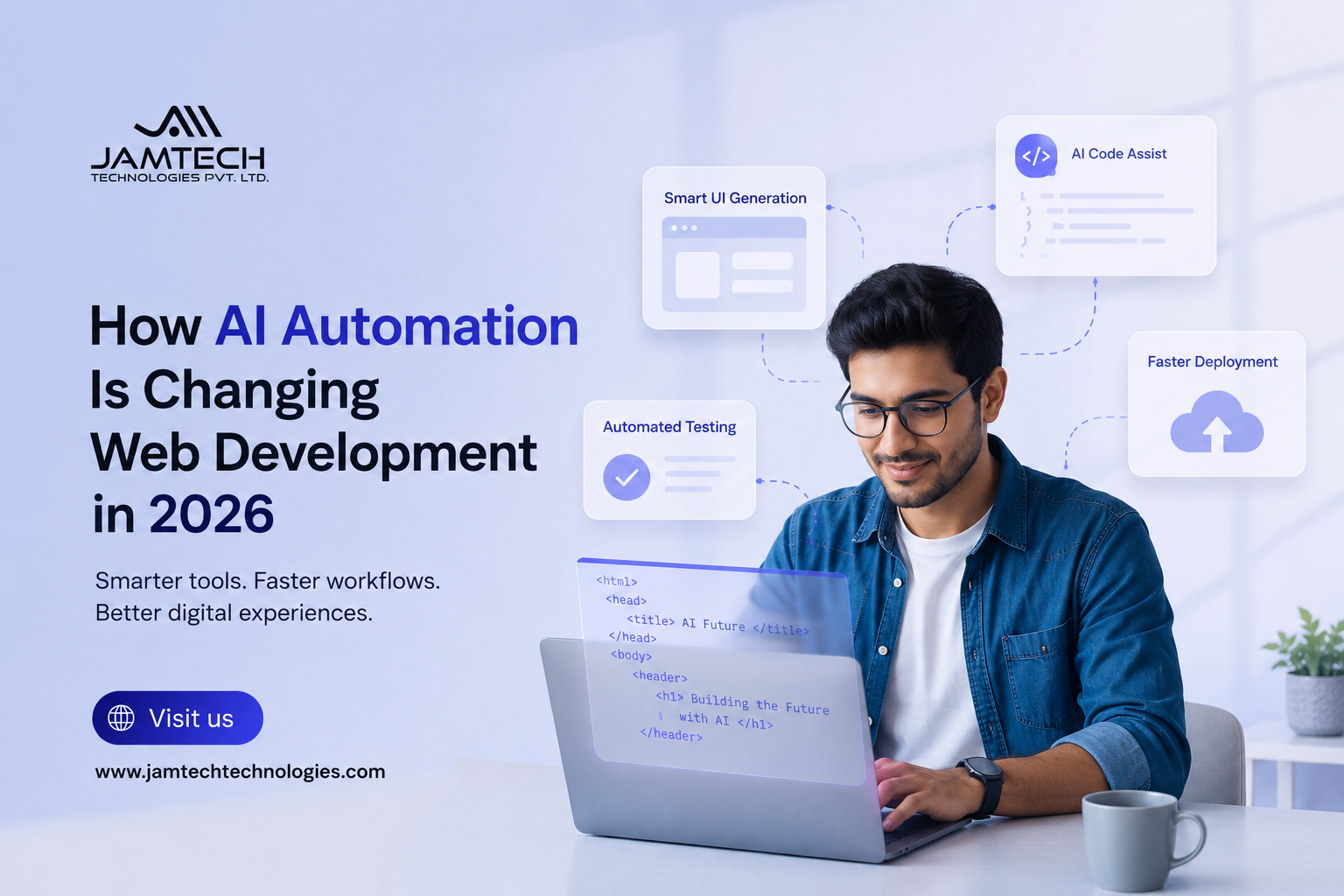
How AI Automation Is Changing Web Development in 2026

Introduction
If you are a startup founder or business owner planning a new website, you have probably heard that AI is changing how websites get built. But what does that actually mean for your project?
AI automation in web development means using artificial intelligence tools to help write code, design pages, test for bugs, and launch websites faster. These tools work alongside human developers, not instead of them. The result is a development process that moves quicker and catches problems earlier.
For founders without a technical background, this matters because it directly affects your timeline, your budget, your product quality, and your ability to compete. This guide explains what AI does in web development today and what you should look for in a development partner.
What AI Automation Means For Web Development
AI automation in web development is the use of artificial intelligence tools to handle repetitive and time-consuming tasks in the process of building a website or web application. Instead of a developer writing every line of code by hand, AI tools can generate code, suggest design improvements, run tests, and flag errors automatically.
Think of it this way: AI handles the routine work so that developers can focus on the parts that require creative thinking and business knowledge. The code still gets reviewed by a human before it goes live. The architecture (how the entire system is structured) still needs experienced decision-making. AI speeds up the work without removing the need for a skilled team.
This is the approach behind what some development companies call "AI-powered development." At Jamtech, that phrase refers to combining modern frameworks, cloud infrastructure, AI tools, and structured delivery processes to design, build, and ship digital products faster while keeping quality high and the system ready to scale. It applies across website development services and extends into mobile apps, AI features, and cloud infrastructure.
How AI Is Used In Web Development Today
AI tools have become part of the daily workflow for professional development teams. According to the Stack Overflow 2025 Developer Survey, 84% of developers are now using or planning to use AI tools in their work. They show up at every stage of a project, from the first lines of code to the final round of testing before launch.
Here is a closer look at where AI fits in.
Code Generation And AI Coding Assistants
AI coding assistants are tools that help developers write code faster. They work inside a developer's editor and suggest the next line of code, complete repetitive patterns, generate entire functions based on a short description, and even write basic tests.
GitHub Copilot is one well-known example. A developer types a comment describing what a piece of code should do, and the tool generates the code to match. Research published by GitHub found that developers using Copilot completed tasks 55% faster on average, while 87% reported that it preserved mental effort during repetitive work. This saves time on tasks that follow common patterns, like building forms or connecting to databases.
Developers still review every suggestion before accepting it. AI-generated code can contain errors or miss edge cases (unusual situations the code needs to handle). The value is speed on routine tasks, not replacing the developer's judgment.
AI-Driven Design And User Experience
AI is also changing how websites look and feel. Design tools powered by AI can analyze how visitors interact with a page and recommend layout changes that improve usability and conversions (the rate at which visitors take a desired action, like signing up or making a purchase).
Some platforms go further. They can generate a full website layout from a written description. A founder can describe their business and target audience, and the tool produces a starting design in minutes. Designers then refine that output to match the brand and meet specific business goals.
This approach works especially well for prototyping, which is the process of building a rough version of a product quickly to test an idea before investing in custom web development.
Automated Testing And Debugging
Every website needs testing before it launches. Traditionally, a QA (quality assurance) team would manually check pages across different browsers and devices, looking for visual glitches, broken buttons, slow load times, and performance problems. This process took days or weeks.
AI testing tools speed this up dramatically. They scan the entire site across browsers and screen sizes, identify bugs, flag accessibility issues (problems that make a site harder to use for people with disabilities), and predict where failures are most likely to happen.
The result is a more thorough review in less time. Developers spend their energy fixing real problems instead of searching for them.
AI Chatbots And Smart Features
Modern websites do more than display information. Many now include AI chatbots that answer customer questions, capture leads, guide visitors through a buying process, and schedule follow-ups, all without a human agent being available. Businesses across industries are finding that AI chatbot services improve daily operations by handling routine inquiries and freeing up staff for higher-value work.
What separates a useful chatbot from a frustrating one is how it is trained. Generic chatbots pull from broad data and often give irrelevant answers. Production-ready chatbots (the kind that actually work for a business) are trained on the company's own data. This includes product documentation, pricing, support history, and FAQs.
At Jamtech, AI Chatbot Integration Services build these kinds of systems. The process uses techniques like LLM fine-tuning (adjusting a large language model to specialize in your business) and RAG, which stands for Retrieval-Augmented Generation. RAG lets the chatbot pull answers from your private documents and knowledge base instead of guessing. The result is a chatbot that gives accurate, brand-specific responses and hands off to a human agent when it reaches its limits.
What Founders And Business Owners Should Know
Understanding how AI works in web development is useful. But as a founder, you also need to know how it affects your project timeline and your choice of development partner.
Here is what matters most when you are making decisions.
AI Does Not Replace Your Development Team
AI handles repetitive tasks well. Writing boilerplate code (standard code that repeats across projects), running test suites, scanning for accessibility issues, generating initial designs. These are areas where AI saves real time.
But your project also needs decisions that AI cannot make. What features should your MVP (minimum viable product) include? How should user data flow through the system? What security requirements apply to your industry? These questions require developers who understand your business goals and your users.
The real value is a team that knows how to use AI tools effectively within a structured development process. AI makes the team faster. It does not replace the team.
How AI Changes Project Timelines
One of the biggest practical benefits of AI-assisted development is compressed timelines. McKinsey's research on generative AI in development found that developers can complete coding tasks up to twice as fast with generative AI, with code generation tasks seeing a 35-45% reduction in time. Prototyping that used to take weeks can now happen in days. A first working version of your product reaches your hands sooner, which means you can test with real users and adjust before investing in full-scale development.
But speed alone does not guarantee quality. A fast prototype still needs proper code review and security testing before it goes to production (becomes a live product available to your users). The team's process matters as much as their tools.
Jamtech's delivery model is built around this balance. The consultation starts with requirement analysis, includes an NDA when needed, and produces a structured proposal with estimates, timelines, team profiles, and relevant case studies. The AI-assisted workflow compresses the building phase, but the planning and review phases stay thorough.
Questions To Ask Before Choosing A Development Partner
When you are evaluating development partners who claim to use AI in their workflow, ask specific questions. Vague claims about "using AI" tell you very little.
Here is a practical checklist:
What AI tools does your team use, and for what specific tasks? A clear answer names tools and describes where they fit in the workflow. A vague answer is a warning sign.
How do you review AI-generated code? Every AI output should go through the same code review and testing process as human-written code.
What security measures protect my data? Ask about certifications, deployment practices, data handling policies, and how they protect sensitive information during development.
Can you show past projects with results I can verify? Look for client references, case studies, or visible third-party ratings on platforms like Upwork, Google, or Trustpilot.
AI Web Development Use Cases By Industry
AI-powered web development applies differently depending on your industry. Here are examples across sectors where Jamtech has delivered projects.
Industry | AI Web Development Application |
|---|---|
E-Commerce and Retail | Personalized product recommendations that adapt to each visitor's browsing behavior, improving conversion rates. Jamtech builds AI-powered ecommerce platforms that integrate these capabilities from the ground up. |
Healthcare | AI chatbots built to meet HIPAA compliance requirements, handling patient inquiries while protecting sensitive health data |
FinTech and Banking | Fraud detection interfaces that flag suspicious transactions in real time and alert users before damage occurs |
EdTech and E-Learning | Adaptive learning platforms that adjust course content based on how a student performs, personalizing the education experience |
Marketing and Sales | AI-driven lead scoring and automated follow-up workflows that help sales teams focus on the highest-value prospects |
Each of these applications starts with a well-built website or web application as the foundation. The AI capabilities layer on top of solid architecture, not instead of it.
How To Get Started With AI-Powered Web Development
If you are ready to explore AI-powered web development for your project, here is a step-by-step path that keeps things practical.
Step 1: Define your project goals and core features. Before talking to any development partner, write down what your product needs to do. What problem does it solve? Who are your users? What does success look like for the first version? You do not need a technical spec. A clear description of the outcome you want is enough to start a productive conversation.
Step 2: Evaluate development partners who use AI in their workflow. Look for teams that can describe exactly how AI fits into their process. Ask the questions from the checklist above. Pay attention to whether they talk about AI as a tool within a larger process or as a magic solution.
Step 3: Ask about their tech stack and security certifications. A modern tech stack should include frameworks that support AI integration. Security certifications like ISO 9001:2015 for quality management and ISO/IEC 27001:2022 for information security show that the team follows established standards. The NIST AI Risk Management Framework provides a useful reference point for evaluating how a partner approaches AI governance and responsible deployment.
Step 4: Start with an MVP and scale from there. Do not try to build everything at once. Launch with the core features, get feedback from real users, and then expand. AI-powered development makes this iterative approach even more practical because each cycle moves faster. For teams building from scratch, innovative new website development paired with AI tools can compress the time from concept to a working MVP.
This is the process Jamtech follows with every project. The consultation starts with requirement analysis. If needed, an NDA is signed before sharing sensitive details. You then receive a detailed proposal with estimates, timelines, team CVs, and a clear scope of work so you know exactly what you are getting before work begins.
Why Jamtech Uses AI-Powered Development
Jamtech integrates AI into every phase of the development lifecycle. Design, development, QA, and deployment all benefit from AI-assisted workflows that reduce manual effort and catch issues earlier.
The technology stack includes modern frameworks like Laravel, ReactJS, NodeJS, and PHP on the development side, with AWS and Docker for cloud infrastructure. AI tools plug into this stack to accelerate code generation, automate testing, support smart features like chatbots, and power voice agent capabilities.
For AI-specific capabilities, Jamtech offers dedicated AI Chatbot Integration Services. This includes building production-ready chatbots with LLM fine-tuning, RAG for private data retrieval, secure private deployment, and MLOps (the practices for monitoring and optimizing AI systems in production).
Quality and security are backed by certifications: ISO 9001:2015 for quality management, CMMI Maturity Level 3 for process discipline, ISO/IEC 27001:2022 for information security management, and ongoing internal audits. These are not just badges. They represent tested, audited processes that apply to every project.
With a base in India and a branch in Austin, Texas, Jamtech provides support coverage across US and India business hours. AI systems like chatbots and voice agents run around the clock once they are live.
Conclusion
AI automation is making web development faster and more reliable. But the technology works best when guided by experienced developers who understand your business goals. The tools handle the routine work. The team handles the thinking.
For startup founders and business owners, the practical takeaway is this: AI does not change what you need (a well-built digital product), but it changes how quickly and efficiently you can get there. The right development partner combines AI tools with proven processes and a track record you can verify.
If you are planning a web project and want to see how AI-powered development works in practice, start with a conversation.
FAQ
Can AI build an entire website on its own?
AI tools can generate basic website layouts and code, but a production-ready website built for your specific business goals still needs experienced developers to handle custom functionality, security, integrations, and ongoing maintenance.
Is AI web development more expensive than traditional development?
AI-powered development often costs less overall because it compresses timelines and reduces manual work. The team delivers faster, which means fewer billable hours for the same result.
How do I know if a development company actually uses AI in their process?
Ask them to name the specific AI tools they use and show where AI fits in their workflow. Then ask how they review AI-generated code for quality and security.
Will AI replace web developers?
AI handles repetitive coding and testing tasks, but developers are still needed for architecture decisions, custom business logic, security, and project management. AI makes developers more productive, not redundant.
Is AI-generated code secure?
AI-generated code needs the same security review as human-written code. A good development partner runs AI output through code reviews, security scans, automated testing, and manual QA before deployment.
Ready to grow your business with Jamtech?
Talk to our experts about your next digital project.