


How Long Does It Take To Build An AI-Powered Application?
A plain-language guide for non-technical founders planning their first AI build, covering realistic timelines by scope and the phases that shape them.
Introduction
You are planning an AI-powered application, and the first thing you want to know is simple: how long will it take? The answers you find online are all over the place. One source says you can ship in a day, another says it takes the better part of a year.
Both can be true, because "an AI app" means very different things to different people. A quick demo and a secure system that serves real customers are not the same project. The honest answer depends on what your app must do and how ready your data is.
This guide gives you a clear, scope-based answer you can plan around. At Jamtech, we build production-grade AI on fast timelines. So we will show you where the time actually goes and how to keep your build on schedule.
The Short Answer: How Long It Takes To Build An AI-Powered Application
Most AI-powered applications take a few weeks for a prototype and a couple of months for a working first version. A production-ready or enterprise build runs several months. A simple, pre-configured AI feature can launch much faster than a custom, data-heavy system.
The gap comes down to scope. A chatbot you plug in with a ready-made model is quick. A custom system trained on your private data and wired into your other tools takes real engineering time.
Here is the reassuring part. When your scope is focused and your data is ready, a production build can ship in weeks, not months. The trick is knowing which kind of project you are actually starting.
What Counts As An AI-Powered Application?
An AI-powered application is software that learns from data and adapts its behavior, instead of only following fixed rules a developer wrote by hand. A regular app does exactly what it is told. An AI app can read a question, understand intent, and respond in ways that improve over time.
In most cases, AI is one part of a larger app rather than the whole thing. You still need a screen people use, a backend that stores information, and connections to your other tools. The AI adds a smart layer on top, such as a chat assistant, a voice agent, or an automation that handles repetitive work.
The biggest source of timeline confusion is the difference between a prototype and a production-ready build. A prototype is a rough demo meant to prove an idea works. A production-ready build is the version real customers can trust every day, and that difference is where most of the time goes.
AI App Development Timeline By Project Scope
Scope sets the timeline before anything else. The more your app must do, and the more reliable it has to be, the longer it takes. The table below shows the four common levels of scope and roughly how long each one runs.
Project Scope | What It Includes | Typical Time |
|---|---|---|
Prototype or proof of concept | A demo built on existing models with limited data, to prove an idea | A few weeks |
AI MVP | A first real version with core features for early users | A couple of months |
Production-ready application | A stable, tested build with integrations and monitoring | Several months |
Enterprise-grade application | A secure, compliant system built for large scale | The better part of a year, sometimes longer |
Prototype Or Proof Of Concept
A prototype exists to answer one question: does this idea actually work? It shows stakeholders and early users what the app could do, without the polish or reliability of a finished product.
Prototypes are fast because they lean on existing, pre-trained models and use a small slice of data. You are testing a concept, not building for daily use. Expect a few weeks of work.
Keep in mind that a prototype is not production-ready. It can break under real conditions, and it is meant to be replaced or rebuilt once the idea is proven.
AI MVP
MVP stands for minimum viable product. It is the first real version of your app, with just the core features early users need and nothing extra.
An MVP takes longer than a prototype because it has to work for actual people. That means bringing in real data, adding basic reliability so it does not fail during normal use, and setting up a way to collect feedback. Plan for a couple of months.
The goal of an MVP is to learn fast on a lean budget. You launch something useful, watch how people use it, then decide what to build next.
Production-Ready AI Application
A production-ready AI application is one your customers can rely on every day. For a non-technical reader, that means the app is stable, the AI gives consistent answers, and problems get caught before users ever see them.
Reaching this level adds real work. You need dependable models, connections to your existing systems, thorough testing, and monitoring that watches the app after launch. This usually takes several months.
This is Jamtech's core zone. We build production-grade AI on fast timelines. You get a system that is genuinely ready for customers, without waiting far longer than you need to.
Enterprise-Grade AI Application
An enterprise-grade application carries the heaviest requirements. It has to pass security reviews, meet compliance rules, handle large numbers of users at once, and stay maintained for the long term.
All of that pushes the timeline the longest, often the better part of a year or more. The extra time buys the safeguards a large organization needs before it trusts AI with sensitive work.
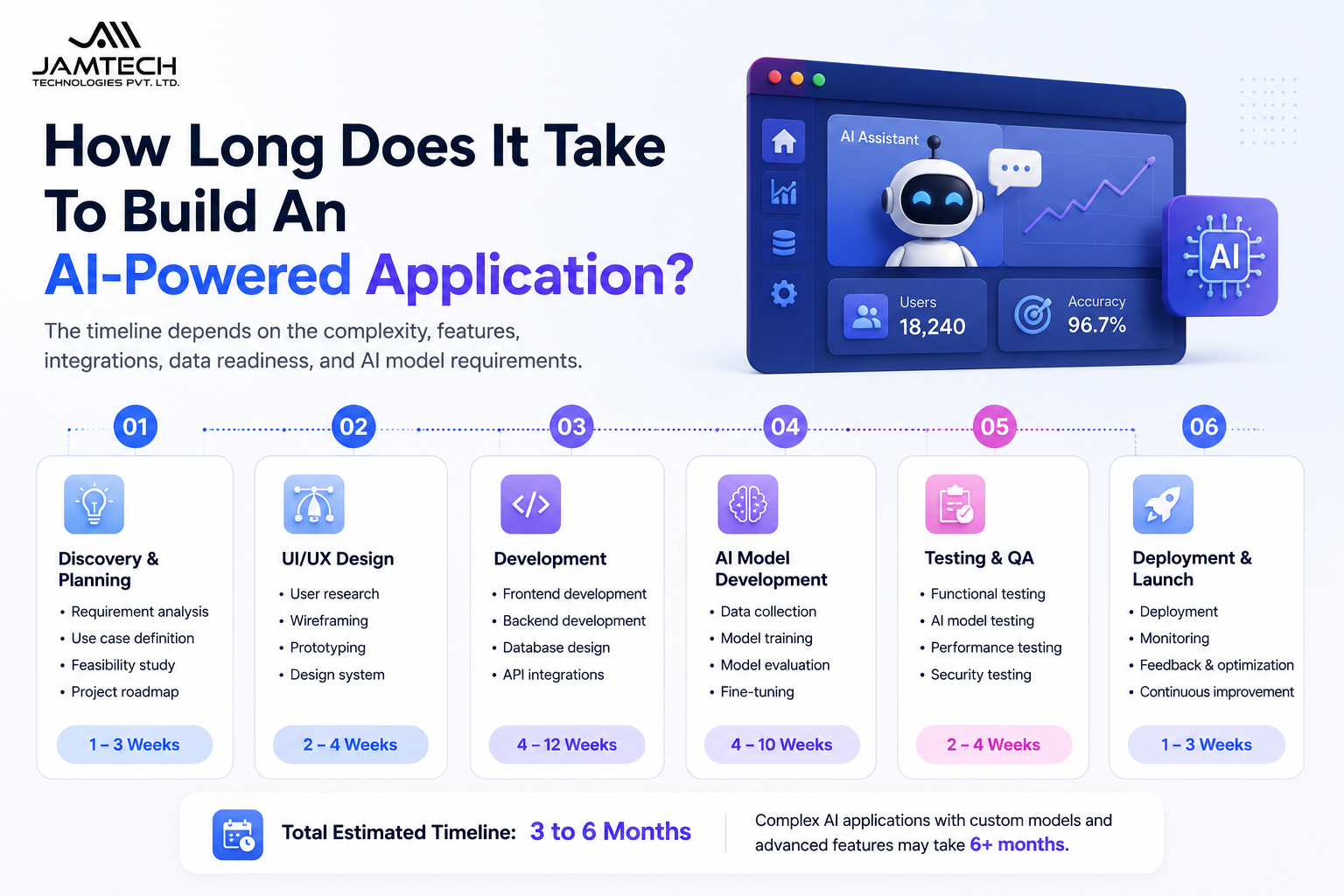
The Phases Of Building An AI Application (And How Long Each Takes)
Every AI build moves through the same set of phases. They run in a rough sequence, though in practice they overlap, and work on a later phase often begins before an earlier one fully wraps.
Understanding these phases helps you see where your weeks go. Below is what each phase does and roughly how long it takes.
Discovery And Planning
Discovery is where you define the problem, decide what role the AI should play, and agree on how you will measure success. It is the foundation for everything that follows.
This phase runs a short number of weeks, but it earns that time back many times over. Rushed or unclear discovery is the most common cause of rework later, when the team builds the wrong thing and has to start again.
Data Preparation
Data preparation means collecting, cleaning, labeling, and organizing the information your AI will learn from. This is often the longest phase, and it surprises many first-time founders.
The reason is simple. AI is only as good as the data behind it, and real-world data tends to be messy, scattered, or incomplete. When your data is clean and ready early, every phase after it moves faster.
Model Selection Or Training
Here you decide whether to use a pre-trained model or build a more custom one. A pre-trained model already knows a lot and gets you moving quickly, while a custom approach needs more iteration and time.
Two terms help here. Fine-tuning means taking an existing model and teaching it your specific material so it fits your domain. RAG, short for retrieval-augmented generation, lets the model pull answers from your private documents instead of guessing.
At Jamtech, we use fine-tuning and RAG on your private data to reach the accuracy your domain demands, while keeping that data secure.
Application Development And Integration
This phase builds the parts people actually touch: the interface, the backend that runs everything, and the connections between them. It is where the AI stops being a standalone model and becomes a real app.
Integration is often the tricky part. Connecting the AI to your existing systems, such as a CRM (the tool that stores your customer records) or your databases, adds time. Weak integration is a frequent failure point, so it deserves care rather than shortcuts.
Testing, Deployment, And Monitoring
AI gets tested differently from regular software. Beyond checking that buttons work, you have to confirm the AI stays accurate and reliable under real conditions with real users.
Deployment starts the next stage rather than ending the work. Once the app is live, monitoring begins, and the model may need retraining as conditions change. Jamtech provides MLOps, the practice of monitoring AI in production and continuously improving it, so your app keeps performing after launch.
What Affects Your AI App Development Timeline
Two projects with the same goal can take very different amounts of time. These are the main factors that speed a build up or slow it down.
Feature complexity: A single AI feature is quick, while many connected features that must work together take longer to build and test.
Data readiness: Clean, organized data lets the team move fast. Scattered or messy data means weeks of preparation before real work starts.
Pre-trained versus custom models: Using a ready-made model is faster. Training a custom model for your exact needs adds iteration and time.
Integration needs: Connecting to your existing tools and systems adds work, and the more connections you need, the longer it takes.
Team experience: A team that has shipped production AI before avoids common mistakes and keeps the schedule predictable.
Compliance requirements: Security reviews and industry rules protect you, and they add steps that extend the timeline.
Timeline Examples For Common AI Use Cases
Different kinds of AI apps carry different timelines. The table below shows common use cases and roughly how long each one takes, with the reason behind the difference.
Use Case | Roughly How Long | Why |
|---|---|---|
Configured chatbot or voice agent | A short setup period | Uses ready-made models with little custom work |
Custom chatbot with private data | A couple of months | Needs fine-tuning and secure connection to your private data |
Recommendation engine | Several months | Depends on quality data and ongoing tuning |
Computer vision app | The longest of these | Needs large, labeled image data and heavy testing |
The contrast at the top of that table matters most for a founder watching the budget. A ready-to-deploy voice agent built on our BYOKCALL platform can be set up in a short time. It runs on your own AI and telephony accounts, with no coding project involved.
A custom chatbot trained on your private documents sits further along the scale. It takes a couple of months because we fine-tune it to your domain and connect it securely to your knowledge. That is the work that makes it genuinely useful.
How To Keep Your AI App Timeline Short And Predictable (Practical Guidance)
You have more control over the timeline than you might think. Use this checklist to protect both your schedule and your budget.
Define one clear problem: Pick a single job for the AI to do well. A focused scope is the fastest path to launch.
Get your data ready early: Start collecting and cleaning data before development begins, so it never becomes the bottleneck.
Start with an MVP: Launch a small, useful version first. You learn from real users instead of guessing.
Choose pre-trained models where they fit: Lean on proven models unless your case truly needs a custom one.
Keep feedback fast: Short, regular check-ins catch problems early, while they are still cheap to fix.
Ask for a fixed quote and a written timeline: A partner who commits to both in writing turns a vague estimate into a real plan.
That last point is where a good partner protects your budget. At Jamtech, we work from fixed quotes rather than open-ended hourly billing, and we share structured proposals with estimates and timelines up front. That is how the number stays reliable instead of drifting.
Building Your AI-Powered Application With Jamtech (Brand/Service Tie-In)
Jamtech is an AI engineering partner that ships production-grade AI on fast timelines, without cutting corners. We handle the full build, from strategy through deployment and ongoing support, so a non-technical founder has one team to rely on.
Our work spans a few clear areas:
AI chatbot integration: Custom chatbots and assistants, fine-tuned on your data and connected securely with RAG.
OpenAI development: AI features built on leading models and wired into your product.
Web and mobile app builds: The full application around your AI, on modern, scalable frameworks.
Ready-to-deploy voice agents: Real-time phone agents through our BYOKCALL platform, set up quickly on your own accounts.
We deploy securely, including private deployment when your data calls for it. Our offices in India and Austin, Texas give you support across US and India business hours. Once your AI systems are live, they can run around the clock.
Conclusion / Key Takeaway
Timeline follows scope and readiness. A prototype takes a few weeks and an MVP a couple of months. A production-ready build runs several months, and an enterprise system the better part of a year or more.
The smartest next step is to scope the smallest useful version of your idea and get a written timeline before you commit. That keeps your budget safe and your launch date real.
Ready to put a real number on your build? Get Free Consultation
Frequently Asked Questions
How long does it take to build an AI-powered application from scratch?
Most builds from scratch take a few weeks for a prototype, a couple of months for an MVP, and several months for a production-ready system. The exact time depends on your scope and how ready your data is.
What takes the most time when building an AI app?
Data preparation is usually the longest phase, since AI depends on clean, well-organized information. Getting your data ready early is the best way to speed up the whole project.
Can an AI app be built faster with pre-trained models?
Yes. Pre-trained models already know a great deal, so they let you skip long custom training and move to a working app much sooner.
Is building an AI application a one-time project?
No. An AI app needs monitoring and occasional retraining after launch, because real-world conditions change and the model should keep pace.
Does the timeline change by industry?
It can. Fields with strict security or compliance rules, such as healthcare or finance, add review steps that extend the timeline.
Newsletter Signup
Want more plain-language guides on building with AI? Subscribe to the Jamtech newsletter for practical advice on timelines and shipping real products, sent straight to your inbox.
Ready to grow your business with Jamtech?
Talk to our experts about your next digital project.