


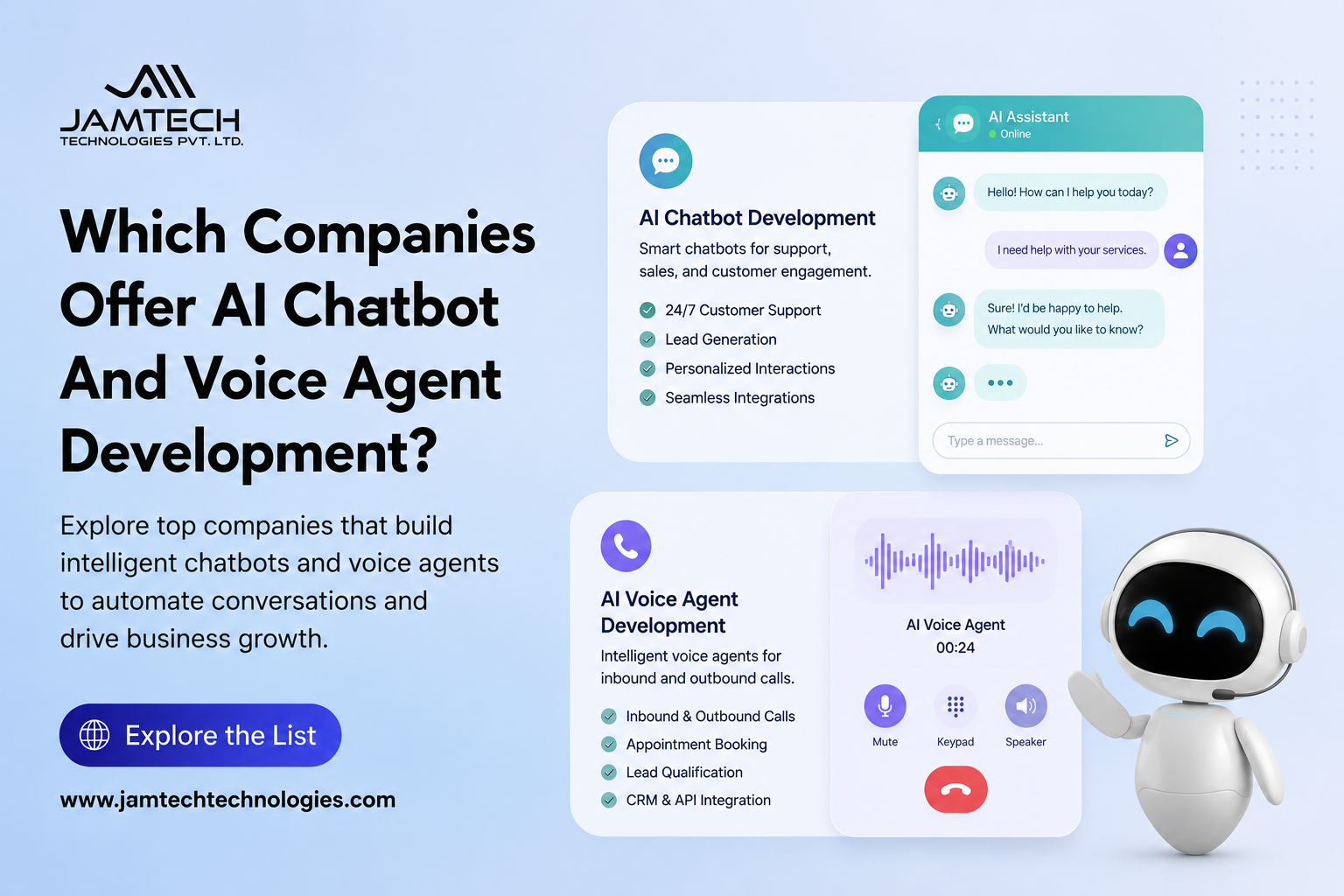
Which Companies Offer AI Chatbot And Voice Agent Development?
Introduction
If you searched for which companies offer AI chatbot and voice agent development, you are probably a founder trying to add smart, automated conversations to your business. You want a real answer, not another ranked list of tools you still have to figure out yourself.
The tricky part is that the market is crowded, and the companies in it are not all the same. Some sell software you set up on your own. Others build the whole system for you and hand you something that works.
This guide explains what AI chatbot and voice agent development actually involves, the types of companies that do it, and how to choose the right one for your budget, your data, and your timeline. By the end, you will know which kind of partner fits your situation and what questions to ask before you sign anything.
What AI Chatbot And Voice Agent Development Actually Means
AI chatbot and voice agent development is the work of designing, building, and connecting AI systems that hold text and voice conversations and complete real tasks for a business. That means a bot that answers a customer's question, books an appointment, or looks up an order, then does the actual work instead of just replying with words.
The companies that do this range from self-serve platforms, where you build the bot yourself, to full-service development partners who handle the entire project for you. Where a company sits on that range decides how much work lands on your plate.
At Jamtech, we treat these as production systems tied to your business data, not novelty features bolted onto a website. A chatbot is only useful when it knows your products, your policies, and your customers, so the build has to connect to the information your business already runs on.
AI Chatbots Vs AI Voice Agents
A chatbot is an AI system that talks through text, usually in a chat window on your website or inside an app. A voice agent is an AI system that talks out loud, most often over the phone, so a caller can speak to it the way they would speak to a person.
Both share the same foundation. Underneath, each one uses a large language model, which is the AI that understands language and decides what to say. That shared brain is why one partner can often build both.
The main difference is the channel and the speed it demands. Voice has to listen and respond out loud in the moment, so it adds telephony (the phone-call technology that connects a caller to the system) and speech tools on top of the language model.
Which one you need depends on where your customers reach you. If they type questions on your site, start with a chatbot. If they call your phone line, a voice agent fits better. Many businesses end up wanting both, and a partner who builds both can help you decide rather than push you toward the one thing they sell.
What A Development Company Handles For You
A development company takes the project from idea to a working, connected system. That covers a lot more than the bot itself, which is exactly what a plug-in you configure alone leaves you to sort out.
Here is what a full build usually includes.
Discovery and requirements: the partner learns your goals, your customers, and the tasks the AI needs to handle before any building starts.
Conversation design: they map out how the bot talks, what it can answer, and when it should hand a person off to a human.
Data and tool connections: they wire the system into your knowledge, your website, and the software you already use so answers stay accurate.
Secure deployment: they launch the system in a controlled environment and test it against real questions before customers see it.
Ongoing support: they watch how it performs after launch and improve it over time.
A self-serve plug-in hands you a blank template and expects you to do most of that yourself. A development partner does the work and gives you a finished system, which matters when you do not have engineers on staff.
Types Of Companies That Build AI Chatbots And Voice Agents
Once you start searching, you will find companies that look similar on the surface but work in very different ways. Sorting them into a few clear groups makes it much easier to place any vendor you come across.
There are three broad types, and each fits a different kind of buyer. Knowing which group a company belongs to tells you how much of the work you will be expected to handle.
Self-Serve Platforms And Builders
Self-serve platforms give you software and a dashboard so you can build a chatbot or voice AI agent on your own. You pick from templates, type in some answers, and switch it on.
These fit simple use cases, especially when you have someone technical in-house who can set things up and maintain them. The trade-off is customization and integration. When you need the bot to connect deeply to your data or handle an unusual workflow, a drag-and-drop builder tends to hit a wall.
Developer Infrastructure Providers
Some companies sell the building blocks rather than a finished product. These are the vendors behind speech, language, and telephony, and other developers use their pieces to assemble conversational AI development projects.
They are a strong choice if you have your own engineering team that can stitch the parts together. If you do not, this route gets hard fast, because the pieces arrive as tools, not as a working system.
Full-Service Development Partners
Full-service partners handle the whole job, from strategy through deployment and support. You describe the outcome you want, and they design it, build it, connect it, and keep it running.
This is the best fit for non-technical founders who want a finished, integrated system instead of a project to manage. It is also where Jamtech sits, building chatbots and voice agents under one roof as an AI chatbot development company and an AI agent development company in a single partner.
How To Choose The Right AI Development Company
Picking the right partner is the real decision here, and it deserves more thought than picking the cheapest quote. The wrong choice can leave you with a bot that gives bad answers or a bill that never stops growing.
The good news is that a handful of clear criteria separate a serious engineering partner from a thin vendor. Use the sections below as the questions you carry into every sales call.
Engineering Depth And The Right Approach
Look for a company with real expertise across the full pipeline, meaning the language model, the speech tools, and the telephony that ties a voice agent to a phone line. A partner who only knows one piece will struggle when the project needs the others.
Ask how they keep answers accurate. Strong partners connect the system to your own data, an approach called retrieval-augmented generation, or RAG, where the bot pulls answers from your approved documents instead of guessing. Some also do fine-tuning, which trains the model on your own content so it speaks in your terms. Jamtech uses both RAG and fine-tuning on a client's data for a custom AI chatbot that stays grounded in what the business actually knows.
Data Security And Compliance
Your bot will touch customer questions, internal documents, and sometimes sensitive records, so ask exactly how your data is handled and where the system is deployed. A private deployment, where your system runs on your own servers or cloud, keeps your information under your control.
Ask what certifications the partner holds, because certifications are outside proof that a company follows real security and quality standards. This matters most for regulated work, like health or finance, where a data slip carries legal weight. Jamtech deploys privately, signs an NDA when needed, and holds ISO 9001:2015 for quality, ISO/IEC 27001:2022 for information security, and CMMI Level 3.
Clear Cost And Timeline
Ask for a fixed quote rather than open-ended hourly billing, so you know the price before the work starts. Hourly billing can drift, and a fixed quote puts the risk on the partner to scope the job well.
Also ask how ongoing usage is billed, since the AI itself has a running cost every time the bot talks. One transparent option is a bring-your-own-key model, where you hold the accounts for the underlying AI and phone providers and pay them directly, with no markup added in the middle. Our BYOKCALL platform works this way for voice, so you can see your real costs and keep ownership of your data. For a first working version, expect a realistic timeline measured in weeks.
Integration And Ongoing Support
The system should connect to the tools you already use, like your website, your support inbox, or your customer records, so it fits your workflow instead of adding a new silo. Ask the partner to name the integrations they have handled before.
A launch is a starting line, not a finish. Ask how they monitor the system after it goes live and how they improve it as you learn what customers actually ask. A partner who disappears after launch leaves you to catch problems on your own.
Common Ways AI Chatbots And Voice Agents Are Used
It helps to picture the AI doing a specific job in your business rather than thinking about the technology in the abstract. Most projects start with one clear task and grow from there.
Here are common jobs these systems handle for startups and growing companies.
Use Case | Chatbot | Voice Agent |
|---|---|---|
Customer support questions | Yes | Yes |
Appointment booking | Yes | Yes |
Lead qualification | Yes | Yes |
After-hours answering | Yes | Yes |
Order and status lines | Yes | Yes |
Internal helpdesk for staff | Yes | Sometimes |
The right column shows why the channel matters. A voice agent shines on tasks that happen over the phone, while a chatbot covers the same ground for customers who prefer to type. Jamtech delivers these across industries, so the use case drives the build rather than the tool.
A Simple Checklist For Shortlisting A Partner
Turn everything above into a short list of questions you can ask any vendor. If a company cannot answer these clearly, that tells you something.
Ask about their full-pipeline experience: have they built the language, speech, and telephony parts of a voice agent before?
Ask how they keep answers accurate: do they connect the bot to your own data with RAG or fine-tuning?
Ask about data handling: where is the system deployed, and what security certifications do they hold?
Ask for a fixed quote: will they scope the project up front instead of billing open-ended hours?
Ask how usage is billed: can you see and control the ongoing AI and phone costs?
Ask about the timeline: how many weeks until a first working version?
Ask about support: who monitors and improves the system after launch?
Bring this list to each conversation. A transparent, consultative partner will welcome the questions and answer them plainly.
How Jamtech Builds AI Chatbots And Voice Agents
Jamtech is an AI chatbot development company and AI voice agent development company that builds both text and voice systems for US startups and growing businesses. We build custom AI chatbots that are secure and connected to your own data, plus real-time voice agents that handle live calls.
Our approach is built around the concerns founders raise most. We work from fixed quotes, sign an NDA when the project calls for it, and hold ISO 9001:2015, ISO/IEC 27001:2022, and CMMI Level 3, so quality and data security are backed by outside standards. We handle the project from discovery to deployment to ongoing support, with coverage across US and India business hours.
A short list of what we deliver:
Custom AI chatbots that use RAG and fine-tuning on your data for accurate, on-brand answers.
Private, secure deployment on your own servers or cloud.
Real-time voice agents for support lines, booking, and after-hours calls.
The BYOKCALL bring-your-own-key model, so you own your accounts and see your true costs with no markup.
Fast delivery, with a first working version in weeks.
Frequently Asked Questions
What Is The Difference Between An AI Chatbot And An AI Voice Agent?
A chatbot talks through text in a chat window, while a voice agent talks out loud over the phone. Both use a language model underneath, so the main difference is the channel and the phone technology a voice agent needs.
How Do I Choose An AI Chatbot And Voice Agent Development Company?
Check for engineering depth across the full pipeline, clear data security and certifications, fixed pricing, and support after launch. Ask each vendor the same set of questions so you can compare them fairly.
How Much Does It Cost To Build A Custom AI Chatbot Or Voice Agent?
Cost depends on the tasks, integrations, and usage, so ask for a fixed quote rather than open-ended hourly billing. A bring-your-own-key model can also make the ongoing AI and phone costs transparent.
How Long Does It Take To Build An AI Chatbot Or Voice Agent?
A first working version is usually measured in weeks rather than months when you work with an experienced partner. The exact timeline depends on how many tools it connects to and how complex the conversations are.
Is My Business Data Safe With An AI Development Company?
It is safe when the partner uses private deployment, signs an NDA when needed, and holds real security certifications like ISO/IEC 27001:2022. Ask exactly where your data is stored and how it is used before you commit.
Can An AI Chatbot Or Voice Agent Connect To The Tools I Already Use?
Yes, a full-service partner can connect the system to your website, support inbox, and customer records. Ask the vendor to name the integrations they have built before to confirm they can handle yours.
Conclusion / Takeaway
The right AI chatbot and voice agent development partner depends on your use case, your budget, and how much you care about security and support. Start by deciding whether you need text, voice, or both, then place each vendor into self-serve, infrastructure, or full-service so you know how much work you will carry.
From there, the checklist does the rest: engineering depth, data security, clear cost, and support after launch. Take those questions into every conversation and the right fit becomes clear.
If you want a partner who builds both, connects to your data, and prices the work up front, the next step is a quick conversation about what you need.
Want more plain-language guides on building AI into your business? Sign up for our newsletter and get new posts in your inbox.
Ready to grow your business with Jamtech?
Talk to our experts about your next digital project.