

How to Choose an AI Development Partner: A Practical Guide for Founders
What Choosing an AI Development Partner Really Means
Choosing an AI development partner means picking a team you can trust to turn your idea into a working, secure product. You judge them on proven delivery, how they handle your data, and how well they fit your goals, not on a slick demo.
An AI development partner is an outside team that plans, builds, and launches AI features for you. That can be a chatbot on your website, a voice agent that answers calls, or an automation that removes manual work.
For a founder, this choice carries real weight. You are spending money and trust on a team that will handle your idea and your customers' data. The right partner protects both, and the wrong one puts them at risk.
Define Your Goal Before You Talk to Anyone
Before you contact any vendor, name the problem you want to solve and the result you want to see. A clear goal makes it easy to compare partners and spot the ones who understand you.
At Jamtech, we start every project with a consultation and a structured proposal that ties the scope to your outcome. That way the plan reflects your goal, not a generic template.
MVP vs Production System
An MVP, or minimum viable product, is a small first version built to test an idea quickly. A production system is the full version meant to run for real users every day.
The difference changes what you need from a partner. Think of a chatbot pilot that answers a few common questions, then a chatbot that serves all your customers and connects to your live data. The first proves the idea, and the second has to stay reliable and easy to update.
When you know which one you need, you can ask a partner to match it. This is where custom AI development services matter. A custom AI development company can shape the build around your stage instead of forcing you into one size.
Set Simple Success Measures
Pick one or two measures you can watch so the project stays tied to a result. Good options for a founder include time saved, faster replies to customers, and fewer manual steps in a daily task.
Keep the measures plain and easy to check. If a partner cannot explain how their work moves one of these, that is a sign the project has drifted away from your goal.
What to Look for in an AI Development Partner
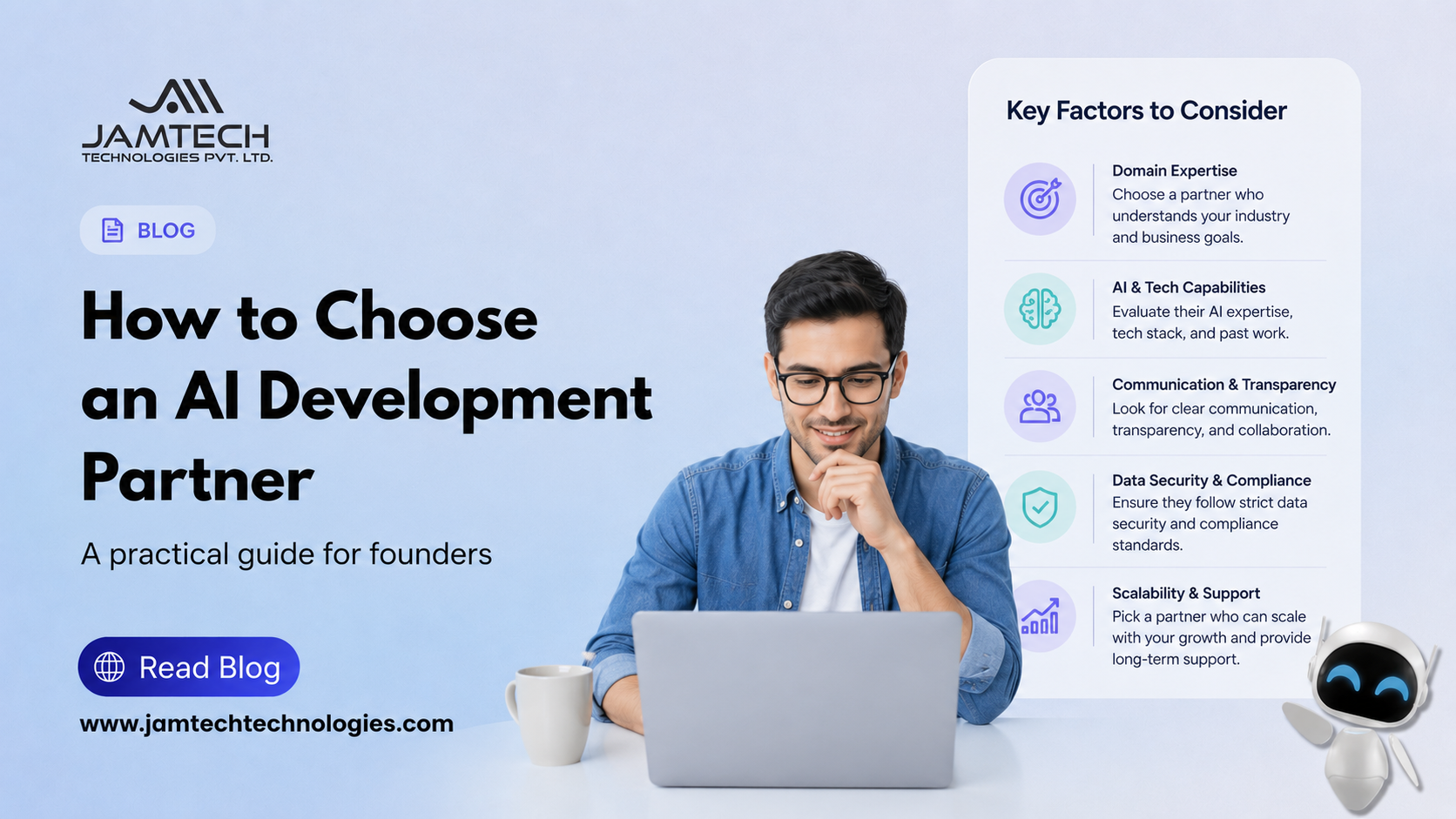
A short framework helps you judge any partner the same way. Look at how well they understand your business, their track record, and their technical fit. Then weigh how they handle data, their path to production, their integration skills, and their pricing.
The sections below walk through each one in plain terms. Jamtech works across all of these. You can use them as both a checklist and a picture of what an end-to-end team looks like.
Business Understanding, Not Just Technology
A strong partner asks about your users, your daily workflows, and your goals first. They connect AI to a real outcome for your business instead of pitching tools you may not need.
Watch how the first conversation goes. If a team spends more time naming trendy features than understanding your problem, they may build something impressive that no one uses.
Proven Track Record and References
Ask for case studies, client reviews, and references, especially for work that looks like yours. Then ask what happened after launch, because a good result is one that kept working.
Public proof helps here. Jamtech grounds trust with visible ratings on Upwork, Google, Glassdoor, and Trustpilot, plus client work you can review before you commit.
Technical and Data Skills That Fit Your Project
Match the partner's depth to your use case rather than to buzzwords. Common skills to look for include building custom chatbots, searching your own documents, tuning a model to your domain, and keeping your data pipelines reliable.
A quick way to understand two of these terms:
Retrieval on your own documents: the AI reads your approved files and knowledge base before it answers, so replies stay grounded in your real information.
Fine-tuning: the team trains a model on your own data so it speaks in your domain and follows your rules.
This is the heart of generative AI development services and agentic AI development services. With agentic AI, the tool can both answer and take steps on your behalf. Jamtech builds production AI chatbots and LLM features using retrieval and fine-tuning on a client's own data, so the results fit your business.
Data Security, Privacy, and Compliance
Ask where your data lives, who can access it, and how the partner handles privacy and any rules in your industry. Treat clear answers here as a requirement, not a bonus. Recognized frameworks like the NIST AI Risk Management Framework describe what trustworthy, secure AI looks like. Rules such as the EU AI Act may also apply, based on where you operate and your industry, so ask any partner how they account for them.
Certifications and an NDA are concrete signals you can check. A non-disclosure agreement, or NDA, is a signed promise to keep your information private. Jamtech offers secure private deployment, signs NDAs when needed, and holds ISO 9001:2015 for quality, ISO/IEC 27001:2022 for information security, and CMMI Level 3.
A Path From Prototype to Production
A good partner can start with a small, low-risk pilot and then show a clear plan to move it into real use. That plan should include ongoing monitoring and upkeep once the AI is live.
Ask them to describe that path in plain language. Jamtech focuses on fast, production-ready delivery and stays on for support after launch, so a pilot does not stall on the way to real customers.
Integration With Your Existing Tools
An AI feature only helps if it fits into the website, app, or systems your people already use. Ask about past integrations and how the AI will connect to what you run today.
This is where the value of a full-stack team shows up. Jamtech builds Web Application Solutions and Mobile Application Solutions, so it can plug AI features straight into your site and app. Many AI integration companies stop at the model, so ask early how the work reaches your users.
Clear Pricing and Honest Timelines
Look for transparent cost, a defined scope, and timelines the partner will stand behind. Be careful with open-ended billing and promises that stay vague.
Jamtech uses fixed quotes instead of open hourly billing, and shares structured proposals with estimates, timelines, and team CVs. You see who does the work and what it costs before it starts.
Questions to Ask on Your First Call
A few direct questions reveal how a partner thinks. Use these on your first call with any AI development company:
How would you define success for this project?
Where will my data live, and who can access it?
Can we start with a small pilot before a full build?
Who owns the code and the model after launch?
What happens when the AI gives a wrong answer?
Listen for plain, honest answers. A partner who welcomes these questions is one who plans to be around after the demo.
Red Flags to Watch For
Some warning signs show up early if you know to look. Any one of these is a reason to slow down and ask more:
Guaranteed results: promises of perfect accuracy or fixed outcomes that no honest team can make.
"AI-powered" everything: heavy buzzwords with no detail on how it actually works.
No talk of data or limits: silence on where your data goes or what the AI cannot do.
No named team: you never learn who will build your product.
No plan past the demo: excitement about the pilot with nothing about production, monitoring, or support.
Compare that with concrete guardrails. Jamtech leans on fixed quotes, signed NDAs, and chatbots designed to answer from approved sources and hand off to a person instead of guessing.
Should You Build In-House or Hire a Partner?
The choice comes down to how core AI is to your company and what team you already have. Here is a simple way to decide:
Situation | Better Fit |
|---|---|
AI is your core product and you have engineers | Build in-house |
You want speed and specialized skills fast | Hire a partner |
You want lower risk early and less to manage | Hire a partner |
You plan to run and improve the AI for years yourself | Build in-house |
For most early-stage founders, hiring a partner is the faster, lower-risk start. A custom AI development company lets you move without building a full AI team first. Jamtech fits founders who want exactly that.
Practical Guidance: A Simple Selection Checklist
Run each vendor through the same short list. It turns the criteria above into something you can score in one sitting, and it keeps your AI development services search honest.
Check | What Good Looks Like |
|---|---|
Understands my goal | Asks about users and outcomes, not just features |
Relevant proof | Case studies and references close to my project |
Secure data handling | Clear answers on storage, access, NDAs, and certifications |
Integration experience | Has connected AI to real sites, apps, or systems |
Clear price | Fixed quote and defined scope, no open-ended billing |
Pilot-to-production plan | Starts small, then shows a path to real use |
Support after launch | Monitors and maintains the AI once it is live |
If a partner clears every row, you have a strong candidate. If a row stays blank after you ask, treat it as an open risk before you sign.
Why Founders Choose Jamtech
Jamtech is one partner for websites, mobile apps, and AI features like chatbots, voice agents, and automations. That means the team that builds your product also builds the AI inside it, so the pieces fit.
On the AI side, Jamtech delivers secure private deployment with retrieval and fine-tuning on your own data. This is backed by fixed quotes, signed NDAs, and ISO and CMMI certifications.
As an AI development company in the USA with a branch in Austin, Texas, it supports US founders across US and Indian business hours. Live bots and voice agents can run around the clock.
The fit is built for startups and founders on a lean budget, from a first MVP to a production system. You get serious, production-grade work without hiring a full AI team of your own.
Conclusion / Takeaway
The right AI development partner is judged on trust, proven delivery, secure data handling, and fit with your goal. A polished demo is nice, but the questions above tell you far more.
Start small and specific. Define one clear problem, run a short pilot with a partner who answers your questions plainly, and grow from there.
FAQ
What should I look for in an AI development partner?
Look for a team that understands your business goal and has proven work like yours. They should handle your data securely and offer clear pricing with a plan from pilot to production.
How is an AI development partner different from an AI development company?
They usually mean the same thing, though "partner" stresses a long-term working relationship while "company" simply names the vendor you hire.
How much does it cost to hire an AI development company?
Cost depends on your use case and scope, so look for a fixed quote and a structured proposal up front rather than open-ended hourly billing.
Should I build AI in-house or hire an AI development partner?
Build in-house when AI is your core product and you already have the team. Hire a partner when you want speed, specialized skills, and lower early risk.
What are the red flags when choosing an AI development partner?
Watch for guaranteed results, heavy buzzwords with no detail, no talk of data or limits, no named team, and no plan beyond the demo.
How long does it take to build an AI product?
It varies with scope. A well-run partner starts with a short pilot, then shows a clear path to a production system instead of a full build at once.
Ready to grow your business with Jamtech?
Talk to our experts about your next digital project.