

How to Judge a Software Development Company You Can Trust: Reviews, Ratings, and Real Proof
You are about to hand a stranger the keys to your product. The website, the app, or the AI feature you have in mind will carry your brand, hold your customers' data, and shape how people see your company. For a founder who does not come from a technical background, that is a lot to trust on faith.
The hard part is that everyone claims to be good. Sales pages look polished, star ratings look high, and every company says it delivers on time. So how do you tell a reliable partner from a risky one before any money changes hands?
This guide gives you a clear way to check. You will learn what public reviews and ratings actually prove, which credentials hold up under scrutiny, and which contract terms protect you. By the end, you will have a simple method for judging any software development company, plus the questions that separate a safe partner from a costly mistake.
How Do You Know If a Software Development Company Is Trustworthy?
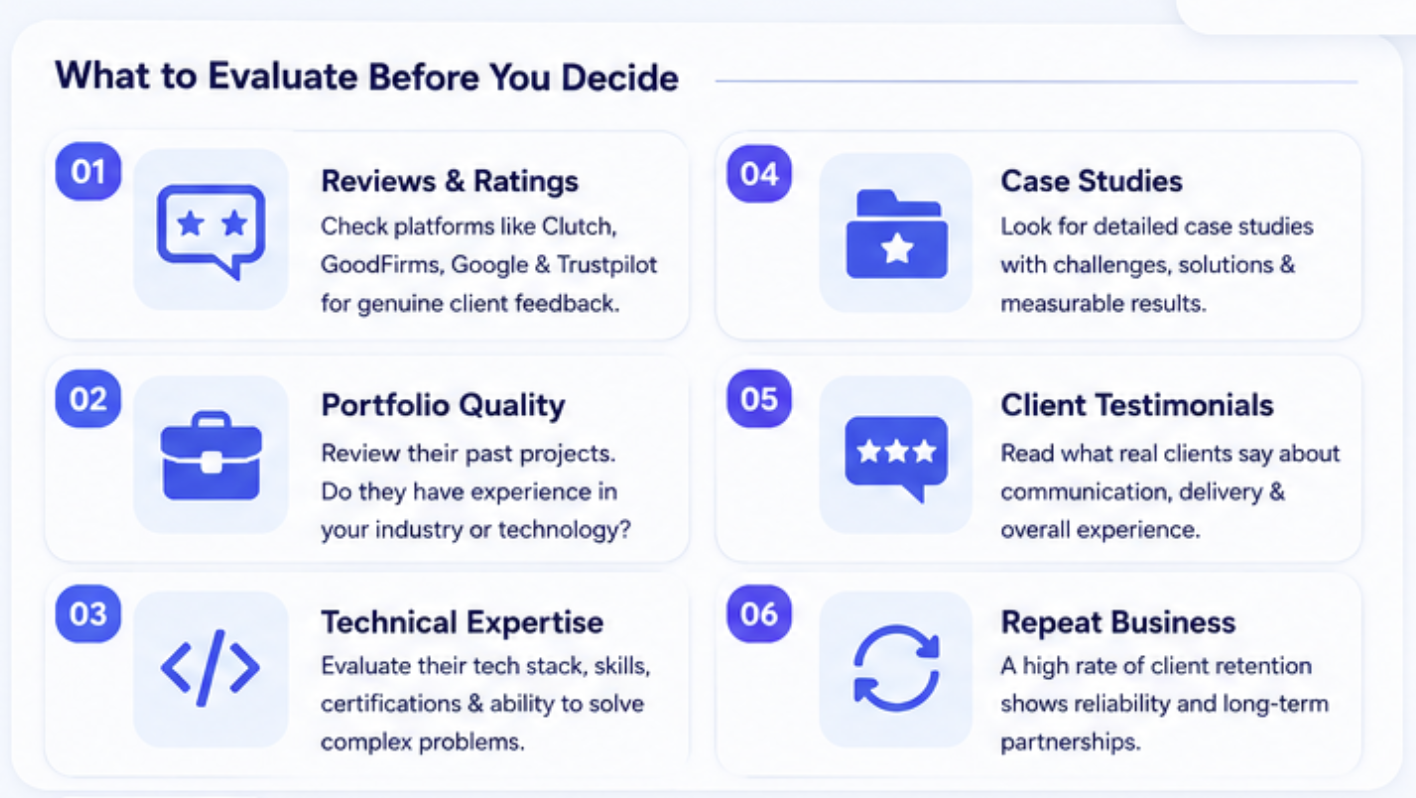
You judge a software development company by layering three kinds of proof: public reviews and ratings, independently verified credentials, and the protections written into your contract. No single star score is enough on its own. A company earns your trust when all three line up.
Think of it as building a case. One good review could come from a friend, and anyone could print a certificate. When reviews across several platforms, audited certifications, and clear contract terms all point the same way, the picture becomes much harder to fake.
This is how Jamtech presents itself to buyers. We show ratings across several platforms, publish our certifications, and put safeguards into the sales process before a project starts. The rest of this guide walks through each layer so you can apply the same test to anyone you consider.
What Star Ratings and Reviews Really Tell You
A public rating is a quick summary of how past clients felt about working with a company. It gives you a starting signal, not a verdict. A high average suggests most people were happy, but the average alone hides a lot.
Two numbers matter as much as the score itself: how many reviews there are, and how recent they are. A high rating built on a handful of reviews is fragile, and glowing feedback from years ago tells you little about the team working there today. Look for a steady stream of recent reviews.
Then read the written reviews, not just the stars. Patterns reveal the truth. If several clients praise clear communication and on-time delivery, that is a strong sign. If several mention missed deadlines or surprise costs, believe them.
Jamtech publishes ratings from Upwork, Google, Glassdoor, and Trustpilot so buyers can compare sources instead of trusting one number. Jamtech holds a 4.6 rating on Trustpilot, and showing it next to other platforms lets you check whether the story stays consistent.
Where to Find Reviews (Trustpilot, Clutch, Google, Glassdoor)
Each review platform has a different purpose, so checking more than one gives you a fuller picture. A company that looks strong on one site and thin on the rest deserves a closer look.
Platform | What it is best for |
|---|---|
Clutch | B2B client project reviews, often verified, focused on agencies and dev firms |
Trustpilot | General consumer and business trust across many industries |
Local presence and broad, easy-to-find feedback | |
Glassdoor | Employee reviews that hint at how the team is treated inside the company |
Clutch is the most useful when you want proof of real client projects, since its reviews are verified through identity and work-history checks. Glassdoor tells a different story: it reflects what employees think, which can hint at whether the team is stable enough to finish your project.
The Limits of a Star Score
A star score can mislead you in two common ways. The first is volume. A perfect average built on only a few reviews is easy to arrange and easy to overturn.
The second trap is mixing up who wrote the reviews. An employer rating on a site like Glassdoor reflects staff opinions about their workplace, not clients' opinions about the finished product. Founders sometimes see a high number and assume it means happy customers when it means something else entirely. Please read the reviews and confirm who is speaking before trusting the average.
Trust Signals That Go Beyond Reviews
Reviews tell you what people say. Credentials and contracts tell you what a company has proven and what it will commit to in writing. These signals hold up even when a review section is thin or brand new.
Certifications and Standards (ISO 9001, ISO 27001, CMMI)
A certification is a stamp from an outside body confirming that a company follows a recognized standard. An independent audit matters far more than a self-claim because the company had to prove its practices to someone who does not work for it.
Three certifications come up often in software work. Here is what each one means in plain terms:
ISO 9001:2015: a quality management standard, confirming the company follows consistent processes to keep work reliable.
ISO/IEC 27001:2022: an information security standard, confirming the company protects sensitive data with proper controls.
CMMI Level 3: a process maturity rating, confirming the company defines and documents its development steps rather than improvising them.
Jamtech holds all three: ISO 9001:2015, ISO/IEC 27001:2022, and CMMI Level 3. When you see credentials like these, please request the certificate details to confirm they are current and genuine.
Contracts, NDAs, and Who Owns the Code
The contract is where trust becomes binding. A dependable partner will put protections in writing before work begins, and a reluctant one will dodge the topic.
An NDA (non-disclosure agreement) is a signed promise to keep your idea and data confidential. A trustworthy partner signs one when needed, gives you a fixed quote instead of open-ended hourly billing, and confirms in writing that you own the source code once the project is delivered. Source code is the underlying instructions your software is built from, and owning it means you are never locked to one vendor.
Jamtech signs NDAs when needed, gives fixed quotes, and shares structured proposals with timelines and team CVs. That structure lets you see the plan, the schedule, and the people before you commit.
How to Vet a Development Partner (Step by Step)
You do not need a technical background to run a solid vetting process. You need a clear order of steps and the discipline to finish them before signing. Please work through the checklist below.
Step | What to do |
|---|---|
1. Define your goal and budget | Write down what you want built and what you can spend, so you can compare partners against the same target. |
2. Shortlist by relevant experience | Pick companies that have built something similar to what you need. |
3. Read reviews across platforms | Check Clutch, Trustpilot, Google, and Glassdoor, and read the written feedback. |
4. Check certifications | Confirm that any claimed standards are both real and current. |
5. Ask direct questions | Use the list below to test how the company answers. |
6. Review the contract before signing | Please confirm the NDA, the fixed quote, and code ownership in writing. |
Questions to Ask Before You Sign
The way a company answers these questions tells you as much as the answers themselves. A trustworthy partner responds clearly and without hedging. Ask each of these:
Who owns the source code once the project is finished?
How do you assure quality during development?
Is your pricing fixed, or is it billed hourly with no cap?
What does support look like after launch?
Can I speak directly with the people who will build my product?
Red Flags to Watch For
Some warning signs should make you pause or walk away. Watch for these:
Vague proposals: no clear scope, no timeline, no named team.
No team access: the company keeps you away from the actual developers.
No security or certification story: no answer when you ask how data is protected.
Unrealistic timelines or prices: a quote or schedule that sounds too good to hold up.
No post-launch support: the plan ends at delivery, with no help afterward.
Pressure to skip a contract: any push to start work without signed terms.
Why Jamtech Is Built for Trust
Jamtech was built using the same layered proof described in this guide. We publish ratings across Upwork, Google, Glassdoor, and Trustpilot, hold ISO 9001:2015, ISO/IEC 27001:2022, and CMMI Level 3, and put NDAs, fixed quotes, and structured proposals into the sales process.
Our delivery model spans the United States and India, with a branch in Austin, Texas alongside our base in Lucknow. That gives you support across US and India business hours, and any AI systems we build can run around the clock once they are live.
We handle the full build under one roof. Our capabilities include:
Automations and custom integrations
We also offer ready-to-deploy products, including BYOKCALL (an AI voice platform that allows you to bring your own keys) and BULLCRM (a modular CRM). If you want a partner who shows the proof before you sign, start with a conversation.
Frequently Asked Questions
Is a 4.6 rating good for a software development company?
A 4.6 rating is a strong signal when it comes from a healthy number of recent reviews across more than one platform, since a high average is only as reliable as the reviews behind it.
How many reviews should a company have before I trust the rating?
There is no fixed cutoff, but a rating built on many recent reviews is far more dependable than a perfect score from only a handful.
Which review site is most reliable for software companies?
Clutch is usually the most reliable for software work because its reviews come from verified B2B clients, though checking Trustpilot, Google, and Glassdoor together gives you a fuller picture.
Do certifications like ISO 27001 really matter?
Yes, because ISO/IEC 27001:2022 is verified by an independent audit, which proves a company protects your data through real controls rather than a self-made claim.
Should a software development company sign an NDA?
Yes, a trustworthy partner will sign an NDA (non-disclosure agreement) when needed to keep your idea and data confidential before any details are shared.
Ready to grow your business with Jamtech?
Talk to our experts about your next digital project.