



How DPDP Consent Differs From GDPR Consent in India
DPDP consent is stricter than GDPR consent in four ways: no legitimate interests ground, age 18, standalone notices in 22 languages and registered consent managers.

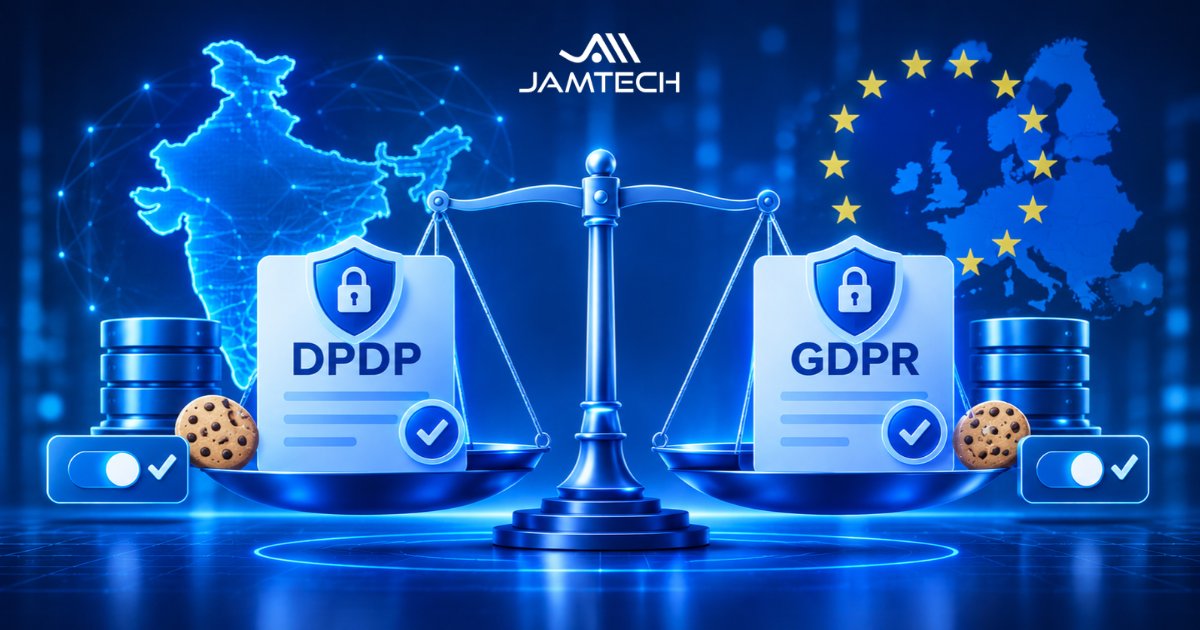
What is the main difference between DPDP consent and GDPR consent?
The main difference is what a business can rely on when it does not have consent. The GDPR gives six lawful grounds under Article 6, including legitimate interests. The DPDP Act gives two: consent, and a closed list of certain legitimate uses in Section 7.
Because the list is closed, more processing in India has to rest on consent. A purpose that you defended in Europe with a balancing test has to find a place on the Section 7 list or get a clear yes from the person.
Take a retailer that emails offers to past buyers. In Europe that programme can rest on legitimate interests if the balancing test is documented. In India the same programme needs consent, unless the person gave their address for that very purpose.
Does the DPDP Act have a legitimate interests ground like the GDPR?
No. Nothing in the Act lets a business process personal data because its own interests outweigh the person's. Marketing to existing customers, product analytics and fraud screening are the purposes teams most often defend that way under the GDPR. Under the Digital Personal Data Protection Act, 2023 (the DPDP Act), each of them needs consent or a fit with Section 7.
What are the certain legitimate uses in Section 7?
Section 7 lists specific situations in which consent is not needed. The ones businesses meet most often are data a person gave voluntarily for a stated purpose and has not objected to, a legal obligation, an employment-related purpose and a medical emergency. Others cover specified government functions, court orders, epidemics and disasters. The list does not stretch, so read the Section 7 text itself, not a summary, before you rely on it.
How do the two laws define valid consent?
Both ask for a clear, informed choice, so a well-built GDPR flow is a good base. Section 6(1) of the DPDP Act asks for consent that is free, specific, informed, unconditional and unambiguous, given by a clear affirmative action and limited to the personal data needed for the stated purpose. Article 4(11) of the GDPR asks for consent that is freely given, specific, informed and unambiguous, again with a clear affirmative act.
Topic | GDPR | DPDP Act |
|---|---|---|
Grounds for processing | Six lawful grounds in Article 6, including legitimate interests | Consent, or a legitimate use listed in Section 7 |
Consent standard | Freely given, specific, informed, unambiguous | Free, specific, informed, unconditional, unambiguous, limited to necessary data |
Withdrawal | As easy as giving consent (Article 7(3)) | As easy as giving consent (Section 6(4)) |
Proof of consent | The controller must be able to demonstrate it (Article 7(1)) | The Data Fiduciary must prove notice and consent (Section 6(10)) |
Children | 16 by default, member states may lower it to 13 | Under 18, with verifiable parental consent |
Data covered | Personal data in any form | Digital personal data, including data digitized later |
Special categories | Extra conditions under Article 9 | None in the Act |
Maximum penalty | €20 million or 4% of worldwide annual turnover, whichever is higher | Fixed amounts, up to ₹250 crore |
Consent intermediary | None | Registered consent managers |
Two rows can be reused almost as they are: withdrawal and proof. Two rows are where a GDPR setup breaks: the grounds row and the children row.
How does a DPDP notice differ from a GDPR privacy notice?
A GDPR privacy notice is a good first draft, but it will not pass as it stands. Section 5 of the DPDP Act requires a notice with or before every consent request. Under Rule 3 of the Digital Personal Data Protection Rules, 2025 (the DPDP Rules), the notice has to stand on its own, in plain language, with an itemized description of the personal data, the specific purpose and the goods, services or uses the processing enables. A general privacy policy linked from the footer does not do that job.
In practice, that points to one notice per purpose or service, each with its own version ID and language versions. A single company-wide notice cannot show which purpose a person agreed to. Store the language shown next to the version, so the record shows what the person could read.
Two extras apply in India. The person must be able to read the notice in English or any language listed in the Eighth Schedule to the Constitution, which means 22 languages. And if you hold consent that was given before the Act, Section 5(2) requires a notice as soon as reasonably practicable, while processing may continue until the person withdraws.
What changes for children's data under the DPDP Act?
The age line moves from 16 to 18. Under the DPDP Act a child is anyone under 18, and a Data Fiduciary needs verifiable parental consent before processing a child's data. Section 9 also bars tracking, behavioral monitoring and targeted advertising directed at children. Under the GDPR the default age for online consent is 16, and member states may lower it to 13.
A GDPR age gate usually lets users in at 16 or 13. For Indian users, that gate has to hold back everyone under 18 until a parent's consent is verified. Decide early whether to build a separate India age gate or to apply 18 everywhere. The second option is simpler to run but changes the experience for users in other countries.
Does the DPDP Act cover paper records and sensitive data?
It covers digital personal data only, which includes data collected on paper and digitized later. The GDPR covers personal data in any form. The DPDP Act also has no special categories, so health, biometric or financial data falls under the same consent rules as an email address. A missing tier does not make that data lower risk. Keep your stricter internal handling for those fields.
What are the penalties under the DPDP Act and the GDPR?
The DPDP Act sets fixed maximums. Failing to take reasonable security safeguards to prevent a personal data breach can cost up to ₹250 crore, and breaching the children's data duties up to ₹200 crore. The Data Protection Board of India decides penalties. The GDPR sets its maximum at €20 million or 4% of worldwide annual turnover, whichever is higher. Because the DPDP caps do not scale with turnover, a small company faces the same ceiling as a large one. Other breaches carry lower maximums, so the two figures above are the top tiers, not the only ones.
What is a consent manager, and does the GDPR have one?
A consent manager is a company registered with the Data Protection Board of India that lets a person give, manage, review and withdraw consent across many businesses from one platform. The GDPR has no registered role like it. MeitY announced that registration opened on 13 November 2026, and a business does not have to appoint one. Our guide to what a consent manager is explains the role in full. For your records, the practical point is that consent can now arrive through a third party, so add that as a channel.
How do you reuse a GDPR consent setup for India?
Start with a purpose triage. List every purpose your GDPR records justify with legitimate interests. For each one, ask three questions in this order:
Did the person give this data voluntarily for exactly this purpose? Section 7 may then cover it.
Does a law require the processing? Section 7 may cover that too.
If neither applies, plan to collect consent from Indian users.
Here is how that sorting tends to come out for four common purposes. Treat the right-hand column as a starting point for a conversation with counsel, not as a ruling.
Purpose | Typical GDPR ground | Likely route in India |
|---|---|---|
Service emails needed to deliver an order | Contract | The Section 7 voluntary-use route may fit |
Marketing to existing customers | Legitimate interests | Consent |
Product analytics | Legitimate interests or consent | Consent |
Fraud screening of customers | Legitimate interests | No obvious listed use, so take legal advice before relying on one |
Then extend your GDPR consent record with four things: the itemized notice version, the language the notice was shown in, the person's age status and a channel value for consent managers. Our post on DPDP consent records lists the full set of fields and how to log withdrawals.
What goes wrong when you copy a GDPR cookie banner to an Indian site?
The banner usually covers only trackers on a website. The DPDP Act applies to every digital channel that collects personal data, including forms, apps and call-center systems, so a banner leaves most of the consent surface untouched. Three other gaps are easy to miss. The banner text is in English only. It has no age check. And its log sits in a vendor tool with no link to a notice version, which makes Section 6(10) proof hard to produce. Treat the banner as one channel in your consent record, not as the whole system.
What should a business do before 13 May 2027?
Start with the steps that take longest, which are the notice rewrite and the age gate, because both touch product screens and legal review. A workable order is:
Run the purpose triage on every purpose your GDPR records justify with legitimate interests.
Rewrite the notice as a standalone, itemized DPDP notice and prepare it in the languages your Indian users read.
Raise the age gate for Indian users to 18 and add a verifiable parental consent step.
Extend the consent record with notice version, language, age status and a consent manager channel.
Test that a withdrawal reaches every Data Processor, and log when each one was told.
Ask counsel to confirm the Section 7 reading for every purpose you keep without consent.
Teams that run one product for India and the EU often bring in full-stack developers to build region-specific consent flows and age gates. The legal reading in the last step stays with counsel either way.
The main duties start on 13 May 2027, reported by ANI from MeitY's statement of 14 November 2026. Rules can change, so check dpbi.gov.in before you act. This article is general information and not legal advice.
Frequently asked questions
Q1. What is the difference between DPDP consent and GDPR consent?
DPDP consent sits in a narrower system. The DPDP Act allows processing on consent or on a closed list of legitimate uses, while the GDPR has six lawful grounds, including legitimate interests. The DPDP Act also treats anyone under 18 as a child and asks for notices in English or any of 22 scheduled languages.
Q2. Does the DPDP Act have a legitimate interests ground like the GDPR?
No. The DPDP Act has no general legitimate interests ground. Outside consent, processing must fit one of the specific legitimate uses listed in Section 7, such as a legal obligation or a medical emergency. Purposes you justified under GDPR legitimate interests, such as marketing or analytics, usually need consent in India.
Q3. If we comply with GDPR, are we compliant with the DPDP Act?
No, though GDPR work gives you a head start. Records, withdrawal and proof of consent can be reused. You still need to rework the lawful grounds, raise the age threshold to 18, write a standalone itemized notice, offer 22-language access and prepare for consent managers. A GDPR audit will not cover those gaps.
Q4. What is the age of consent under the DPDP Act compared to the GDPR?
The DPDP Act sets it at 18, while the GDPR sets 16 by default and lets member states lower it to 13. Under the DPDP Act, anyone below 18 is a child and needs verifiable parental consent. A GDPR age gate set at 16 or 13 will let in Indian users the Act protects.
Q5. Does the DPDP Act require parental consent for children?
Yes. A Data Fiduciary needs verifiable consent from a parent or guardian before processing the personal data of a child, meaning anyone under 18. Section 9 also bars tracking, behavioral monitoring and targeted advertising directed at children. Breaching these duties can cost up to ₹200 crore.
Q6. What are the legitimate uses under Section 7 of the DPDP Act?
Section 7 lists situations where consent is not needed. The common ones are data a person gave voluntarily for a stated purpose, a legal obligation, employment-related purposes and medical emergencies. Others cover government functions, court orders, epidemics and disasters. The list is closed, so read the Section 7 text before relying on it.
Q7. Can I use my GDPR privacy notice for the DPDP Act?
Use it as a draft, not as the final notice. Rule 3 asks for a notice that stands on its own, in plain language, with an itemized description of the data, the specific purpose and the uses it enables. A general privacy policy linked in the footer does not meet that standard on its own.
Q8. In which languages must a DPDP notice be available?
The person must be able to read the notice in English or in any language listed in the Eighth Schedule to the Constitution, which is 22 languages. That is Section 5(3) of the DPDP Act. Build the notice so each language version carries its own version ID, which keeps your consent records provable.
Q9. What are the penalties under the DPDP Act compared to the GDPR?
The DPDP Act sets fixed maximums, up to ₹250 crore for failing to take reasonable security safeguards and up to ₹200 crore for breaching the children's data duties. The GDPR sets its maximum at €20 million or 4% of worldwide annual turnover, whichever is higher. DPDP caps do not scale with company size.
Q10. Does the DPDP Act cover paper records?
Only when they are digitized. The DPDP Act covers digital personal data, which includes data collected on paper and digitized later. The GDPR covers personal data in any form. A purely paper record that never enters a system falls outside the DPDP Act, but most businesses scan or key in their paper forms.
Q11. Does the DPDP Act have special categories of sensitive data?
No. The DPDP Act has no special categories, while the GDPR adds extra conditions for categories such as health and biometric data under Article 9. In India, health or financial data follows the same consent rules as an email address. Keep stricter internal handling for those fields anyway.
Q12. Is consent withdrawal handled the same way under the DPDP Act and the GDPR?
Broadly yes. Both laws require withdrawal to be as easy as giving consent: Article 7(3) of the GDPR and Section 6(4) of the DPDP Act. Under the DPDP Act, the Data Fiduciary must also stop processing within a reasonable time and make its Data Processors stop. Log each processor notification.
Q13. Does the GDPR have consent managers like the DPDP Act?
No. Registered consent managers are a feature of India's law. A consent manager is a company registered with the Data Protection Board of India that lets a person give, manage, review and withdraw consent across businesses. Registration opened on 13 November 2026, and businesses are not required to appoint one.
Q14. When do the DPDP consent rules start applying to businesses?
The main duties, including the consent and notice rules, start on 13 May 2027, based on MeitY's statement of 14 November 2026. Consent manager registration began earlier, on 13 November 2026. Use the time before May to run a purpose triage and extend your consent records.
Ready to grow your business with Jamtech?
Talk to our experts about your next digital project.