





How AI Chatbots Handle Order Status and Sales Calls for Your Business
Introduction
Your support team is answering the same question all day: "Where's my order?" Meanwhile, your sales line rings after hours and nobody picks up. Both problems cost you money, and both have the same fix.
AI chatbots now handle order status lookups and sales conversations on their own. They connect to your business systems and respond to customers in seconds using real-time data. That means fewer repetitive tickets for your support staff and fewer missed sales calls when your team is offline.
This guide walks you through how AI chatbots handle these high-volume workflows and what to look for when choosing a solution. Whether you need a text-based chatbot on your website or a voice AI agent answering your phone, the goal is the same: give your customers faster answers and give your team time back.
What Is an AI Chatbot for Order Status and Sales?
An AI chatbot is software that holds real conversations with your customers through text or voice. Unlike older chatbots that follow rigid scripts, today's AI chatbots understand what someone is asking, even when they phrase it differently every time.
What makes these chatbots useful for order status and sales is their ability to connect to your live business data. When a customer asks about an order, the chatbot pulls tracking information straight from your order management system. When a visitor asks about pricing or services, the chatbot qualifies them as a lead and collects their contact details for your sales team.
How Chatbots Handle Order Status Requests
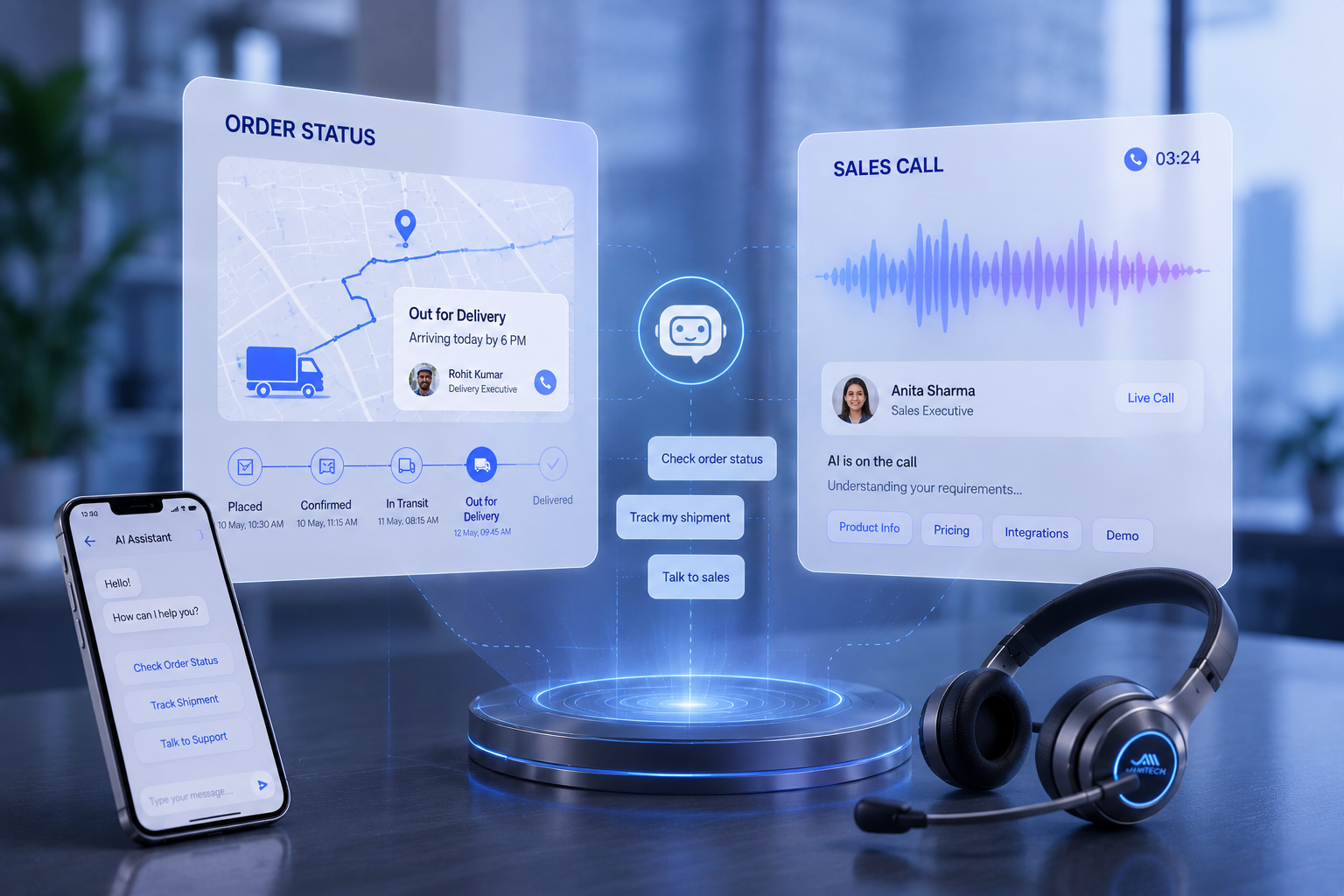
Think of it this way: a customer lands on your website and types "Where's my order?" The chatbot recognizes the intent behind that question. It asks for an order number or email address, then queries your order management system through an API connection.
Within seconds, the customer gets a real answer: their package shipped yesterday and should arrive by Friday, along with the tracking number. No hold music. No waiting in a support queue.
This type of question is called a WISMO request, short for "Where Is My Order?" If you run an e-commerce operation or any business that ships products, you already know how often these questions come in. According to IBM's guide on AI customer service chatbots, order tracking and status updates are a primary chatbot use case because they let customers check shipping information and delivery estimates conversationally, without waiting for a human agent. A chatbot handles this lookup automatically, so your human agents can focus on issues that actually need human judgment.
How Chatbots Handle Sales Calls and Lead Qualification
On the sales side, chatbots work as the first point of contact for potential customers. A text-based chatbot on your website can greet visitors and walk them through qualifying questions based on what they are looking for. If the lead is a good fit, the chatbot collects their contact information and passes it directly to your sales team with full context.
Voice AI agents take this further by handling actual phone calls. An AI phone agent picks up your inbound sales line and holds a natural conversation. It asks the right questions, then either books an appointment or routes the caller to a live rep. This is especially useful after business hours, when missed calls turn into missed revenue.
The key difference between a sales chatbot and a simple contact form is engagement. A chatbot responds instantly and keeps the conversation going with follow-up questions. A form sits there and hopes someone fills it out.
Why Businesses Use Chatbots for Order Tracking and Sales
Mid-scale businesses adopt chatbots because the operational case is clear. When your support queue is clogged with repetitive questions and your sales line goes unanswered at night, the math changes. Automating those two workflows frees up your team and keeps your business available around the clock.
The Stanford HAI 2025 AI Index Report found that 78% of organizations reported using AI in 2024, up from 55% the year before. The Federal Reserve has also begun monitoring AI adoption across the US economy, tracking how businesses integrate AI into their operations.
The payoff shows up in two areas: support cost reduction and sales conversion. Let's walk through each.
Fewer Repetitive Support Tickets
Every WISMO ticket that a chatbot resolves is one your human agents don't have to touch. That adds up fast. When your support staff spends less time copying and pasting tracking numbers, they can handle the complex cases that actually require judgment, like damaged shipments or billing disputes.
Beyond the time savings, your customers get answers faster. A chatbot responds in seconds. A human agent, juggling multiple tickets, might take minutes or hours. Faster answers mean fewer follow-up messages and fewer frustrated customers escalating to managers.
This also affects your hiring decisions. Instead of adding more support staff every time ticket volume grows, you let the chatbot absorb the routine work. Your team stays lean, and your per-interaction cost goes down.
Faster Sales Response and Higher Conversion
Speed matters in sales. When someone calls your business or starts a chat on your website, they are interested right now. If they wait too long or can't reach anyone, they move on to a competitor.
A chatbot eliminates that delay. It responds instantly and qualifies the lead with the right questions. If a potential customer reaches out and nobody responds, they move on to whoever does. A chatbot responds in seconds, before that window closes. Then it either books a meeting or hands the conversation to a live salesperson with context already attached. Your reps spend less time on cold outreach and more time closing warm leads.
Voice AI agents fill the gap after hours. If your phones stop ringing at 6 PM but potential customers keep searching at 9 PM, an AI phone agent picks up those calls and sends your team a qualified lead summary by morning. You stop losing deals to voicemail.
What to Look for in a Chatbot for Order Status and Sales
Not every chatbot solution fits every business. Before you pick a vendor or start an integration project, you need to know what actually matters. The right chatbot connects to your existing systems and keeps customer data secure while giving you the flexibility to customize responses for your specific workflows.
Here is what to evaluate.
Integration With Your Existing Systems
A chatbot is only as useful as the data it can access. If it can't connect to your order management system, it can't answer order status questions with real information. If it can't push qualified leads into your CRM, your sales team has to do double entry.
Look for chatbots that support direct API connections to the platforms you already use. That includes your order management or e-commerce platform, your CRM, your inventory system, and your telephony provider if you need voice AI.
Key point: The chatbot should pull live data from your systems instead of relying on static FAQ pages or pre-loaded responses that go stale.
Key point: CRM integration means every qualified lead lands in your pipeline automatically, with the full conversation attached.
Key point: If you run voice AI for sales calls, the platform should connect to telephony providers like Twilio or Plivo so calls route properly.
Key point: Ask about data flow. Can the chatbot both read and write to your systems, or is it one-way? Order updates and lead routing both require two-way connectivity.
Security and Data Privacy
Your chatbot handles customer names, order details, email addresses, and sometimes payment information. That data needs to be protected.
Look for solutions that offer encrypted data transfer and secure API connections, with clear policies on how your data is stored and used. If your business operates in a regulated industry or handles sensitive customer records, ask whether the chatbot can run on private servers or your own cloud infrastructure instead of a shared environment.
Key point: Private deployment options let you keep customer data on infrastructure you control, rather than sending it through a third-party platform.
Key point: Check whether the vendor's AI models are trained on your data. Some providers use customer interactions to improve their models. If that concerns you, choose a platform that explicitly keeps your data isolated.
Key point: Compliance certifications like ISO 9001:2015 and ISO/IEC 27001:2022 signal that the vendor follows established security and quality management standards.
Key point: An NDA and a clear data processing agreement should be part of any enterprise chatbot engagement from the start.
How to Set Up a Chatbot for Order Tracking and Sales Calls
Getting a chatbot live doesn't have to be a long, painful project. The process follows a straightforward path: define what you need, choose your approach, connect your data, test the experience, and deploy. The timeline depends on whether you go with a ready-made tool or a custom-built solution.
Start by mapping the specific workflows you want the chatbot to handle. For order tracking, that means identifying which systems hold your order data and what information customers typically ask for. For sales, that means defining your qualification criteria and deciding where qualified leads should land in your CRM.
Once your workflows are clear, connect the chatbot to your data sources. This is where the integration work happens. A well-built chatbot uses Retrieval-Augmented Generation (RAG), a method that lets the AI pull answers from your own documents and internal knowledge bases rather than relying on its general training data. RAG means the chatbot gives accurate, company-specific responses instead of generic guesses.
Configure escalation rules so the chatbot knows when to hand off to a human. Not every conversation should stay automated. Complex complaints and sensitive issues should route to your team with the full conversation history attached.
Test the chatbot with real scenarios before launch. Have your team run through common order status questions and sales conversations, including edge cases. Fix anything that feels off, then deploy.
Custom-Built vs. Off-the-Shelf Chatbots
This is one of the most important decisions you will make. Off-the-shelf chatbot tools are fast to set up. You sign up and configure basic settings, then start using them within days. They work well for simple use cases, like answering FAQs or collecting contact information.
Custom-built chatbots take longer to deploy but offer deeper integration with your business. They connect to proprietary data sources and match your exact business logic. They can also be fine-tuned on your domain-specific language so they respond accurately to industry-specific questions.
Here is when each approach makes sense:
Factor | Off-the-Shelf | Custom-Built |
|---|---|---|
Setup time | Days | Weeks |
Customization depth | Limited templates | Full control over logic and data |
Data access | Pre-built integrations only | Direct API access to any system |
Domain accuracy | General-purpose responses | Fine-tuned on your business data |
Ongoing maintenance | Vendor-managed | Your team or your integration partner |
Best for | Simple FAQ and basic lead capture | Complex workflows with proprietary data or regulated industries |
If your order status lookup requires pulling data from a custom-built ERP, or if your sales qualification process has specific rules that generic tools can't handle, custom is the right path. If you need something running tomorrow with basic functionality, off-the-shelf gets you started.
Why Jamtech for Your AI Chatbot and Voice AI Integration
Jamtech builds custom AI chatbots and voice AI agents for US businesses that need production-grade solutions ready for real workloads. If you have tried off-the-shelf tools and hit their limits, or if your business data is too specific for a generic chatbot, Jamtech's integration services are built for that problem.
For order status and customer support chatbots, Jamtech connects AI to your private data through RAG and LLM fine-tuning, so every response is grounded in your actual business information. Deployments run on private infrastructure when data security requires it, backed by ISO 9001:2015 and ISO/IEC 27001:2022 certifications along with CMMI Level 3 maturity.
For voice AI, Jamtech's BYOKCALL platform lets you run AI phone agents using your own provider accounts for telephony (Twilio, Plivo), speech-to-text (Deepgram, AssemblyAI), language models (OpenAI, Groq), and text-to-speech (ElevenLabs, Cartesia). You plug in your own API keys, and BYOKCALL handles the real-time call orchestration. No per-minute markups and no vendor lock-in. Setup takes minutes.
Both paths come with end-to-end support, from architecture and integration through deployment and ongoing maintenance, with deployment timelines measured in weeks.
FAQ
What Types of Businesses Benefit Most From Order-Tracking Chatbots?
E-commerce companies, logistics providers, subscription services, and any business that processes a high volume of customer orders benefit the most. If your support team spends significant time answering "Where's my order?" questions, a chatbot can take that workload off their plate.
Can a Chatbot Handle Sales Calls, or Only Text-Based Conversations?
Both. Text-based chatbots handle sales conversations on your website, while AI voice agents like BYOKCALL can answer inbound phone calls, qualify leads, book appointments, and route callers to your sales team.
How Long Does It Take to Deploy an AI Chatbot for Order Tracking?
It depends on the approach. Off-the-shelf tools can go live in days. Custom-built chatbots that integrate with your order management system and private data typically take a few weeks, including testing and configuration.
Do Chatbots Replace Human Customer Service Agents?
No. Chatbots handle the repetitive, high-volume questions that consume most of your team's time. Complex issues and high-touch conversations still go to human agents, who now have more bandwidth to handle them well.
Conclusion
AI chatbots and voice agents solve two of the most common operational headaches for growing businesses: repetitive order status inquiries that bury your support team, and missed sales calls that cost you revenue. The right setup connects to your live business data and keeps your operation running outside business hours.
What matters most is how well the chatbot integrates with your systems and how accurately it handles your specific workflows. Generic tools work for simple cases, but businesses with proprietary data or complex order flows need a custom approach.
If you are ready to stop losing support hours to "Where's my order?" and stop losing sales to voicemail, Jamtech can help you build and deploy the right solution.
Ready to grow your business with Jamtech?
Talk to our experts about your next digital project.