




Nanotechnology in Medicine: Shrinking Solutions for Big Medical Challenges
In this era of scientific exploration, few frontiers hold as much promise and potential as the landscape of nanotechnology in medicine. At the intersection of physics, chemistry and biology, nanotechnology offers a suite of tools and techniques that are revolutionizing how we diagnose, treat, and prevent diseases.
Nanotechnology operates at the scale of nanometers, enabling scientists to manipulate matter at the molecular and atomic levels. This precise control opens up a in Nanotechnology in medicine opens up a world of possibilities where the ability to interact with biological systems on such a tiny scale can yield profound insights and transformative therapies.
Nanotechnology holds immense potential for early disease detection and diagnosis. Nanoscale sensors and imaging probes can detect biomarkers of disease with unprecedented sensitivity, enabling the early detection of conditions such as cancer, cardiovascular disease, and neurological disorders. By catching diseases at their earliest stages, clinicians can intervene sooner, improving patient outcomes and reducing healthcare costs.
What is Nanotechnology in Medicine?
Nanoscience is the study of the unique properties of materials between 1-100 nm, and nanotechnology is the application of such research to create or modify novel objects. Nanotechnology has gained popularity in several industries, as it offers better built and smarter products. The ability to manipulate structures at the atomic scale allows for the creation of Nanomaterials. Unlike other large-scaled engineered objects and systems, Nanomaterials are governed by the laws of quantum mechanics instead of the classical laws of physics and chemistry. In short, nanotechnology is the engineering of useful objects and functional systems at the molecular or atomic scale.
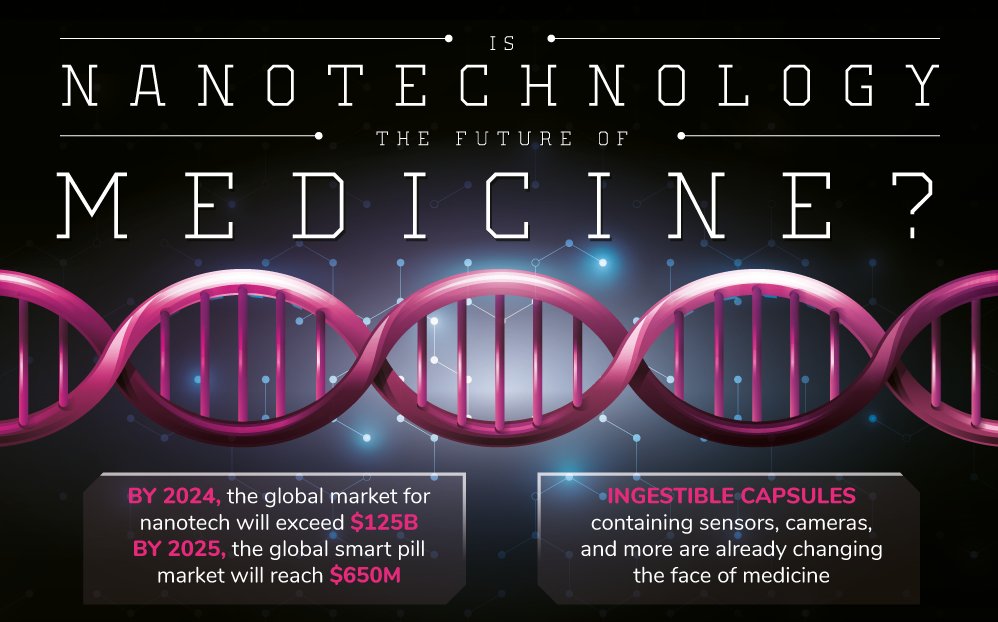
Benefits of Nanotechnology in medicine:
The use of Nanomaterials in everyday products can be generally divided into two types. First, Nanomaterials can be merged or added to a pre-existing product and improve the composite objects' overall performance by lending some of its unique properties. Otherwise, Nanomaterials such as Nanocrystals and Nanoparticles can be used directly to create advanced and powerful devices attributed to their distinctive properties. The benefits of Nanomaterials could potentially affect the future of nearly all industrial sectors.
The benefit of Nanotechnology & Nanomaterials can be found in sunscreens, cosmetics, sporting goods, tyres, electronics and several other everyday items. Additionally, nanotechnologies have revolutionized advances in medicine, specifically in diagnostic methods, imaging and drug delivery. Table I illustrates the areas where nanotechnologies have had a significant impact.
Exponential forms of Nano-Tech in Medicine:
1. A Nanomedicine:
The application of nanotechnology in medicine and healthcare is referred to as Nanomedicine, and it has been used to combat some of the most common diseases, including cardiovascular diseases and cancer. The present review provides an overview of the recent advances of nanotechnology in the aspects of imaging and drug delivery.
Beyond diagnostics and therapeutics, nanotechnology is also revolutionizing regenerative medicine and tissue engineering. The journey from the lab to the clinic is not without challenges. Researchers must grapple with issues of biocompatibility, safety, and scalability to ensure that nanotechnologies can be translated into viable medical solutions. Regulatory agencies play a crucial role in evaluating the safety and efficacy of these novel technologies, balancing innovation with patient safety.
As we stand on the cusp of a new era in medicine, nanotechnology offers a glimpse into a future where diseases are diagnosed with precision, treatments are personalized to each patient, and regenerative therapies restore health and vitality.
2. NanoBiotechnology:
Nanobiotechnology, a recently coined term, emerged from the blending of molecular biology and nanotechnology. It is a branch of science which revolves around structures or functional materials at the Nanoscale, which are produced by employing both physical and chemical methods. In the last thirty years, the discipline of nanotechnology has been a crucial area of research, due to the unique chemical, electrical, optical, biological, and magnetic properties of Nanomaterials. Nanotechnology has managed to attract a lot of attention, because it is an established fact that when nanotechnology joins hands with biotechnology, they give birth to a platform which holds immense potential and importance with respect to diversity in applications.
The development of nanotechnology has provided mankind with some incredible tools that allow the delineation of processes to a degree which was considered to be next to impossible a few years ago.
Following are the features of Nano-Tech in Medicine:
1. Enhanced Imaging Techniques: Nanotechnology has vastly improved medical imaging techniques. Contrast agents composed of nanoparticles enable clearer and more detailed images, aiding in the early detection and accurate diagnosis of diseases.
2.Minimally Invasive Procedures: Nanotechnology has paved the way for minimally invasive procedures, reducing patient discomfort, recovery times, and the risk of complications. This shift towards minimally invasive techniques represents a significant advancement in patient care and has the potential to revolutionize surgical practices across various medical specialties.
3. Theranostics: The convergence of therapy and diagnostics, known as theranostics, is a promising area in nanomedicine. By integrating imaging capabilities with therapeutic interventions, theranostic nanotechnologies enable clinicians to monitor disease progression, adjust treatment regimens, and personalize therapies according to each patient's response.
4. Immunotherapy: Nanotechnology is revolutionizing immunotherapy, harnessing the power of the immune system to target and eliminate cancer cells. Nanovaccines stimulate the immune system to recognize and attack specific antigens associated with cancer cells, offering a promising avenue for cancer prevention and treatment.
5. Addressing Antibiotic Resistance: The rise of antibiotic-resistant bacteria poses a significant threat to global health. Nanotechnology offers novel approaches to combat this growing problem by developing antimicrobial nanoparticles that can selectively target and kill bacteria, including multidrug-resistant strains.
6. Remote Monitoring and Drug Release: Nanotechnology enables the development of implantable devices equipped with sensors and drug-delivery systems, allowing for real-time monitoring of physiological parameters and on-demand release of therapeutics.
As of today, Nano-Tech holds immense promise for revolutionizing every aspect of healthcare, from diagnosis and treatment to prevention and monitoring.
Nano-Tech is ultimately improving patient outcomes and transforming the landscape of healthcare as we know it.
Ready to grow your business with Jamtech?
Talk to our experts about your next digital project.